


Gas Diffusion Electrode Flow Cells


Buy Flow Cells | Why Use GDE Cells? | Choosing GDE Cell | Applications | Resources | Technical Support
Gas diffusion electrode (GDE) flow cells are electrochemical devices that facilitate cutting-edge electrochemistry research around green chemistry, clean energy, and industrial gas production.
These cells pass electrolyte solution continuously over the electrodes under an applied potential. Compared with standard H-cells, this continuous-flow format offers higher efficiency, real-time analysis, and scale-up opportunities. Additionally, while standard H-cells require gases such as carbon dioxide (CO2) or oxygen (O2) to dissolve into the liquid electrolyte and diffuse towards the reaction surface, GDE flow cells feed gas directly to the back of the electrode. This creates a three-phase boundary (TPB), which shortens the transport path for reactants and enabling higher current densities than standard electrochemistry techniques.
Buy Flow Cells
Related categories: MEA electrolyzers, PSE reactors, electrochemical cells, electrodes, electrochemistry


Why Use GDE Cells?
Electrochemical CO2 reduction (CO2RR) provides an excellent example of where GDE can improve research, and make lab results more industrially relevant. CO2 is poorly soluble in water, so converting it into useful chemicals and fuels at an industrially relevant rate will require overcoming mass-transport limits directly. By supplying CO2 to the catalyst surface at a higher local concentration and with a shorter diffusion path, GDE flow cells make CO2RR viable at rates that H-cells simply cannot sustain.
Flow cells sit between H-cells and membrane electrode assemblies (MEAs) in regards to their potential efficiencies and industrial applicability. Circulating the catholyte adds some ohmic resistance compared with a zero-gap MEA, but it also suppresses competing hydrogen evolution, making it far easier to sample and monitor a reaction in real time. It is a useful middle ground for method development and catalyst screening before committing to MEA-scale hardware. Some key features of our gas diffusion electrode cells include:
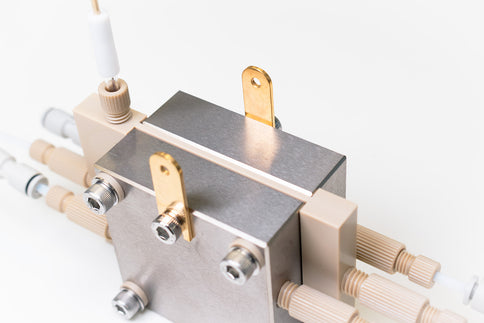
-
Compatibility with Many GDE Working Electrodes
Accommodates a hydrophobic gas diffusion electrode loaded with catalyst. Compatible with carbon-based substrates (carbon paper, carbon cloth) or metal-based substrates (nickel foam, titanium mesh) depending on the target reaction and electrolyte.
-
Separate Liquid and Gas Chambers
Independent, continuous flow of gas and liquid for cleaner phase separation and higher reaction efficiency.
-
Facilitates Three-phase Boundary
The gas and liquid phases meet at the solid catalyst surface where electrochemical reaction takes place under applied potential
-
Real-time Monitoring
The continuous-flow format supports in-line sampling and analysis of reaction products as the reaction runs, rather than only end-point measurement.
Choosing the Right GDE Flow Cell
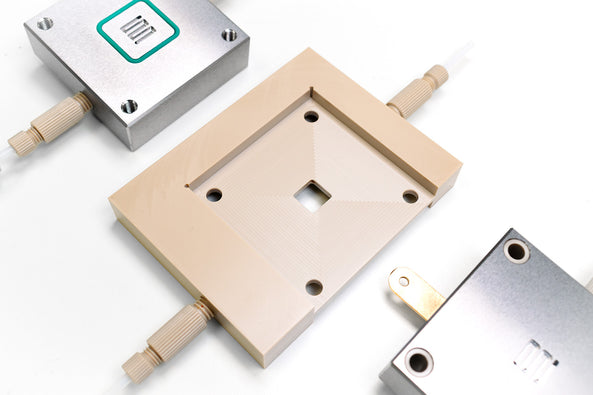
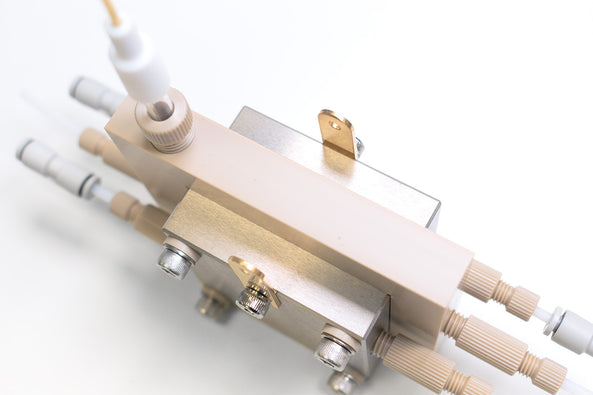
Not all GDE flow cells share the same architecture. Half-cell designs, such as the standard and advance GDE cell, have a single electrolyte stream flowing past the working electrode. These are the most common format and the best starting point for catalyst screening and method development.
Full-cell designs, such as the Dual Channel GDE Flow Cell, add a membrane between two independently pumped anolyte and catholyte compartments. This lets you run and probe different electrolytes, flow rates, or pH on each side. The full-cell design is useful for asymmetric operation (bipolar-membrane configurations, for example) or when the anode and cathode reactions have very different requirements.
We offer three GDE flow cell configurations, differentiated by architecture and channel design rather than current density alone. Technically, the current density is really a downstream consequence of these choices, not a separate variable.
| Standard (C2052G1) | Advanced (C2052C1) | Dual Channel (C2052T1) | |
|---|---|---|---|
| Architecture | Half-Cell | Half-cell | Full-cell, membrane-separated |
| Channel | <3.5 mm | <2.5 mm | Two independent ~10 mm compartments |
| Best for | Catalyst screening, method development, optical/spectroscopic access | High current-density testing, cost-sensitive or low-volume electrolytes | Independent anolyte/catholyte control, asymmetric electrolytes or pH |
| Worth Knowing | Lower current-density ceiling than the advanced cell | Needs careful flow-rate control to avoid gas bubbles blocking the narrow channel | Larger footprint and more setup complexity than a single-channel cell |
GDE Cell Applications
Flow cells handle heavy-duty electrochemical tasks that standard H-cells can't support at useful rates
 CO2 Reduction Reaction (CO2RR)Oxygen Reduction Reaction (ORR)Hydrogen Evolution Reaction (HER)Water ElectrolysisFuel CellsMetal-Air Batteries
Catalyst choice is what ultimately determines which product forms and how efficiently. Noble metals and metal oxides such as Pt and RuO2 are popular choices for HER and OER, while Cu, Au, Ag, Bi, and Sn are widely used to steer CO2RR toward targeted products like ethylene (C2H4), CO, and formic acid (HCOOH). Transition metal oxides, sulfides, and phosphides, along with nanoengineered hybrids, are also a rapidly evolving area. Targeted catalyst synthesis remains an advanced and active field of research, and both reaction kinetics and Faradaic efficiency depend strongly on the electrolyte, applied potential, and the facet and surface structure of the catalyst system.
Technical Support