


MEA Electrolyzers


Buy MEA Electrolyzers | Components | Membrane Types | Plate Material & Configuration | Resources | Technical Support
High-performance electrochemical cells with a layered 'zero-gap' architecture to minimize ohmic resistance and enable higher current densities than standard H-cells or GDE flow cells. Typically operating over 2 A/cm2, MEA electrolyzers can achieve a higher hydrogen yield in water electrolyzers, compared to traditional alkaline systems.
Eliminating the gap between electrode and membrane, the catalyst layers or coated gas diffusion electrodes are pressed to the bipolar flow field plates or bonded directly onto a solid polymer membrane. With no liquid electrolyte between the membrane and the catalyst, the membrane itself conducts ions, then gases or reactants are fed to the back of each electrode through flow field plates. This cell architecture is widely recognized for its usability in up-scaling green hydrogen production and CO2 reduction. The sandwiched central membrane provides a selective, robust barrier which prevents the mixing of produced hydrogen, oxygen, or reduced CO2 products for high-purity gaseous outputs.
Buy MEA Electrolyzers
Related categories: GDE flow cells, electrochemical cells, electrodes, electrochemistry


Core Components
- Membrane: solid polymer electrolyte (PEM, AEM, or BPM) that conducts ions and separates cathode and anode compartments.
- Gas diffusion electrode or catalyst coated membrane: the catalyst is applied to the gas diffusion electrode or on the membrane surface.
- Gas diffusion layers (GDL): porous materials (carbon paper, nickel foam, titanium mesh) that distribute reactant gases and conduct electrons.
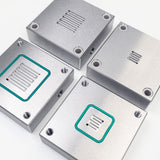
- Flow field plates: machined plates with serpentine, parallel, mesh, or hybrid channel geometry direct gas flow across the GDLs and provide electrical contact.
- Observation window (optional): transparent acrylic windows support further analysis.
Membrane Types
The membrane is the most consequential design choice in an MEA cell, as it determines the ionic environment, compatible catalysts, plate materials, and achievable selectivity. Ossila MEA Electrolysers are compatible with PEM, AEM, and BPM membranes
Key Characteristics
Proton Exchange Membrane (PEM)
 Acidic environmentHigh proton conductivityWell-established
 Requires acid-stable anode plates
Anion Exchange Membrane (AEM)
Alkaline environmentEnables non-precious catalysts (Ni, Fe)Carbonate formation is main challenge
Bipolar Membrane (BPM)
Decouples cathode and anode pHReverse bias most common for CO2RRAddresses AEM carbonate crossoverStill emerging as a commercial architecture
Electrochemistry
| PEM | AEM | BPM | |
|---|---|---|---|
| Ion Conducted | H+ (protons), acidic environment | OH- (hydroxide), alkaline environment | H+ + OH- via water dissociation at junction layer, decoupled pH on each side |
| Anode Reaction (OER) | H2O → 2H+ + ½O2 + 2e- | 2OH- → H2O + ½O2 + 2e- | Anode side: alkaline (reverse bias) 2OH- → H2O + ½O2 + 2e- |
| Cathode Reaction (HER) | 2H+ + 2e- → H2 | 2OH- → H2O + ½O2 + 2e- | Anode side: alkaline (reverse bias) 2OH- → H2O + ½O2 + 2e- |
| Cathode Reaction (CO2RR, general) |
CO2 + nH+ + ne- → products (CO, HCOOH, CH4, C2H4 etc.) Acidic cathode favours C1 products (CO, formate); competing HER |
CO2 + nH2O + ne- → products + OH- (CO, C2H4, C2H5OH etc.) Alkaline cathode improves C2+ selectivity on Cu; carbonate crossover |
CO2 + nH+ + ne- → products Acidic cathode (reverse bias), similar to PEM but CO2 reconverted at junction; reduced crossover loss vs. AEM |
| Cathode Reaction (NRR) | Not recommended, acidic conditions promote HER |
N2 + nH2O + ne- → NH3 + OH- Alkaline environment suppresses competing HER on NRR catalysts |
Limited reliable literature |
Materials and Compatibility
| PEM | AEM | BPM | |
|---|---|---|---|
| Electrolyte/Feed | High-purity deionized water (acid-sensitive membrane) | Dilute KOH, carbonate solution, or deionized water | Deionized water (water dissociation at BPM junction provides H+ and OH-) |
| Catalysts (frequently reported) | Precious metals: Pt (HER), IrO2 (OER), Sn/Bi (CO2RR formate) | Earth-abundant metallic derivatives of Ni, Fe, Co (OER/HER), Cu (CO2RR C2+), Mo (NRR) |
Flexible: acidic cathode suits Pt, Sn/Bi, while alkaline anode suits Ni/Fe |
| Recommended Membranes (commercial) | Nafion 117/212, Aquivion E87, Gore-Select | Sustainion X37, Aemion AF1, Fumasep FAA-3, PiperION | Fumasep FBM, Xion composite BPM (reverse bias for CO2RR) |
| Plate Materials |
Cathode: Graphite or Ti Anode: Ti (mandatory, acid-stable) Premium: Pt-coated Ti |
Cathode: Graphite or Ni, Au-coated Ni (Premium) Anode: Ni or Au-coated Ni (Premium) (Ti also compatible) |
Cathode: Ti (or Graphite) Anode: Ti or 316L SS (alkaline anode suits SS) |
| Maturity | Fully commercialized and widely deployed at scale | Emerging / R&D and early commercial stage, fast-growing field | Emerging technology with well-developed CO2RR literature |
| Main Limitation | High catalyst cost (Pt, Ir); limited success in CO2RR and NRR | Membrane durability; carbonate crossover in CO2RR | Additional energy penalty from water dissociation; more complex assembly |
Plate Material Configuration
Flow field plates are one of the key elements of the MEA architecture as it simultaneously support three main functions: electron conduction, reactant distribution, and mechanical support. Choosing the right plate material provides chemical stability under your desired operational conditions. Historically, titanium plates provide excellent stability across a wider pH range. Nickel and stainless steel is limited to neutral or mild alkaline solutions, while and Au- and Pt-coated titanium are a reasonable choice for wide range of applications across different pH regions.
| Configuration (cathode plate, anode plate, membrane) |
Best Suited | Reasoning |
|---|---|---|
| Titanium, titanium, PEM/BPM |
- Water electrolysis |
Fully acid-compatible on both the cathode and anode. Slightly higher contact resistance than Pt or Au-coated Ti at high current density, but suitable for most research applications. Common choice for PEM cells. Also suitable for BPM CO2RR cells. BPM (reverse bias) decouples cathode and anode pH via water dissociation at the junction layer, addressing carbonate crossover in AEM cells. BPM is well-suited to formate production because the acidic cathode environment favours Sn/Bi catalyst selectivity toward formate/formic acid. |
| Pt-coated titanium, Pt-coated titanium, PEM |
- Water electrolysis |
Premium PEM configuration for high current density and long-duration testing. Pt coating significantly reduces interfacial contact resistance vs. bare Ti and prevents TiO2 passivation layer formation over extended operation (ACS Catal. 2024, 14, 921). Best choice when minimising ohmic losses is the priority. Not required for standard CO2RR screening where Ti/Ti suffices, and Pt can trigger HER |
| Graphite, titanium, PEM |
- Water electrolysis |
A widely recommended PEM combination. Graphite is electrochemically stable at the reductive cathode potential and does not corrode under PEM cathode conditions. Titanium is mandatory at the anode: the acidic OER environment corrodes carbon and stainless steel. PEM is preferred over AEM for formate production because formate does not cross a cation exchange membrane, giving higher product purity. |
| Nickel, nickel, AEM |
- Water electrolysis |
All-Ni configuration suited to alkaline AEM conditions. Good electrical conductivity and corrosion resistance in KOH/alkaline media. Lower cost than Au-coated option. Not recommended for CO2RR or NRR as Ni is catalytically active for HER and may reduce selectivity toward CO2RR or NRR products. |
| Au-coated nickel, Au-coated nickel, AEM |
- Water electrolysis |
Premium AEM configuration for long-duration stability. Au coating prevents Ni passivation and minimises contact resistance under alkaline conditions. Preferred when experiment duration and reproducibility outweigh cost considerations. Not listed for formate: AEM formate crossover limits long-term product purity regardless of plate material. |
| Titanium, stainless steel (316L), BPM |
- CO2RR |
Most common BPM CO₂RR configuration reported in the literature (e.g. Appl. Chem. Int. Ed. 2023; EES 2021). In reverse bias, the anode sees alkaline conditions where 316L SS is stable, reducing cost vs. all-Ti. The Ti cathode is stable at reductive potentials. Decoupled pH allows efficient OER with earth-abundant catalysts at the alkaline anode while maintaining acidic cathode selectivity. |
Note: Graphite flow fields are currently not available from Ossila.
Resources
 CO2 Reduction (CO2RR)
Electrochemical carbon dioxide reduction reactions (CO2RR) uses electrical energy to drive the reduction of CO2 in an aqueous or solid-state electrolyte environment. This article introduces the science underpinning electrochemical CO2 reduction.
Read more...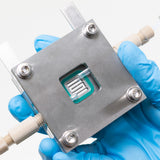 CO2RR: Cells and Membranes
Ossila's modular CO2RR hardware ecosystem is designed to enable researchers to transition between architectures without rebuilding experimental infrastructure from scratch.
Read more...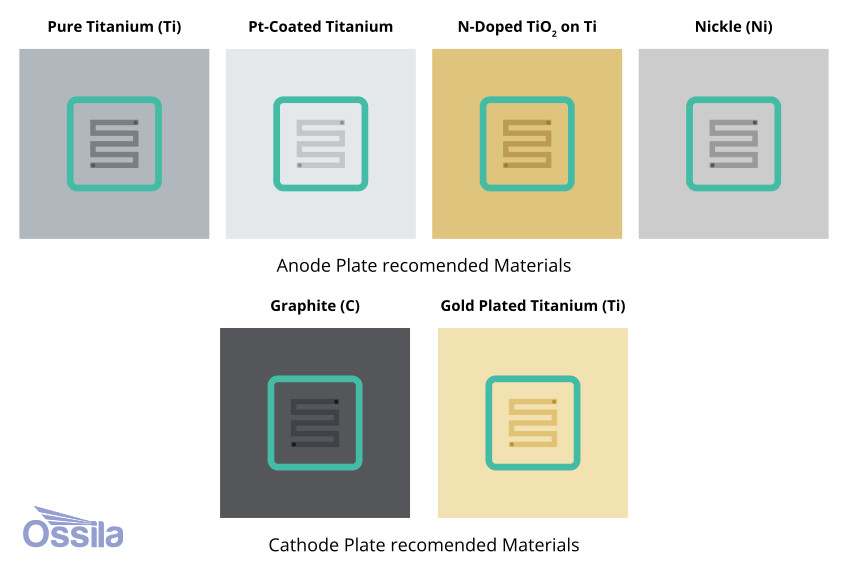 Troubleshooting CO2RR
Practical hardware decisions determine whether a CO2RR electrolyzer operates reliably at elevated current density. These include flow field plate material selection, flow field geometry, and the operational failure modes such as salt precipitation, GDE flooding, membrane degradation, and catalyst contamination.
Read more...Technical Support