Membrane Electrode Assembly Electrolyzer

Advanced Multi-layer Electrochemical Device for High Efficiency Reactions
Zero-gap membrane electrode assembly for reduced ohmic resistance and high current densities
Specifications | Options & Pricing | In the Box | Gallery | Literature | Related Products | Technical Support
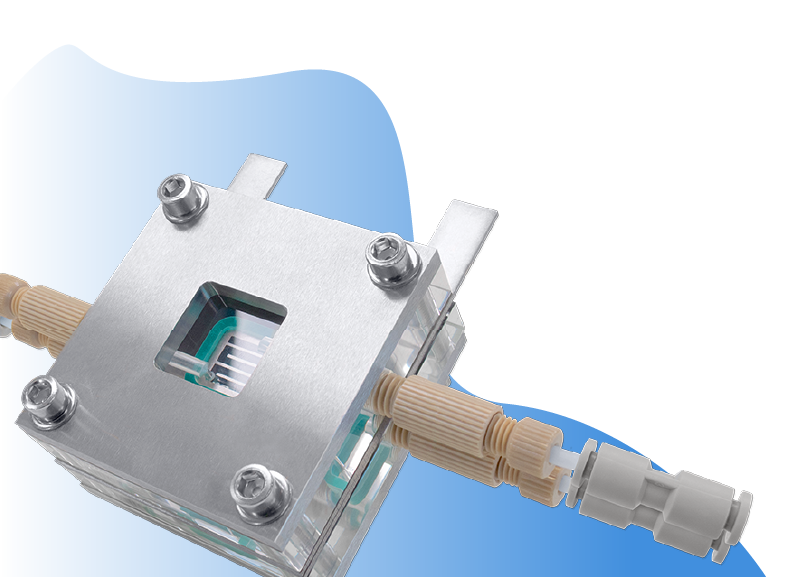
A layered advanced electrochemical device designed for high-efficiency electrochemical reactions, including water electrolysis, CO2 reduction, and nitrogen reduction. The Membrane Electrode Assembly Electrolyzer is a high-performance device that offers an intermediate step between a GDE flow cell and PSE reactor, combining a membrane with continuous electrolyte flow on both sides.
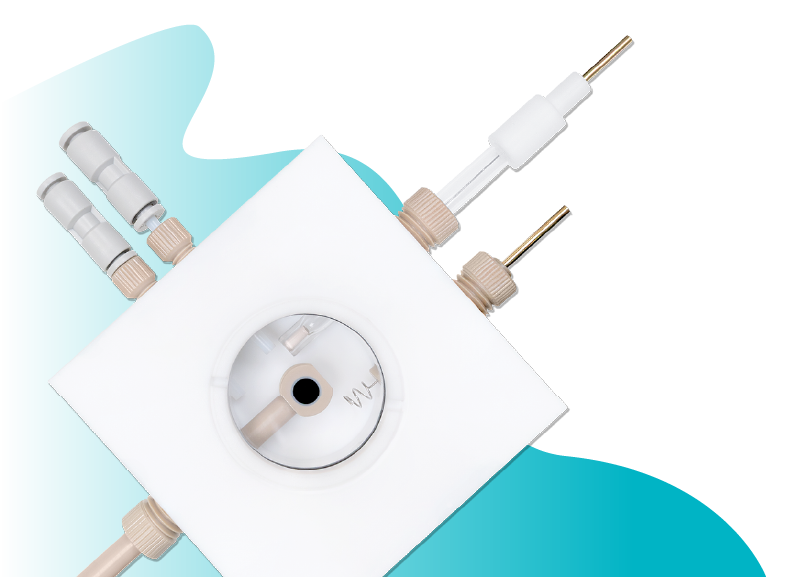
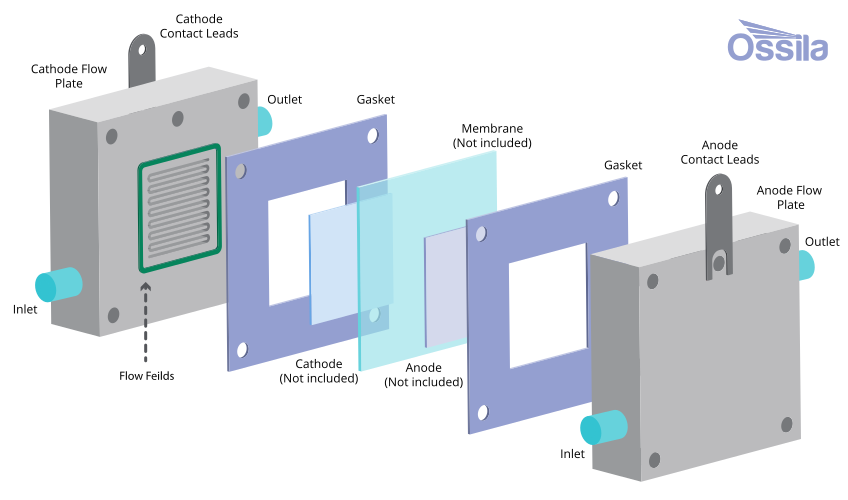
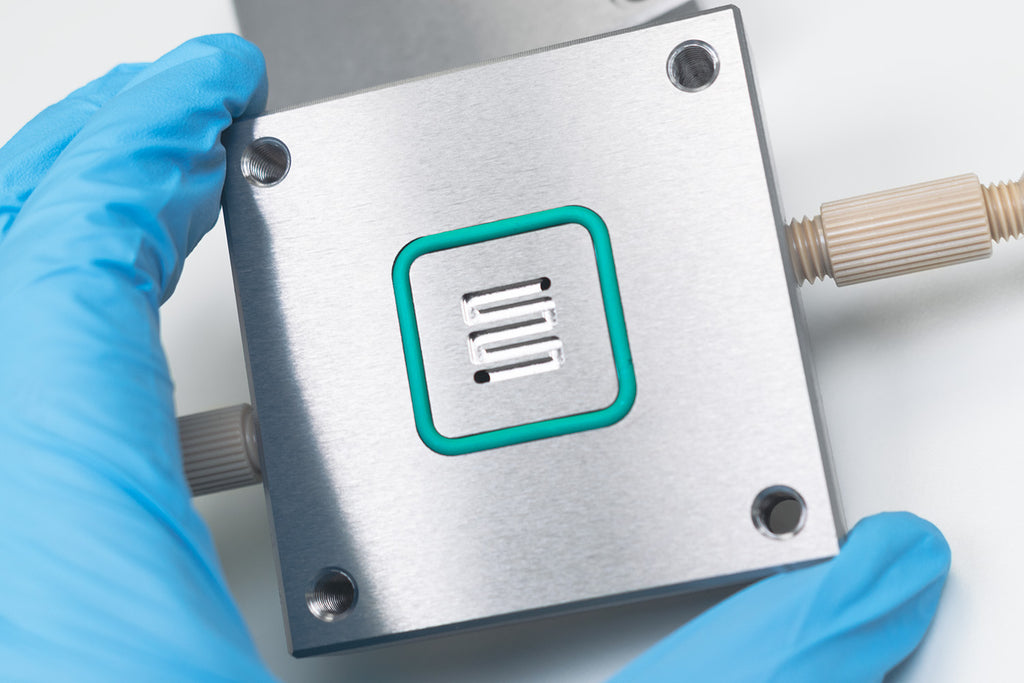
The multilayer structure accommodates a proton exchange membrane (PEM) or anion exchange membrane (AEM) sandwiched between a catalyst loaded anode and cathode layers, surrounded by the gas-diffusion layers. Using a zero-gap architecture minimises ohmic resistance and supports high current densities, making MEA electrolyzers the preferred format when efficiency and scale-up are the priority. Under an applied potential, reactants (gas or liquid) are fed to the back of each electrode through the serpentine flow channels. Ions generated at one electrode conduct directly through the membrane to the other side, completing the circuit without a liquid electrolyte between the membrane and catalyst.

Ion-exchange Membrane
Allows ions to migrate reducing
product crossover

Sandwich Structure
High efficiency, uniform reactant delivery

Zero-gap Configuration
Reduce ohmic resistance, eliminating catholyte layer

Serpentine Flow Field
Uniform gas distribution & efficient product removal
Key Applications
- Water Electrolysis (HER/OER): Splits water into H2 (cathode) and O2 (anode) at high current density. PEM cells (acidic, Ti plates) offer proven high efficiency; AEM cells (alkaline, Ni plates) allow earth-abundant catalysts at lower cost.
- CO2 Reduction (CO2RR): CO2 is fed to the cathode and reduced to CO, ethylene, ethanol, or other products. AEM cells improve selectivity toward multi-carbon products; BPM cells (Ti/Ti or Ti/SS) decouple cathode and anode pH to address carbonate crossover losses
- CO2 Reduction to Formate/formic acid (CO2RR): Sn or Bi catalysts selectively reduce CO2 to formate at the cathode. PEM cells are preferred: formate does not cross a cation exchange membrane, giving higher product purity and Faradaic efficiency. BPM cells are also well-suited to the acidic cathode.
- Nitrogen Reduction (NRR): N2 is delivered to the cathode and reduced to NH3 under ambient conditions, without the high temperature and pressure of Haber–Bosch. AEM cells (alkaline, Ti or graphite plates) are preferred as the alkaline environment suppresses competing HER on selective NRR catalysts.
- Oxygen Reduction (ORR): O2 or air is fed to the cathode to evaluate catalysts for fuel cell cathodes, metal-air battery electrodes, or selective H2O2 production via the two-electron ORR pathway. PEM cells (Ti/Ti or Pt-Ti plates) are standard for high current density ORR work.
Specifications
| Flow Field Geometry | Single S-shaped serpentine channel, both cathode and anode plates |
|---|---|
| Channel Dimensions (W x D) | 1.5 mm x 1.5 mm |
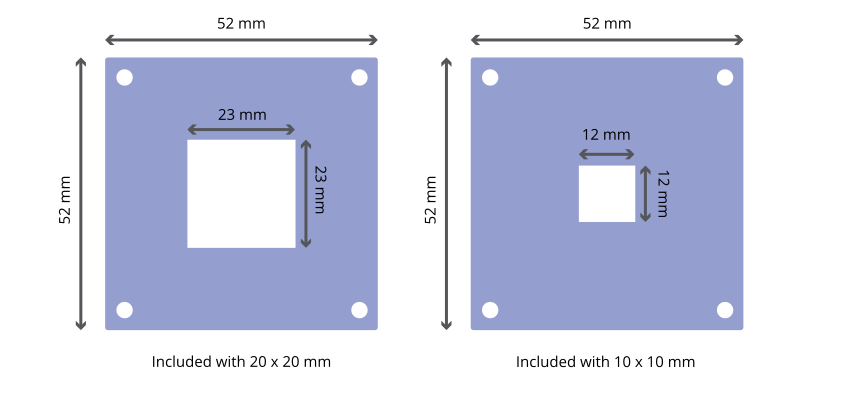
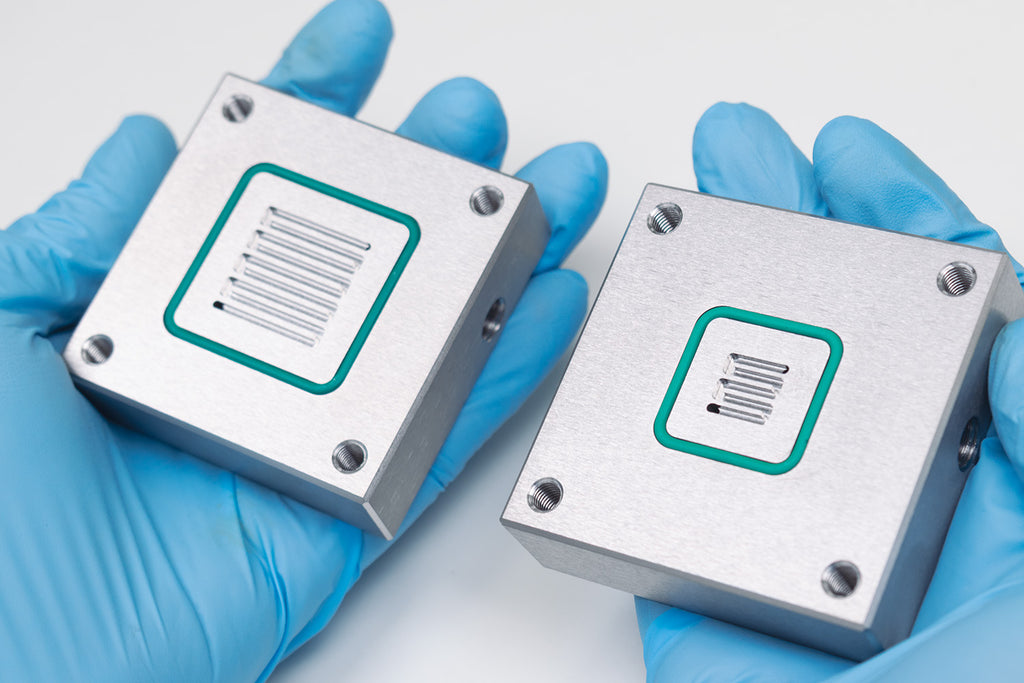
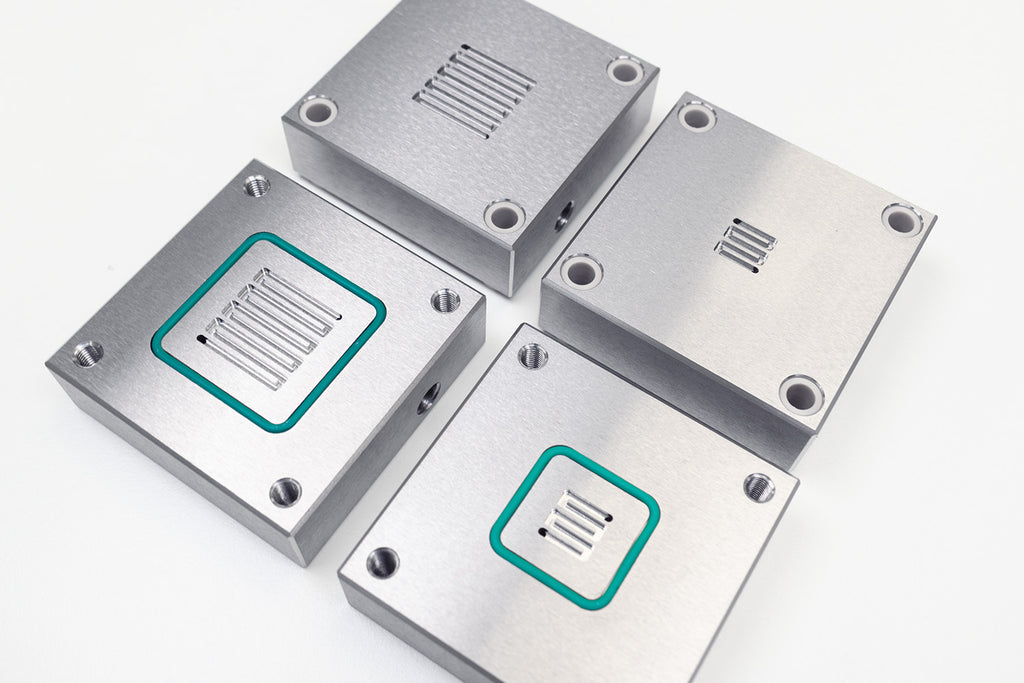
| Active Areas Available | 1 cm2 (10 x 10 mm), 4 cm2 (20 x 20 mm) |
| Membrane Compatibility | PEM and AEM |
| Cathode/ Anode Field Plate Materials | Ti (TA2, in stock); Ni, Au-Ni, Pt-Ti, and 316L SS (see pricing table) |
| Cathode/ Anode Field Plate Dimensions | 60 mm x 60 mm x 19 mm (H x W x T) |
| Gasket Materials | FKM (0.2, 0.3, 0.8, 1.0 mm) and PTFE (0.25 mm) |
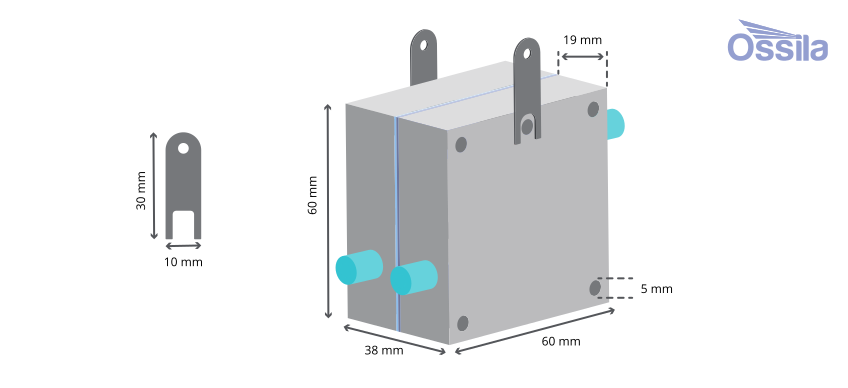
Options and Pricing
The MEA Electrolyser is stocked in grade 2 (Ti/Ti) plate configuration for both active area sizes, suitable for PEM water electrolysis, AEM water electrolysis, and CO2 reduction. Alternative plate material combinations are available on request for AEM, PEM, and BPM membrane compatibility. Contact us to discuss your requirements.
In Stock
| Cathode Plate | Anode Plate | Active area | SKU | Price (ex. VAT) |
|---|---|---|---|---|
| Titanium | Titanium | 1 cm2 (10 x 10 mm) | C2050A1 | £1990 |
| Titanium | Titanium | 4 cm2 (20 x 20 mm) | C2050D1 | £2190 |
Available on Request*
| Cathode Plate | Anode Plate | Active area | SKU | Price (ex. VAT) |
|---|---|---|---|---|
| Pt-coated Ti | Pt-coated Ti | 1 cm2 (10 x 10 mm) | C2050F1 | £3230 |
| Nickel | Nickel | 1 cm2 (10 x 10 mm) | C2050K1 | £2870 |
| Au-coated Ni | Au-coated Ni | 1 cm2 (10 x 10 mm) | C2050P1 | £4070 |
| Stainless steel (316L) | Titanium | 1 cm2 (10 x 10 mm) | C2050T1 | £2150 |
| Titanium | Stainless steel (316L) | 1 cm2 (10 x 10 mm) | C2050W1 | £2150 |
| Au-coated Ti | Au-coated Ni | 1 cm2 (10 x 10 mm) | C2050X1 | £3650 |
*Plates with 4 cm2 dimensions and Au-coated titanium or Au/Pt-coated stainless steel plates also available with a 4-week lead time. We currently do not offer graphite flow plates.
In the Box
- Titanium cell
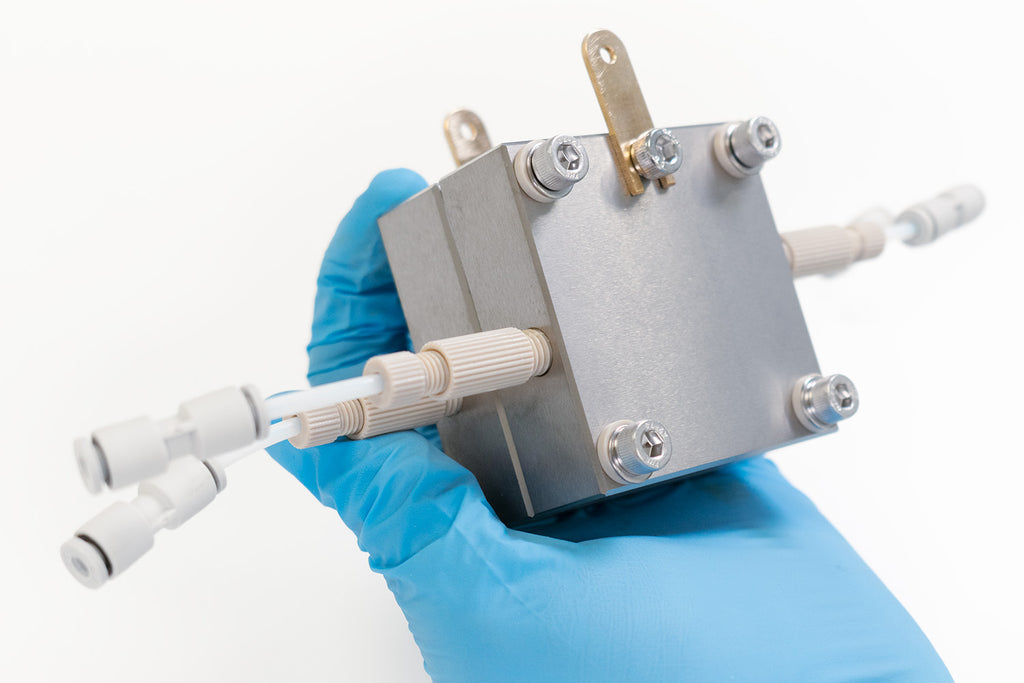
- Anode & cathode contact leads
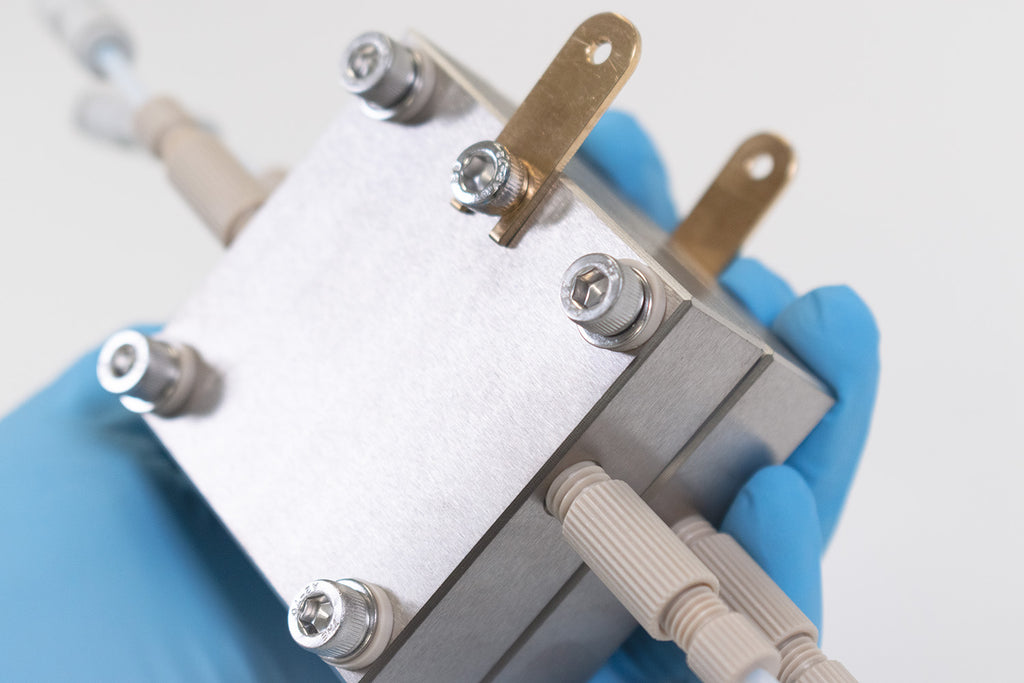
- PEEK gas inlet/outlet screws
- Push-fit gas locks
- PTFE 0.25 mm thick gasket
- FKM 0.2 mm thick gasket
- FKM 0.3 mm thick gasket
- FKM 0.8 mm thick gasket
- FKM 1.0 mm thick gasket
- 1m potentiostat PTFE tubing
- PTFE white tape x1
- Spare gas O-rings
- Spare flow field O-rings
- PTFE rod 3 mm air inlet stopper x 4
- Gas tube cutter
- Spare washes and screws
Product Gallery
Literature
- K. Kamiya et al. (2025), Gaseous CO2 electrolysis: latest advances in electrode and electrolyzer technologies toward abating CO2 emissions, Chem. Sci., 2026, 17, 4363-4374; DOI: 10.1039/D5SC08419A.
- M. Hussain et al. (2025), Boosting electrochemical CO2 reduction to CO by regulating pressure in zero-gap electrolyzer, J. CO2 Until., 100, 103179; DOI: 10.1016/j.jcou.2025.103179.
- J. Lee et al. (2024), Best Practices in Membrane Electrode Assembly for Water Electrolysis, ACS Materials Lett., 6 (7), 2757–2786; DOI: 10.1021/acsmaterialslett.4c00699.