


Screen Printing Conductive Inks


Buy screen printing inks | Choose the right material | Resources | Technical support
Screen printing inks are typically consisting of conductive or resistive particles such as silver, carbon, or PEDOT dispersed in a binder, designed for the development and fabrication of printed electronics. With these high quality inks, you can print detailed device patterns with high repeatability and reliability. Choose from our range of conductive inks and pastes that are compatible with screen printing, including popular silver and next-generation carbon inks.
Key Features
- Conductive inks are ideal for the development of flexible electronics such as electrodes, biosensors, displays, or wearable electronics.
- Screen printing is an easy and reliable method of producing patterned films consistently in multi-pixel devices or module fabrication.
- Relatively complex patterns can be deposited through sequential layer deposition.
- With a low start-up cost, screen printing is ideal for small-scale R&D of printed electronics. Any left-over ink is easily recovered, reducing waste material.
Buy Screen Printing Conductive Inks
Filter by Material:


Choose the Right Screen Printing Material
At Ossila we have a range of screen printing materials to cover applications including transparent electrodes, flexible printed circuits, sensors, transistors, and solar cells.
Material Properties
| Conductive Material | Solvent | Electrical Performance | Viscosity | |
|---|---|---|---|---|
| Silver Ink (AG-510) | Silver | DEGMEA | < 0.015 Ω/sq/mil | 2.5 – 4.0 Pa·s |
| Carbon Ink (C-250J) | Carbon black, graphite | DEGMEA, naptha | ≤ 0.022 Ω⋅m | 23.5 – 36.5 Pa·s |
| PEDOT:PSS materials | PEDOT:PSS | Glycol | 100 – 1000 Ω/sq | 1.5 – 6.0 Pa·s |
Substrates & Applications
| Compatible Substrates | Recommended Applications | |
|---|---|---|
| Silver Ink (AG-510) | Print-treated PET or silicon, polyester, TPU, polycarbonate, ITO-sputtered films or glass, polyimide (Kapton) |
Flexible circuits, membrane switches, touch screens, electroluminescent panels, printed electrodes |
| Carbon Ink (C-250J) | Print-treated PET, rigid PCB substrates | Membrane switches, flexible circuits, solar cells, printed electrodes |
| PEDOT:PSS materials | Flexible polymer films, glass, paper, textiles | Electroluminescent lighting, electrochromic displays/indicators, pressure sensors, wearables, touch sensors/switches, 3D conformal touch surfaces |
Resources
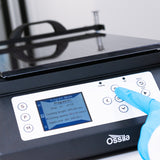 Screen Printed Electrodes
Screen-printed electrodes (SPEs) are an important development within electrochemical analysis methods, offering a sensitive, cheap, and simple platform for sensing technologies across various fields. Screen printed electrodes can be particularly useful for environmental analysis sensors, detecting biomolecules and biomarkers, flexible electronics and more.
Read more...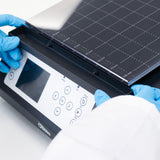 What Is A Screen Printer?
Screen printers use a porous screen and squeegee to create patterned thin films from inks or pastes. During printing, a combination of moving the solution over the screen with downward pressure from the squeegee forces solution through the open areas of the screen. A stencil blocks selected regions, so ink only transfers where the pattern is open.
Read more...Technical Support