


What is a Screen Printer?
Jump to: Screen Printing Theory | Screen Printer Machines | Benefits of Screen Printers | Screen Printer Applications
Screen printers use a porous screen and squeegee to create patterned films from inks or pastes. During printing, even pressure should be applied to the screen via the squeegee. When dragged across the screen will flood the stencils pattern. The ink will only transfer though open or uncured areas. This means the rest of the solution can be reused in the next coating allowing for an easily repeatable and consistent form of printing. Screen printing can be applied sequentially to create layers of thin films, creating more intricate and detailed patterns.
The printed layer thickness is loosely controlled by stencil geometry and ink viscosity, so screen printing is better suited to applications where repeatable patterning matters more than nanometre-scale thickness control. These methods can be used to print detailed patterns with high repeatability and reliability.
Screen Printing Theory
Screen printers rely on a few key but simple principles - the coating solution is transferred through a porous screen which has a pattern cured or placed onto it, allowing ink to transfer though certain sections, creating a patterned film or image. In practise, the coating liquid is dragged over a coating screen, and the liquid soaks through any porous section onto the substrate below. There are several methods for creating the non-porous regions such as:
- Placing a hydrophobic or non-porous patterning sheet onto the screen, like a mask or stencil. This may not be the optimal method as the gap between the sheet and screen could slide when used, creating bleed within the patterns lines.
- If using a mesh screen, using a photo-emulsion material can create a pattern by exposing a positive of the pattern to light for an extended amount of time.= These materials harden when exposed to light, creating non-porous regions of the screen.
- Pattern the substrate itself with hydrophobic or non-adhesive layers (with wax, tape, etc)
Any of these methods will block ink transfer in certain places, creating a patterned coating quickly and easily.
When optimizing a print, the key parameters to consider include:
- Printing speed and consistency
- Printing gap
- Proper and secure alignment
- Stencil thickness & patterning method
- Printing pressure - Keeping the pressure consistent across both sides of the squeegee as well as keeping it consistent throughout the print is key. Hold the squeegee towards yourself at a 45-degree angle will aid in keeping the pressure consistent.
- Pattern spacing - Having the core design centred will allow for the ink to flow and fully flood the design. When the pattern gets closer to the edges of the frame it can become tricky to fully flood the design.
- Coating solution viscosity/wettability - Thicker solutions will often require higher force of pressure to aid them though the screen sheet
Compared to other coating techniques, it is more difficult to control film thickness with screen printing. Therefore, it is most suitable for applications that do not require precise thickness control.

Screen Printer Machine
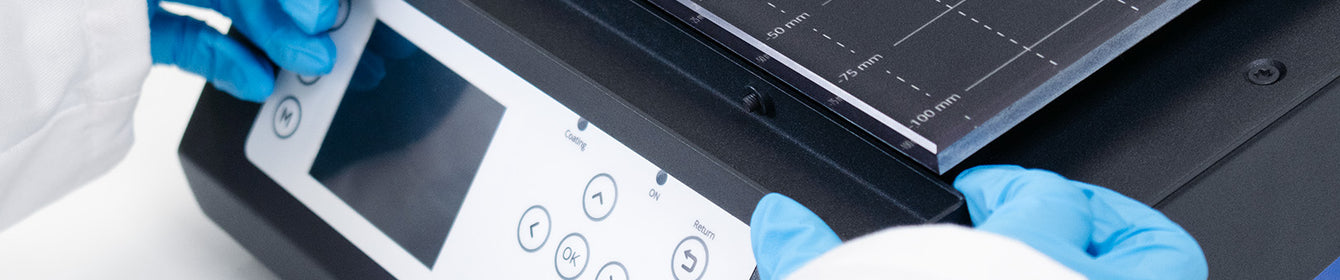
To screen print, you typically need a frame, a base, a porous or mesh screen (with stencil or other patterning) and a squeegee. You can use a screen printer machine to fix your screen in a consistent location. This will ensure more effective repeatability and allow for layering up multiple different patterns to create a multi element device.
The screen printing method follows this basic process:
- Mount the patterned screen in the frame and align it above the substrate.
- Pour the coating liquid onto one end of the screen.
- Perform a flood stroke by applying the coating solution over one end of the screen and dragging the solution down with the squeegee. Once at the bottom of the screen, this space solution can be “re-flooded” and pushed by up towards the top of the screen.
- Perform the print stroke: draw the squeegee across the screen to force ink through the open pattern areas. Re-Flooding can also be done here to ensure the entire pattern is coated. It’s key to do this before removing the frame so that it keeps it’s position.
- Dry, cure, or sinter the printed layer once removed from the board. This process will depend on the ink chemistry and substrate material.
Using an automated screen printer improves repeatability by controlling alignment and motion. With some systems you can control squeegee speed, pressure, and angle to ensure you have a repeatable coating process.
Benefits of Screen Printers
Quick and Easy
Screen printers provide an easy and reliable method of producing patterned films consistently. The effortless process and simple components make it a widely used technique.
Versatile
It’s easy to change pattern by simply changing the stencil or sheet. You can use many different stencils, and many different coating solutions. If using emulsification techniques the screens can not only be washed and used but the emulsion can be removed and a new design can be cured onto it.
Patterned Coatings
Create multiple layers on the same substrates. This technique is great for patterning multi-pixel devices or for module fabrication. Relatively complex patterns can be deposited through sequential layer deposition.
Cost Efficient and Low Waste
The low start-up cost makes this a simple way to coat substrates. Although it requires more coating solution than other methods, any left-over solution can be easily recovered, reducing waste material.
Screen Printer Applications
 ElectrodesBiosensorsFlexible DevicesSensors and DetectorsWearable TechnologyStretchable Electronics


More Resources
 Screen Printed Electrodes
Screen-printed electrodes (SPEs) are an important development within electrochemical analysis methods, offering a sensitive, cheap, and simple platform for sensing technologies across various fields. Screen printed electrodes can be particularly useful for environmental analysis sensors, detecting biomolecules and biomarkers, flexible electronics and more.
Read more... Semiconductor Characterization Methods
Semiconductor characterization refers to the process of measuring and evaluating the properties of a semiconductor. This is quite a broad term and can refer to different processes depending on the context. It can refer to:
Read more...Contributors
Written by
Application Scientist
Graphic Designer & Coatings Specialist