


Fluorescent Dopant Materials


Fluorescent dopant materials are conjugated small molecules or polymers that are doped into host materials to emit specific colors of light efficiently, improving device performance by controlling color purity, brightness, and energy transfer, often using Förster Resonance Energy Transfer (FRET) from host to dopant for efficient light emission. Fluorescent dopant materials function by absorbing high-energy, short-wavelength light such as UV or blue light, and re-emitting it at lower-energy, longer-wavelengths visible light.
Common fluorescent dopant materials are blue emitting pyrene derivatives such as N1,N6-bis(dibenzo[b,d]furan-4-yl)-3,8-diisopropyl-N1,N6-bis(4-isopropylphenyl)pyrene-1,6-diamine (BD-1) and 1,1'-(2,5-Dimethyl-1,4-phenylene)dipyrene (DMPP), and green/red emitting 5,12-Dihydro-5,12-dimethylquino[2,3-b]acridine-7,14-dione (DMQA) and 4-(Dicyanomethylene)-2-tert-butyl-6-(1,1,7,7-tetramethyljulolidin-4-yl-vinyl)-4H-pyran (DCJTB).
Jump to: Browse Dopant Materials by Collection | Browse all Dopant Materials | Resources and Support
Browse Dopant Materials by Collection


Browse Dopant Materials
Related categories: OLED materials, transport layer materials, OLED host materials, TADF materials
Filter by price change:
Filter by color:
Filter by purification technique:




Resources and Support
 Fluorescence and Phosphorescence
Fluorescence and phosphorescence are types of photoluminescence. Photoluminescence refers to radiative emissions where the absorbance of a photon is followed by the emission of a lower energy photon. The main empirical difference between fluorescence and phosphorescence is the time in between absorbance and the emission of photons. Fluorescence is where a material absorbs a photon, and almost immediately emits a lower energy photon.
Read more...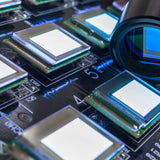 Organic Light Emitting Diodes
Organic light emitting diodes are thin film devices that convert electrical energy into visible light. In OLED devices, electrons and holes are injected into the organic medium and recombine radiatively via electroluminescence (EL). The color of the light emitted is dependent on the molecular structure of the organic material. This can be easily customized to make a wide range of wavelengths thanks to the endless configurations of organic molecules.
Read more...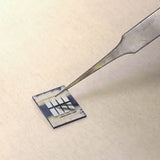 OLED Fabrication Guide
In this guide, we demonstrate how to make standard OLED devices in a glove box using materials and equipment easily available to any lab. Find out more.
Read more... OLED Testing Guide
This guide gives you an overview of what to consider when characterizing an OLED, as well as tips for their measurement.
Read more...