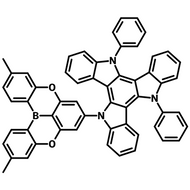
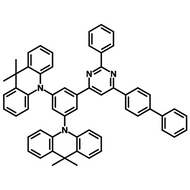
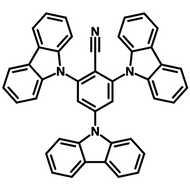
TADF Blue Dopants


Thermally Activated Delayed Fluorescence (TADF) blue dopants are known as third-generation organic light-emitting diode (OLED) materials designed to achieve 100% internal quantum efficiency without the use of rare heavy metals like iridium or platinum. TADF blue dopants are specialized organic molecules used in OLED that efficiently emit blue light by harvesting both singlet and triplet excitons, overcoming the limitations of traditional fluorescent emitters, to create highly efficient and stable blue pixels for displays and lighting. They achieve this through Thermally Activated Delayed Fluorescence (TADF) by featuring a small energy gap between their excited singlet (S1) and triplet (T1) states, allowing slow-decaying triplet excitons to convert back to radiative singlet states via Reverse Intersystem Crossing (RISC), thus boosting light output.
The benchmark TADF blue dopants are 4TCzBN and t-Bu-n-DABNA, both exhibiting high external quantum efficiencies (EQE) over 35%, along with narrow emission with full width at half maximum (FWHM) of 19 nm (CIE y=0.15) for the MR-TADF emitter t-Bu-n-DABNA.
Jump to: Browse all Blue Dopant Materials | Resources and Support
Browse Blue Dopant Materials
Related categories: Charge transport layer materials, Dopant materials, Host materials, TADF materials, OLED materials
Filter by purification technique: