


Working Electrodes


What is a Working Electrode? | Browse Working Electrodes | Working Electrode Material | Stationary vs. Rotating Electrode
Other WE Designs | Selection Guide | Resources
We offer working electrodes (WE) with various materials, geometries and sizes, which are compatible with our extensive range of electrochemical cells and other electrodes.

What is a Working Electrode?
A working electrode (WE) is a specific component in an electrochemical cell where the electrochemical reaction of interest occurs. The working electrode serves as the interface for the electron transfer and the redox process being investigated happens directly at the surface of the working electrode. It is the key site where the reaction of interest occurs. The potential of this electrode is varied to drive the desired chemical reaction and the current produced by the reaction at this electrode is measured by a Potentiostat.
Common materials are selected for conductivity and inertness, including glassy carbon, gold or platinum, often fashioned into disc electrodes. Selecting the appropriate material and geometry is therefore critical to obtaining meaningful data.
Once you finalize the experimental conditions, use the following criteria to choose a suitable working electrode for your electrochemical study:
- Will the electrode remain electrochemically stable under the intended conditions? Is the material chemically inert to the electrolyte?
- Does the material have good enough electrical conductivity? Does the material exhibit fast and well-defined electron transfer behaviour for the reaction?
- Will the electrode remain intact over multiple studies? Will the electrode maintain reproducible surface characteristics?
To maintain the high quality of our working electrodes, consider using our electrode polishing kit.
Browse all Working Electrodes
Related categories: substrates and fabrication, electrochemical cells, photoelectrochemical cells, potentiostat, electrochemistry


Working Electrode Material
Glassy Carbon (GC), Platinum (Pt), and Gold (Au) are the most common working electrode materials. Ti and other materials may suit specific applications.
Glassy carbon is made through the thermal decomposition of selected polymer resins, creating a structure of randomly arranged and entangled aromatic ribbon molecules. This creates an electrode surface composed of both basal and edge planes, formed from a network of interconnected curved carbon fragments. Because of that, it lacks a crystal grain structure, significantly reducing the number of “weak spots" for chemicals to attack, defining its unique inert electrochemical properties. It is also often cheaper than platinum electrodes.
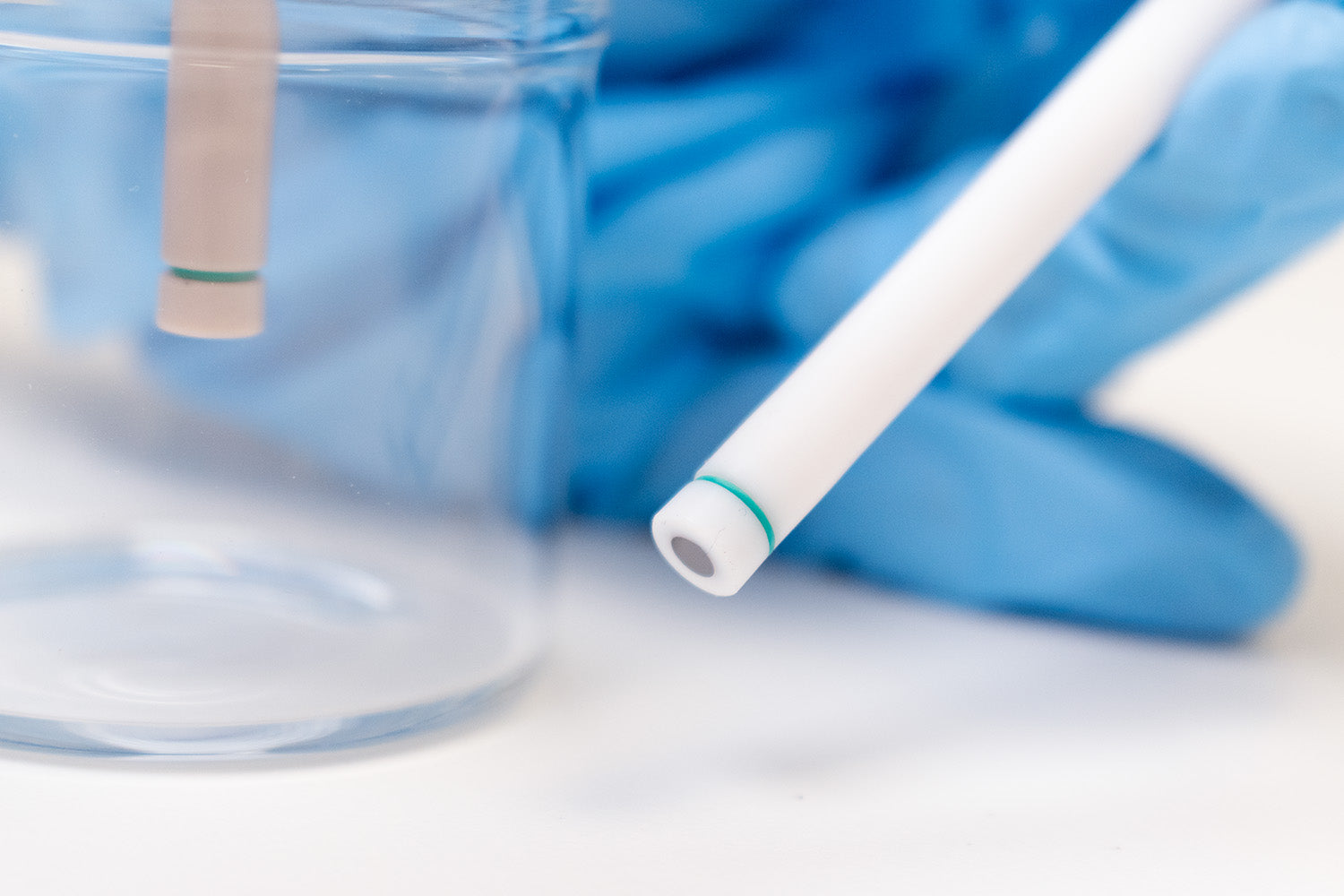
Glassy Carbon (GC) is a widely used working electrode material. It has a wide potential window (particularly in negative potentials) and has low intrinsic catalytic activity and high chemical inertness. GC electrodes will only decompose in extreme conditions such as hot, concentrated Nitric Acid (HNO3) or Perchloric Acid (HClO4) or temperatures above 450°C. This lack of reactivity makes it a preferable material over more conductive metal.
Platinum (Pt) is one the most stable metals with excellent electrical conductivity and fast electron transfer kinetics. Pt is highly resistive against oxidation and stable under most of the known hostile environments, including acids, high temperature, and organic solvents. However, Pt is not a suitable base electrode for certain experiments, as it shows high catalytic activity towards some electrochemical reactions including hydrogen evolution reaction (HER) and oxygen reduction reaction (ORR). Therefore, Pt is not always suitable to use as working electrode material, especially where the catalytic neutrality is critical.
Gold (Au) is also a chemically stable and conductive material, and it’s a well-suited electrode for CO2 reduction studies due to its selectivity. It is also suitable for surface monolayer assembly related studies as Au has strong affinity for thiol-based chemistry (ideal for SAMs).
Please note that, above working electrode suggestions are only for the laboratory electrochemistry experiments.
Frequently, an active material is dropcast onto the surface of the working disk electrode during electrode preparation. Hence, it’s preferable for a working electrode to have a mirror-like surface. Poor surface preparation may lead to increased non-Faradaic currents due to high capacity, noise, and irreproducible results. Guidance on Electrode cleaning is available in further resources.
Stationary vs Rotating Disk Electrode
Stationary electrodes are the most common type supporting many general measurements. However, working electrodes with rotational control allow for more interesting studies.
Rotating Disk Electrodes (RDE) have rotating disk control. By rotating the reaction disk, you encourage mass transport (diffusion) of ions towards the working electrode. Mass transfer of the electrode is a limiting factor determining the anodic/ cathodic peak in cyclic voltammetry measurements.
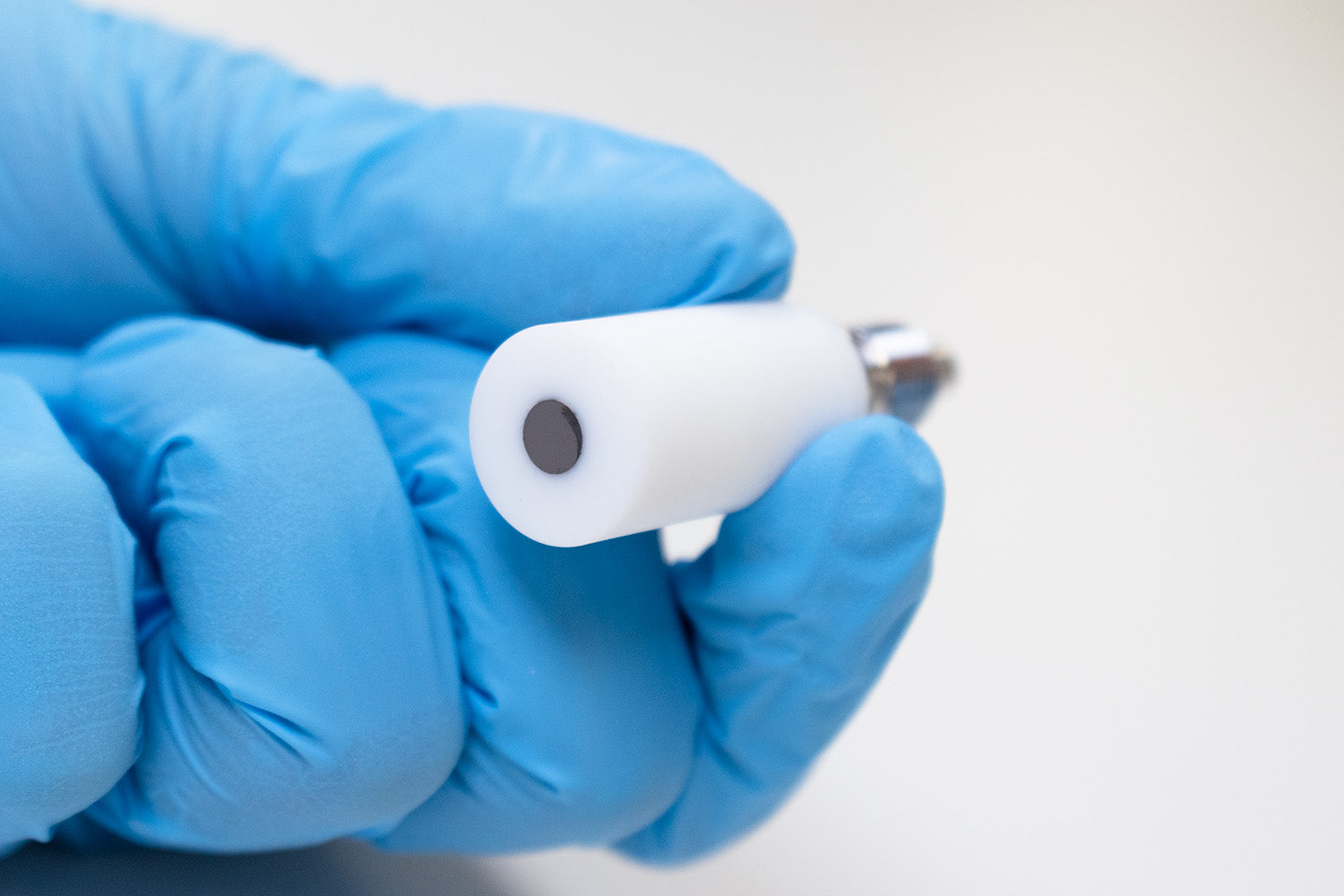
By using an RDE, you can establish a laminar flow that maintains a constant diffusion layer thickness, enabling the measurement of a steady-state current where mass transport is precisely controlled. This is essential for studying ORR, OER, or HER, as the rotation ensures a continuous supply of dissolved reactants while preventing produced gas bubbles from masking the active sites and obstructing the reaction.
Rotating Ring Disk Electrode (RRDE) is an advanced electrode compared to RDE. Rather than the whole disk rotating, the electrode comprises a separate outer ring next to the central rotating disk. These are separated by an insulating layer, essentially giving you two working electrodes. When both move together, reactants are pulled to the central disk and radially flow outward towards the ring. The reaction typically occurs at the disk electrode and is measured at the ring electrode.
This RRDE configuration enables a deeper understanding of the electrochemical reactions occurring at the electrode including reaction kinetics and the electron transfer number, enabling the tracking of reaction pathways and the identification of intermediate products.
Other WE Designs
L-Shaped Electrodes
L-shaped working electrodes allow the active electrode surface to be positioned closer to the reference electrode or Luggin capillary. This reduces the uncompensated solution resistance between the working electrode surface and the point where the reference electrode senses the potential, thereby minimising measurement errors arising from iR drop. By shortening the ionic path through the electrolyte, the measured potential more closely represents the true potential at the working electrode surface.
This design becomes particularly useful in experimental conditions where the electrolyte resistance is relatively high. (e.g. non-aqueous or organic solvents, viscous electrolytes, small volume or specialised cells).
Detachable Electrodes and Electrode Holders
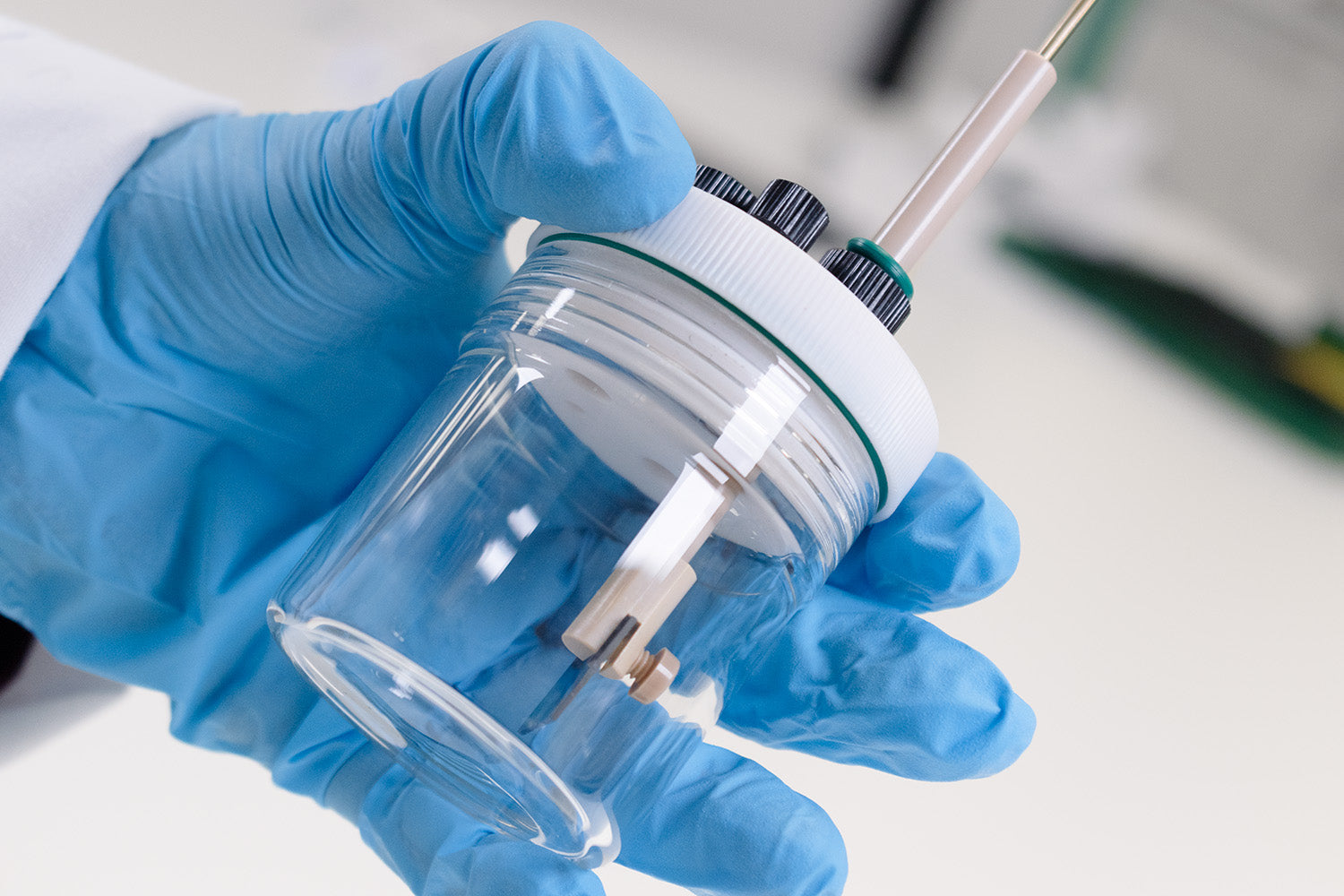
Electrode holders have a conductive core and an electrode disk embedded into one side of the holder. The screw mechanism holds the conductive electrode against the electrode disk, completing the circuit. This can be especially useful for photo electrochemistry experiments (which would require transparent electrodes such as ITO), or for measuring other specialist working electrode materials.
Detachable electrodes have a standard working electrode that can be detached from the holder (in Ossila’s case using a push-screw mechanism). These electrodes allow specialist materials to be incorporated into electrochemical experiments. This is especially useful for fundamental studies, as it allows users to extract the electrode after reactions have occurred, to allow post-experimental characterisation as microscopic (e.g. SEM, AFM) and spectroscopic (e.g. XPS, RAMAN, FTIR) studies.
Application-Base Working Electrode Selection Guide
| Application | Material (WE) | Holder Type | Body Materials | Priorities |
|---|---|---|---|---|
| Standard Voltammetry | GC | Straight | PEEK |
Wide potential window into negative potentials. Body is thermal stable and mechanically robust. |
| Standard Voltammetry | Pt | Straight | PEEK |
Fast kinetics. Body is thermal stable and mechanically robust. |
| Standard Voltammetry (Aggressive Organic Solvents) | GC | Straight | PTFE |
Inert electrode. Body has extreme resistance to specialized organic solvents. |
| Catalyst Testing (HER/OER) | GC | All stationary shapes/ RDE | PTFE |
GC Avoid Catalytic Contribution Best electrode design is dependent on experiment. |
| Catalyst Testing (ORR) | GC (Disk) + Pt (Ring) | RDE/RRDE | PTFE |
Enables the diffusion control and the determination of the intermediates. |
| Catalyst Testing (CO2RR) | Au (Disk and Ring) | RRDE | PTFE |
Gold selectivity is preferred for CO₂ studies. Can track reaction pathways in situ. Contact us for custom-made RRDE electrodes |
| Post-Analysis (SEM/XPS/ RAMAN/ FTIR/ etc) | GC | Dual purpose /Detachable | PTFE |
Easily transfer electrode between systems. |
| Photoelectrochemistry/ Specialist electrodes | GC | Electrode Holder | PTFE |
Easy transfer into system. Wider potential window. Good for hydrogen studies. |
| Photoelectrochemistry/ Specialist electrodes | Pt | Electrode Holder | PTFE |
Easy transfer into system. High conductivity. Good for measuring electronic devices e.g. solar cells. |
| High Current Systems | Any | L-Shaped | Any |
Reduces iR drop by minimising distance to RE. |
| SAMs/ Biosensing | Au | Straight | Any |
Strong thiol chemistry and functionalisation. |
| In-situ Spectroscopy (Raman/UV-Vis) | GC | Dual purpose /Detachable | PTFE |
Compact removable heads fit into the tight constraints of specialized Spectroelectrochemical cells. |
| Aggressive Organic Solvents | GC | Straight | PTFE |
GC is inert; PTFE is preferred over PEEK for extreme resistance to specialized organic solvents. |
Resources and Support
 What are Electrodes?
An electrode is made from conductive material that can transmit electricity. When an electric current is applied, the electrode facilitates the transfer of electrons, enabling electrical reactions.
Read more...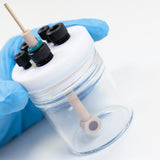 Choosing Working, Reference and Counter Electrodes
Choosing the right electrodes is an important part of innovative electrochemical research. There are several factors to consider when choosing which electrode is best for your application.
Read more... What is a redox reaction?
A redox reaction, also referred to as an oxidation-reduction reaction, involves the loss or gain of electrons. The loss of electrons is called oxidation and the gain of the electrons reduction.
Read more...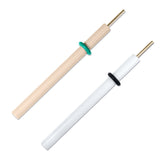 PEEK vs PTFE
The choice of whether to use PEEK (polyether ether ketone) or PTFE (polytetrafluoroethylene, Teflon) comes down to the conditions of your planned experiments. The key polymer properties to consider are:
Read more...