


High quality glassy carbon working electrode
Perfect for use in standard electrochemistry cells for cyclic voltammetry and more
Specifications | Pricing | Related Products | Resources and Support
Glassy carbon working electrode is the most commonly used carbon-based electrode in electrochemistry such as cyclic voltammetry and linear sweep voltammetry due to its properties of high temperature resistance, hardness, low density and low electrical resistance. Glassy carbon is one of the widely used electrode materials for making working electrodes. With a wide potential window and good electrical conductivity, glassy carbon is electrochemically inert, dense, and hard as glass, without gas or liquid permeability. In addition to very high thermal stability, glassy carbon is extremely resistant to chemical attack.
Glassy carbon, also known as vitreous or polymeric carbon, is produced by the thermal degradation of selected polymer resins. It is made up of aromatic ribbon molecules which are randomly oriented and tangled in a complicated manner. The surface of glassy carbon electrode is the mixture of basal plane and edge plane from intertwined discrete fragments of curved carbon planes.
Combine the glassy carbon working electrode with our affordable reference electrodes, counter electrodes and electrochemical cells to start performing electrochemical experiments immediately. If you are testing a new material, catalyst, or enzyme, typically you can drop-cast a small amount of pre-prepared ink of it onto the GCE surface.To keep your electrodes working at the highest standards, we recommend using our electrode polishing kit.

Standard Shape
Will fit in any cell

Highly Inert
Suitable for a wide range of EC experiments

Wide Potential Window
For use under a broad voltage range

Expert Support
From in-house scientists & our
customer care team
Specifications
All dimensions are in millimeters.
Glassy Carbon Working Electrode

| Product Name | Available disc diameter (n) size(s) |
| Glassy Carbon Working Electrode | 3 mm 4 mm |

Pricing and Options
| Product Name | Product Code | Price |
| Glassy Carbon Working Electrode - 3 mm diameter - PTFE Body | C2013F1 | £250 |
| Glassy Carbon Working Electrode - 4 mm diameter - PTFE Body | C2013G1 | £280 |
| Glassy Carbon Working Electrode - 3 mm diameter - PEEK Body | C2019F1 | £250 |
| Glassy Carbon Working Electrode - 4 mm diameter - PEEK Body | C2019G1 | £280 |
Related Products


Resources and Support
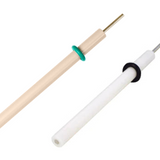 PEEK vs PTFE
The choice of whether to use PEEK (polyether ether ketone) or PTFE (polytetrafluoroethylene, Teflon) comes down to the conditions of your planned experiments. The key polymer properties to consider are:
Read more...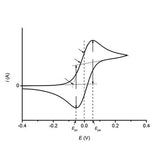 Cyclic Voltammetry Basics, Setup, and Applications
Cyclic voltammetry is an electrochemical technique for measuring the current response of a redox active solution to a linearly cycled potential sweep between two or more set values.
Read more...