


Reference Electrodes


What is a Reference Electrode? | Browse Reference Electrodes | Reference Electrode Set-Up | Aqueous vs. Non-Aqueous Cell | Luggin Capillary
Application-Based Selection Guide | Other Types of Reference Electrode | Resources
We offer both aqueous and non-aqueous reference electrodes, as well as replacement half cells to use with your electrochemical set up.

What is a Reference Electrode?
A reference electrode (RE) is a critical component in a three-electrode electrochemical system, providing stable and well-defined electrochemical potential to act as a fixed voltage baseline in electrochemical measurements. The reference electrode allows an accurate measurement of the potential of a working electrode without interference, crucial for techniques like voltammetry and potentiometry.
The RE is often isolated from the rest of the electrolyte, functioning as a half-cell with a well-defined chemical equilibrium that remains unchanged under controlled conditions.
This reaction stays “locked” at a specific voltage as long as the internal chloride concentration remains unchanged. This allows you to measure the working electrode’s potential accurately (at a set of external conditions) without the reference point drifting.
Aqueous silver/silver chloride (Ag/AgCl) and non-aqueous silver/silver ion (Ag/Ag+) electrodes are the most popular practical reference electrodes due to their stability, robustness, and lack of mercury.
Ag/AgCl reference electrode is the standard for general aqueous electrochemistry, corrosion testing, and biosensors. Double-junction designs are available for use in chloride-sensitive samples or with specific ion-selective electrodes to prevent contamination.
To maintain the high quality of our electrodes, consider using our electrode polishing kit.
Browse Reference Electrodes
Related categories: substrates and fabrication, electrochemical cells, photoelectrochemical cells, potentiostat, electrochemistry


Reference Electrode Set Up
The reference electrode is suspended within its own half-cell, filled with a defined reference electrolyte solution — for example, a saturated KCl solution for Ag/AgCl electrodes. This half-cell is separated from the bulk studied solution by a frit: a porous glass membrane or salt bridge that allows liquid to pass through at a slow, controlled rate. This maintains electrical connectivity for voltage measurement while keeping mixing between the two solutions to a minimum. Even so, some degree of mixing should always be expected over time, which is one reason why electrode and solvent compatibility matter. In cases where contamination is a particular concern, a double-frit design adds a second layer of separation between the reference solution and the bulk studied solution.
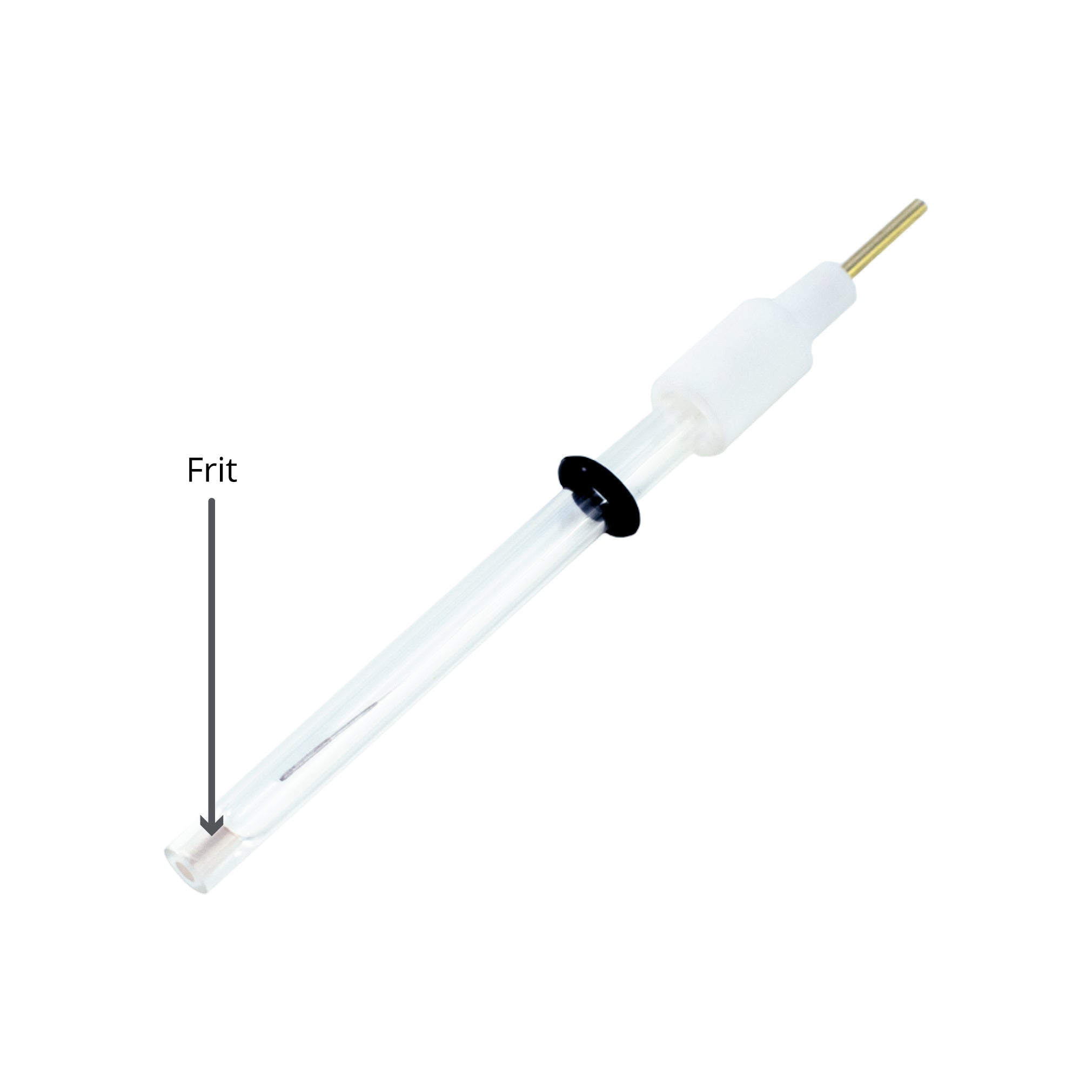
Frits should always be stored submerged in the appropriate solution between uses — for example, Ag/AgCl frits are typically stored in KCl solution. Allowing a frit to dry out in air causes irreversible degradation of the porous membrane, increasing resistance and compromising measurement reliability.
Aqueous vs. Non-Aqueous
The silver/silver chloride (Ag/AgCl) electrode is the most widely used in aqueous electrochemistry due to its excellent stability, ease of handling, and absence of toxic materials. It provides a reliable reference potential determined by the equilibrium between silver metal and silver chloride in the presence of chloride ions.
This system is recommended for aqueous solutions. A common configuration of the reference electrode, like this Ossila Ag/AgCl reference electrode, involves direct contact with a saturated potassium chloride solution (3.0–3.5 M) in distilled water.
However, using a non-aqueous reference cell is vital for any systems where water can contaminate the bulk electrochemical reaction or reactants. In these cases, aqueous reference systems should be avoided as they could leak water into the electrolyte. This could lead to the formation of liquid junction potential if two mediums are naturally less compatible.
For non-aqueous systems, we would recommend the one of the following approaches:
- Use an Ag/Ag⁺ reference electrode in matching electrolyte. The Ossila Ag/Ag⁺ recommends using 0.01M silver nitrate in acetonitrile.
- Use a pseudo-reference electrodes (e.g., Ag wire), calibrated using internal standards such as ferrocene
For particularly sensitive reactions, it’s important to keep the electrode immersed in the same electrolyte in a well-sealed container, with minimum exposure to moisture. For best practices, keep the reference cell in an Ar/N2 filled glovebox or dry box.
Luggin vs. Straight Capillary
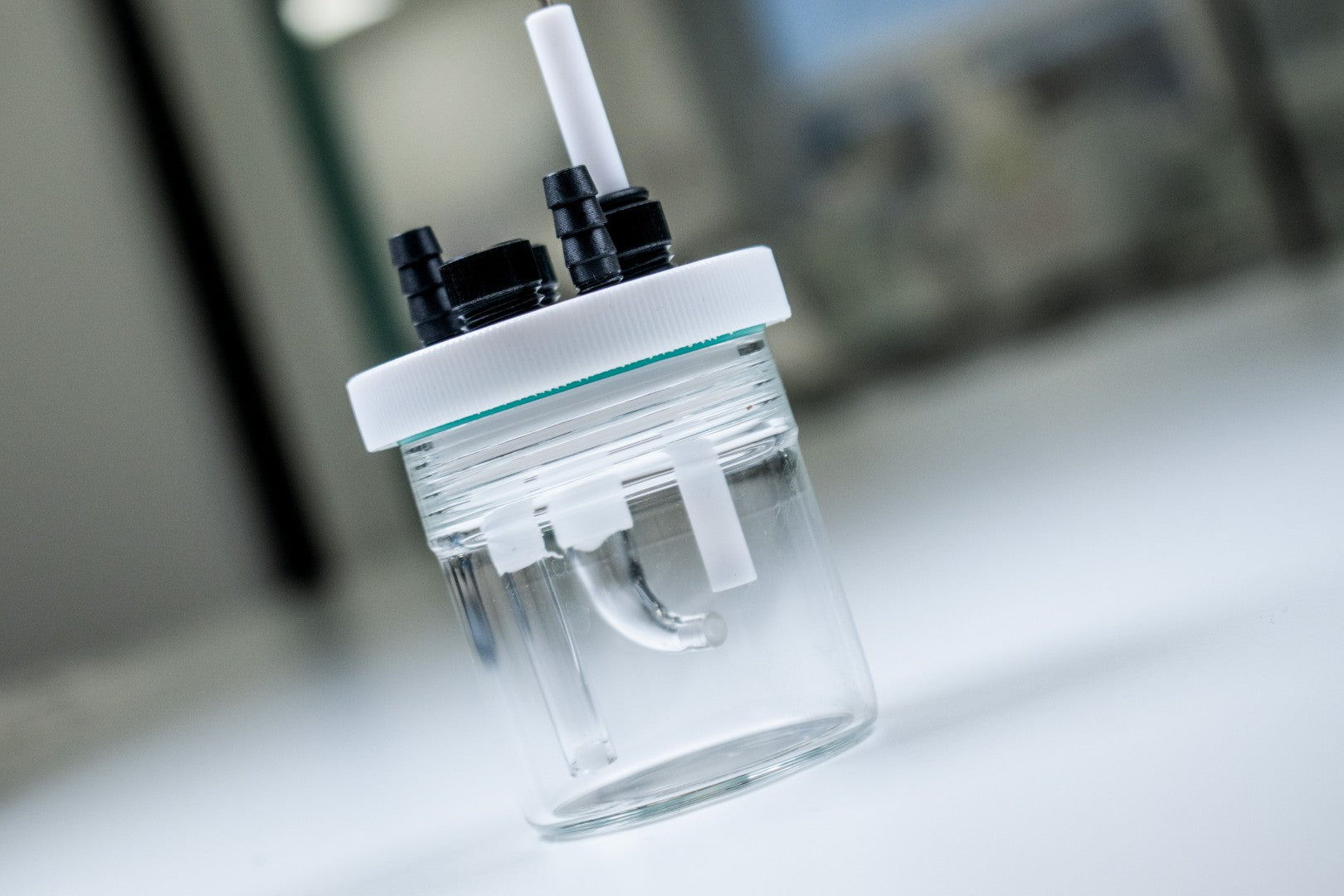
One of the most important qualities of the reference electrode is that it is located as close to the working electrode as possible. Distance between these two electrodes can introduce uncompensated resistance, reducing the accuracy of potential measurements.
In small volume cells, the reference electrode is suspended in a straight capillary with a salt bridge. A Luggin capillary is a curved version of this straight reference cell, where the salt bridge is directed closer to the working electrode. This is useful in electrochemistry cells with larger volumes.
Application-Based Selection Guide
| Reference cell conditions | pH / Solvent | Recommended Setup | Justification |
|---|---|---|---|
| Aqueous (General) | Neutral- moderately Alkaline/ Acidic | Ag/AgCl (3M KCl) | The standard "plug-and-play" electrode for most analytical chemistry. |
| Aqueous (Highly Corrosive) | Highly Acidic (pH < 1) | Not Recommended | Hg/Hg2SO4 is better suited |
| Aqueous (Highly Alkaline) | Highly Basic (pH > 13) | Not Recommended | Hg/HgO is better suited |
| Aprotic / Organic | MeCN, DCM, THF, ACN | Chosen Solvent + Pt Wire | Choose a solvent that is compatible with the electrolyte. |
Other Reference Electrodes
The Saturated Calomel Electrode (SCE) is based on the Hg/Hg₂Cl₂ equilibrium in saturated potassium chloride. This historically served a similar role to silver reference electrodes with highly stable potentials. However, its use has declined in recent years due to the presence of mercury and the increasing environmental and regulatory restrictions associated with it.
Standard Hydrogen Electrode (SHE) is the universal reference used in electrochemistry. This assigns a potential of 0.000 V to the equilibrium between hydrogen gas and protons under standard conditions. While SHE provides the theoretical basis for all electrochemical potential scales, it is rarely used in routine laboratory measurements because it requires continuous hydrogen gas supply, precise pressure control, and specialised experimental setups.
Reversible Hydrogen Electrode (RHE) is the standard used in many areas of electrocatalysis and energy research to measure potentials against. The RHE is conceptually derived from the hydrogen electrode, but the reference potential automatically accounts for the pH of the electrolyte. This is particularly useful when comparing experiments performed under different acid or alkaline conditions.
As a result, potentials measured against practical reference electrodes such as Ag/AgCl are often converted to the RHE scale using appropriate correction factors that include both the intrinsic reference electrode potential and the pH-dependent term derived from the Nernst equation. Reporting results on the RHE scale allows electrochemical reactions involving proton-coupled processes such as hydrogen evolution or oxygen evolution to be compared more meaningfully across different electrolyte environments.
| Electrode | Standard reduction potential / eV |
|---|---|
| Normal Hydrogen Electrode | 0.000 (by definition) [1] |
| Standard Calomel Electrode | 0.242 [1] |
| Ag / Ag+ 0.01 M (usually AgNO3) in CH3CN | Variable dependent on setup [5] |
| Ag/AgCl, KCl(sat. in H2O) * | 0.197 [1] |
It is essential to clearly state the reference electrode used when reporting potentials.
In many fields, potentials are converted to the Reversible Hydrogen Electrode (RHE) scale:

(at 25°C, using 3 M KCl)
Electrode potentials are temperature dependent. The Nernstian slope varies with temperature and is approximately 0.0591 V per pH unit at 25°C (298 K). Changes in temperature can shift peak positions and affect interpretation, particularly in high-precision measurements. If you are operating at a different temperature other than room temperature or your system generates Joule heating due to high current draw, please make sure current conversion coefficients are used.
Differences in electrolyte composition between compartments can create liquid junction potentials, introducing systematic errors. Always make sure to use compatible electrolytes and to use appropriate salt bridges to minimise such issues.
Resources and Support
 What are Electrodes?
An electrode is made from conductive material that can transmit electricity. When an electric current is applied, the electrode facilitates the transfer of electrons, enabling electrical reactions.
Read more... Choosing Working, Reference and Counter Electrodes
Choosing the right electrodes is an important part of innovative electrochemical research. There are several factors to consider when choosing which electrode is best for your application.
Read more... What is a redox reaction?
A redox reaction, also referred to as an oxidation-reduction reaction, involves the loss or gain of electrons. The loss of electrons is called oxidation and the gain of the electrons reduction.
Read more... PEEK vs PTFE
The choice of whether to use PEEK (polyether ether ketone) or PTFE (polytetrafluoroethylene, Teflon) comes down to the conditions of your planned experiments. The key polymer properties to consider are:
Read more...