


Porous Solid Electrolyte (PSE) Reactors


Buy PSE reactors | Choosing a PSE reactor | Applications | Technical Support
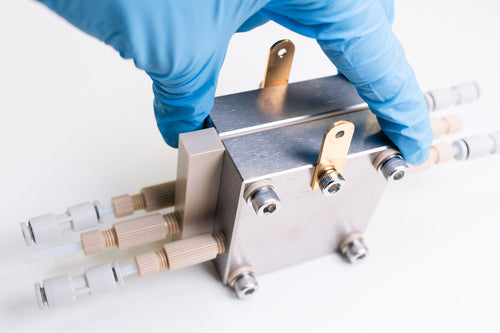
Porous solid electrolyte (PSE) reactors are electrochemical devices that eliminate the liquid catholyte layer entirely. This enables the direct synthesis of high-purity, concentrated liquid chemicals such as formic acid or hydrogen peroxide, straight from gas-phase inputs.
Standard GDE flow cells solve the mass-transport problem for gas-phase reactants. However, the product still ends up diluted in a flowing catholyte stream, mixed with supporting electrolyte salts. Separating that product back out is often the most energy-intensive step in the whole process.
PSE reactors solve this issue: a central porous solid electrolyte channel, typically made from a high-conductivity ion-exchange resin or polymer membrane, replaces the catholyte entirely. Ions generated at the cathode (H+ and HCOO~-, for example) migrate into this central chamber and recombine there, forming a pure, concentrated liquid product that can be swept out using nothing more than deionised water or a gas carrier.
This also addresses a stability problem that limits GDE flow cell operation. Without a bulk liquid catholyte, there's no bulk phase for carbonate salts to precipitate into, so the flooding and salt-build up failures that limit continuous flow cell runs are largely avoided.
Buy Porous Solid Electrolyte Reactors
Related categories: GDE flow cells, MEA electrolyzers, electrochemical cells, electrodes, electrochemistry
Our premier Porous Solid Electrolyte reactor (C2053S1) is engineered for researchers and engineers looking to bypass the mass-transport limits of H-cells, the dilution penalties of standard flow cells, and the carbonate built-up in standard MEA architecture.

| Porous Solid Electrolyte Flow Cell (C2053S1) | |
|---|---|
| Architecture | Three-chamber, zero-gap, central solid electrolyte |
| Channel gap | 1.5 mm |
| Catholyte stream | None, replaced by central solid-electrolyte channel |
| Best for | Direct liquid synthesis (formic acid, H₂O₂) without downstream purification |
| Worth knowing | More setup complexity than a single-channel flow cell; periodic membrane/resin replacement required |
Choosing a PSE Reactor
-
Central Porous Solid Electrolyte Channel
Replaces the liquid catholyte with a solid ion-exchange medium, removing the bulk liquid phase entirely.
-
Zero Catholyte Dilution
Generated ions migrate directly into a separate collection chamber rather than mixing into a flowing electrolyte.
-
Improved Long-Run Stability
Managing pH internally, rather than through a bulk catholyte, reduces the carbonate salt build-up and flooding that limit extended GDE flow cell operation.
-
Advanced Phase Separation
Keeps gas feed and pure liquid products cleanly segregated for optimized mass transport and maximum reaction efficiency.
-
Direct Pure-Product Collection
Product is recombined and collected using only deionised water or a carrier gas, with no downstream separation or distillation needed.
-
Streamlined Scale-Up:
Offers the ideal testing architecture for transition from laboratory-scale catalyst screening to industrial-scale pilot deployment.
PSE Applications
 High-Purity CO2 Reduction (CO2RR): Direct conversion of CO2 into concentrated, electrolyte-free formic acid, acetic acid, or alcohols.Hydrogen Peroxide Electrosynthesis (ORR): Production of pure, localised H2O2 streams via the two-electron oxygen reduction pathway.Electrochemical Separation & Recovery: Capturing and concentrating valuable ions from dilute waste streams without introducing extra chemical solutes.
Technical Support