


Spectroelectrochemical Cells


Buy Spectroelectrochemical Cells | Choose a Spectroelectrochemical Cell | Resources | Get Started with Spectroelectrochemistry | Technical Support
What is a spectroelectrochemical cell?
A spectroelectrochemical cell is a unique design of an electrochemical cell allowing real-time investigation of chemical and structural changes at electrode-electrolyte interfaces by employing spectroscopy techniques such as Raman, UV-Vis and IR. Spectroelectrochemical cells bridge the gap between electrochemical measurement and molecular-level understanding. Where electrochemistry answers what is happening electrically, spectroelectrochemistry reveals why it is happening through real-time, molecular-level insight at the interface where reactions occur. These powerful, specialized instruments combine transparent optical windows with precise electrochemical control, enabling simultaneous spectroscopic and electrochemical characterization of electrode surfaces, interfaces, and electrolytes throughout a live electrochemical experiment.
All cells in this range feature transparent quartz windows for direct laser or light beam access, alongside three-electrode configurations for precise potential and current control. The working, reference, and counter electrodes can be housed in a single chamber, or the reference electrode can be isolated in a separate compartment using a H-cell geometry, reducing cross-contamination and improving measurement accuracy in demanding experiments.
Constructed from chemically inert materials and compatible with aqueous and non-aqueous electrolytes, our spectroelectrochemical cells integrate seamlessly with the Ossila Potentiostat and other standard potentiostat models for complete electrochemical control.
Buy Spectroelectrochemical Cells
Related categories: photoelectrochemical cells, equipment accessories, electrodes, electrochemistry


Choose the Right Spectroelectrochemical Cell
In-Situ Raman Electrochemical Cell
A compact cell designed for real-time Raman spectroscopic monitoring of chemical and morphological changes at the working electrode surface. Compatible with confocal and surface-enhanced Raman spectrometers as well as infrared microscopes, it is widely used for battery research (such as lithium-ion and sodium-ion intercalation, SEI formation, cathode structural changes, and electrolyte decomposition), electrocatalysis, and oxygen reduction reaction intermediate studies.
Gas Diffusion In-situ Raman Electrochemical Cell
A three-chamber cell built around a gas diffusion electrode (GDE) architecture that replicates real fuel cell and electrolyser operating conditions, enabling true operando Raman measurements rather than simplified in situ approximations. Reactant gases can actively feed through the GDE during measurement, while the quartz window above provides unobstructed Raman access to the electrode surface. Purpose-built for CO2 reduction, nitrogen reduction, hydrogen evolution, oxygen reduction, and fuel cell research where realistic operating conditions and real-time interfacial observation are both essential.
UV-Vis Spectroelectrochemical Cell
Cuvette-style cells optimized for UV-Vis spectroelectrochemistry, supporting transparent working electrodes such as ITO, FTO, and platinum mesh that allow optical probing directly through the electrode. Particularly suited to electrochromic material characterization, oxidation-state and bandgap tracking, charge-transfer kinetics, and solution-phase redox studies of organic and organometallic systems.
Resources
Product Help
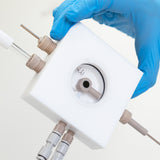 In-situ Raman Electrochemical Cell Assembly
Learn how to assemble the in-situ rama electrochemical cell with an easy-to-follow video and step-by-step instructions.
Read more... Troubleshooting Cyclic Voltammetry and Voltammograms
Cyclic voltammetry is a powerful and versatile electrochemical technique. With modern potentiostats and software packages, the method is relatively straight-forward to perform. Despite this apparent simplicity, there are still a number of things that can go wrong, particularly when setting up the electrochemical cell.
Read more...Theory
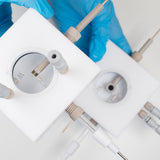 In-Situ Raman Spectroscopy
In-situ Raman spectroscopy is a non-invasive technique which combines electrochemistry and Raman spectroscopy. This technique can probe interactions, product formation and other processes that occur at electrode interfaces in real time.
Read more...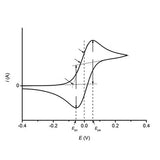 Cyclic Voltammetry Basics, Setup, and Applications
Cyclic voltammetry is an electrochemical technique for measuring the current response of a redox active solution to a linearly cycled potential sweep between two or more set values.
Read more... What is an Electrochemical Cell?
An electrochemical cell is defined as a device that generates electrical energy from chemical reactions or uses electrical energy to drive chemical reactions. The simplest possible electrochemical cell consists of two connected electrodes in an electrolyte solution.
Read more...Get Started with Spectroelectrochemistry
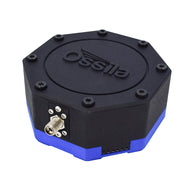
Our standard spectroelectrochemical cells are compatible with the Ossila USB Spectrometer, cuvette holder, and USB light sources. When getting set up for spectro-electrochemical investigations, choose the Ossila USB Spectrometer Kit which includes the essential components at an affordable price.



Technical Support