


In-Situ Raman Spectroscopy
Jump to: What Is In-situ Raman Spectroscopy?
| In-Situ Raman Spectroscopy Cell | Applications | Cell Types | Working Electrodes
HER and Water Splitting | CO2RR | Battery and Metal-Air Systems | Photoelectrochemical Systems | Experimental Tips | Limitations | More Resources
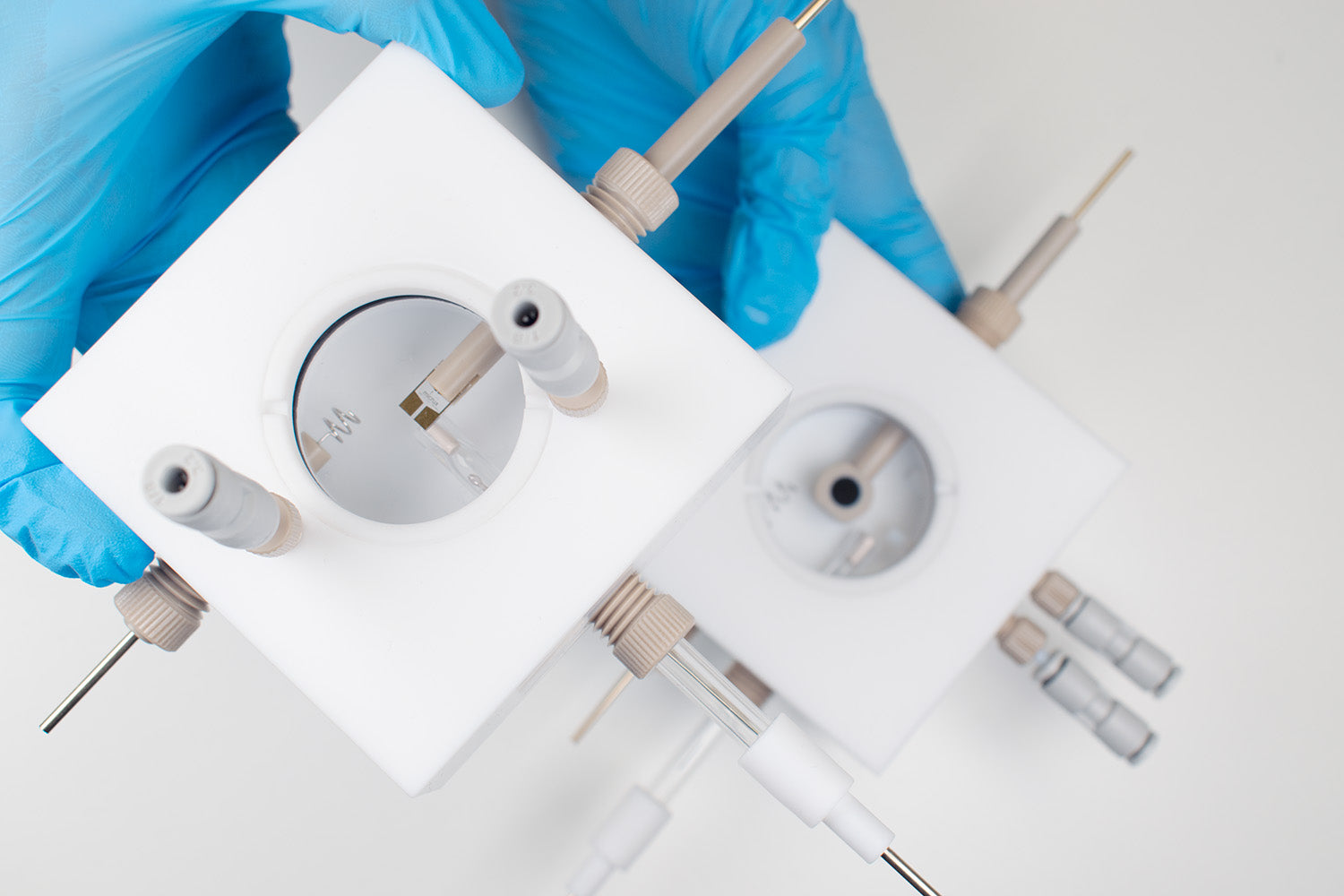
In-situ Raman spectroscopy is a non-invasive technique which combines electrochemistry and Raman spectroscopy. This technique can probe interactions, product formation and other processes that occur at electrode interfaces in real time. Standard ex-situ Raman measurements can only capture the stable end states after an electrochemical process is complete. However, in-situ Raman measurements allow you to observe chemical and structural transformations occurring at the electrode surfaces in real time.
Using in-situ Raman spectroscopy, researchers can find direct relationships between electrochemical performance and surface-level transformations. This is particularly valuable when working with systems where complex interfacial processes determine functionality, including:
- Electrocatalysis (HER, HOR, OER, ORR, CO2RR, NRR)
- Energy storage devices (Li-ion, Na-ion, Zn-ion, Zn-air, Li-O2)
- Photoelectrochemical systems
- Sensing technologies
- Corrosion studies.
Example interactions that can be observed include transient intermediate formation, molecular adsorption, bond rearrangement, and catalyst structural evolution under an applied potential.
Browse Spectroelectrochemistry Equipment


What Is In-situ Raman Spectroscopy?
Electrocatalytic processes occur at highly dynamic solid-liquid or solid-gas interfaces. During electrochemical operation, the catalyst surfaces are continuously evolving, both in structure and oxidation state. Hence, many reaction intermediates exist only transiently at the electrode surface and are often present at extremely low concentrations, making surface-sensitive techniques crucial for identifying atomic-level mechanisms.
Electrochemical measurements observe reactions that occur at electrode-electrolyte interfaces under an applied potential. Here, a potentiostat applies a defined function of voltage or current between electrodes driving chemical processes like oxidation, reduction, ion insertion, and catalytic transformations.
Raman spectroscopy is a non-destructive vibrational characterization technique that probes molecular structure through the inelastic scattering of light. When a laser interacts with a material, a small fraction of scattered photons undergo energy shifts associated with molecular vibrations. This generates a unique spectral fingerprint of chemical bonds, crystal structures, and molecular species.
In-situ electrochemical Raman spectroscopy combines these two techniques into a single system.
Operando spectroscopy is like in-situ spectroscopy, and is gaining popularity. The difference between operando and in-situ spectroscopy lies in the differences in experimental conditions. In-situ experiments are conducted in realistic environmental conditions, but usually the electrode is not performing its desired function. Operando spectroscopy is conducted while the system is actively performing its intended purpose.
In-Situ Raman Spectroscopy Cell

A typical in-situ Raman spectroscopy cell uses a three-electrode configuration consisting of a working electrode, counter electrode, and reference electrode. The cell also has an optically transparent window to allow the transmission of light into and out of the cell.
The working electrode is positioned in this cell and aligned with the objective microscope in a top-illumination geometry. The laser is passed through the optical window and focused on the electrode-electrolyte interface (usually on the working electrode). Any scattered light is collected through the same optical path.
The counter electrode completes the electrochemical circuit, while the reference electrode is positioned close to the working electrode. Often all three electrodes are positioned within the one chamber in a standard in-situ Raman set-up.
While electrochemical control is essential, optical design is often the limiting factor in these cells. The working distance between the objective lens and the electrode, the numerical aperture of the lens, and refractive index mismatches between air, the window, and the electrolyte all influence signal quality and focusing stability.
Fused silica or quartz are commonly used as optical window materials, due to its optical transparency and chemical stability. However, window thickness and refractive index must be carefully considered to avoid focal distortion.
What Can You Use In-Situ Raman Spectroscopy For?
You can use in-situ Raman spectroscopy for tracking structural evolution, phase transitions, and molecular adsorption processes at the electrode-electrolyte interface.
In-situ Raman spectroscopy techniques can be used to:
- Study hydrogen and oxygen evolution reactions (HER/OER), CO2 and nitrogen reduction.
- Identify surface oxides and adsorbed intermediates in fuel cell catalysts.
- In battery research, it can monitor the intercalation/de-intercalation of ions and the formation of the solid electrolyte interphase (SEI).
- Study charge carrier dynamics and surface degradation in photoelectrochemical systems, under the influence of both light and electrical bias. This can provide key information about a catalyst's stability and activity.
Types of In-Situ Raman Spectroscopy Cell
The standard in-situ Raman electrochemical cell has one chamber and are suitable for diffusion-controlled systems and general electrocatalysis.
H-cell configurations separate anodic and cathodic compartments, improving control over reaction environments, while still having an optical window in the working electrode chamber.

Some in-situ Raman cells have a gas-diffusion electrode system. These cells have three separate compartments, one holding the reference and working electrodes, with a separate half-cell holding the counter electrode. This essentially makes the cell act as a H-cell with membrane preventing cross contamination. The final cell is a gas flow chamber. This chamber is exposed to only the working electrode. The gas that drives the reaction (CO2, O2, etc) flows through this portion, reacting with the surface of the working electrode.
These cells are essential for reactions involving gases. Example uses include studying the reaction kinetics at the tri-phase (gas-liquid-solid) interface, such as CO2 reduction, oxygen reduction, and metal-air batteries. The architecture is also compatible with complimentary gas analysis (Ex. GCMS).
Working Electrodes for In-Situ Raman Spectroscopy
The working electrode (WE) is one of the most critical components of an in-situ cell, as it dictates both the electrochemical interface and the Raman scattering efficiency. The choice of WE material and its physical form factor depend on whether your research objective is to monitor bulk structural evolution (e.g., phase changes in a battery anode/ cathode) or interfacial surface chemistry (e.g., identifying reaction intermediates during hydrogen evolution reactions).
Inert carbon-based electrodes are stable and chemically resistant, have a wide electrochemical window and a relatively low, reproducible Raman background. However, because they lack plasmonic properties, they offer no signal enhancement for surface-adsorbed species.
Active transition metals are used as working electrodes when the working electrode is also the reaction catalyst.

To overcome weak Raman scattering, you can use "SERS-active" metals, where SERS stands for Surface-Enhanced Raman Spectroscopy. These surfaces have nanoscale roughness or specific feature morphologies (like dendrites or nanoparticles) that excite localized surface plasmon resonances (LSPR). This can enhance the Raman spectroscopy signal by several orders of magnitude. However, traditional SERS is restricted to using specific materials - Au, Ag, and Cu.
Shell-Isolated Nanoparticle-Enhanced Raman Spectroscopy (SHINERS) overcomes this limitation by using "smart dust", which is plasmonic nanoparticles (usually Au or Ag) encapsulated in an ultra-thin, chemically inert shell. These "SHINERS" can be spread over any non-plasmonic surface, such as urinary or binary heterogeneous catalysts. The shell prevents the plasmonic core from participating in the electrochemical reaction while allowing the enhanced electromagnetic field to reach the underlying catalyst surface.
| Electrode Types | Material | Applications |
|---|---|---|
| Inert Carbon-Based Electrodes | Glassy carbon, boron-doped diamond and carbon paper | Analyzing battery materials, conductive polymers, and dispersed catalysts |
| Active Transition Metal Electrodes | Polycrystalline or single-crystal metal electrodes (e.g., Pt, Cu, Ni, Au) | For tracking oxidation states and surface-bound species during hydrogen evolution reactions (HER), oxygen evolution reactions (OER), and CO2 reduction reactions (CO2RR) |
| SERS-Active Metals | Nanostructured Gold (Au), Silver (Ag), or Copper (Cu) | For the detection of low-coverage intermediates such as *OH, *OOH, and *CO |
| SHINERS | Au or Ag nanoparticles encased in Al2O3 or SiO2 shell (2-4 nm thick) | Used to identify the peroxo (*O22-) and superoxol (*O2-) species on electrode surfaces during the Oxygen Reduction Reaction (ORR). |
HER and Water Splitting Reactions
Hydrogen Evolution/Oxidation Reactions (HER/HOR) are widely studied to investigate interfacial water dissociation, specific hydroxyl (*OH) adsorption, and potential-dependent catalyst restructuring. Measuring oxygen electrocatalysis (ORR/OER) is essential for fuel cells and electrolyzers. Both HER and ORR can be directly probed using Raman spectroscopy, which is capable of tracking surface oxidation states and identifying surface-bound intermediates under operating conditions.
Operando Raman measurements also allow monitoring of metal-oxygen bonds, the formation of active amorphous oxyhydroxide phases (e.g., MOOH), and adsorbed oxygen intermediates (OOH*, O*) during these processes.
CO2RR Operando / In-situ Raman Spectroscopy
Carbon dioxide reduction reaction (CO2RR) studies represent one of the fastest-growing applications of in-situ electrochemical Raman analysis.
- Surface-enhanced Raman scattering (SERS) has been important for investigating the conversion of CO2 into hydrocarbons.
- Additionally, operando spectroscopy provides critical insights into adsorbed CO species (bridged vs. linear), surface-bound carbonaceous intermediates, electrolyte cation effects, and catalyst reconstruction (e.g., Cu oxidation/reduction) under applied potential.
- Beyond these, in-situ Raman is crucial for monitoring emerging reactions. In nitrogen reduction (NRR) and biomass upgrading, for example, identifying surface intermediates is needed to solve reaction pathway bottlenecks.
Advances in SERS and Shell-Isolated Nanoparticle-Enhanced Raman Spectroscopy (SHINERS) continues to expand the sensitivity and application of these techniques into non-plasmonic materials.
In electrocatalysis, you must monitor two distinct regions simultaneously to understand the full picture: Low Frequency/ Lattice Region (400 cm-1) and High Frequency region (1000-4000 cm-1). If you are tracking the phase or oxidation level changes of the catalysts, most of the Raman peaks appear in the Lattice region. The Raman peaks related to molecular intermediates, such as C-O and O-H stretching related to CO2RR and water splitting studies, appear in the high frequency region.
If your catalyst material background is too high, try shifting from a 532 nm laser to 785 nm or 1064 nm. While this lowers the signal-to-noise ratio, it prevents the detector from saturating with background light.
Battery and Metal-Air Systems
Raman spectroelectrochemistry can provide in-depth knowledge on the structural and chemical transformations that occur during battery operation. This includes, but is not limited to, information about electrolyte degradation, parasitic reactions, ion intercalation/ deintercalation, and interfacial reactions.
Standard In-situ Raman spectroscopy is widely used in lithium-ion and sodium-ion batteries to monitor intercalation and deintercalation processes. In graphite systems, it tracks staging behavior and disorder evolution, while in cathode materials it reveals phase transitions and lattice changes. It is also used in SiOx anodes, transition metal oxides, and layered cathodes such as LFP, NMC, and LCO.

In lithium-oxygen (LOB) and zinc-air batteries (ZAB), Raman spectroscopy is particularly powerful because many discharge products are Raman-active. Lithium peroxide (Li2O2) and ZnO can be directly detected, enabling study of discharge product formation and decomposition.
Gas diffusion electrode architectures are especially important in these systems due to oxygen transport requirements. Ossila gas diffusion Raman cell architecture may also support operando investigations of oxygen-involved electrochemical systems such as Li-O2 and metal-air chemistries, where controlled gas transport and optical access to the gas-liquid-solid interface are important, as illustrated in the figure.
Further mechanistic and diagnostic information can be acquired by correlating Raman signatures with key battery parameters as the cyclability, rate performances, and capacity fading.
Photoelectrochemical Systems
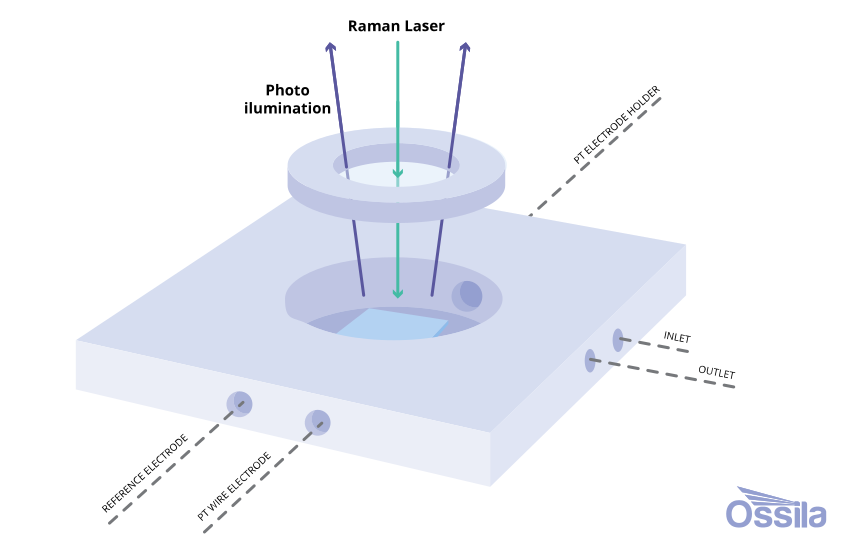
In photoelectrochemical systems, in-situ Raman spectroscopy enables observation of light-driven interfacial processes under applied bias. Semiconductor electrodes such as TiO2, Fe2O3, and BiVO4 generate electron-hole pairs under illumination, which drive surface reactions.
Raman spectroscopy can track light-induced changes in surface chemistry, adsorption behavior, and lattice structure, particularly in water splitting systems and oxygen evolution reactions.
Transparent conductive substrates such as FTO and ITO are commonly used to allow simultaneous optical access and electrical contact, and the photo light directed to the cell at an angle to avoid spectral interference and to compatible with the microscopic configuration.
Unlike in other cases, using SHINERS in a photoelectrochemical (PEC) in situ Raman Cell may introduce several complex scenarios such as photo-induced parasitic reactions, physical shielding and shadowing effects, and pinholes and electrochemical leakage. Hence you had better avoid SHINER enhancements during PEC in situ Raman Electrochemical studies.
Reproducibility and Experimental Considerations
Reproducibility of your experiment depends on consistent electrode preparation, stable optical alignment, and controlled electrochemical conditioning. Variations in nanostructure morphology, hotspot distribution, or focus position can significantly affect signal reliability.
Please note that environmental control is critical for air- and moisture-sensitive systems as batteries and always ensure the purity of the gas purge during gas reduction studies.
Overall, In-situ electrochemical Raman spectroscopy connects electrochemical performance with molecular-scale structure across electrocatalysis, energy storage, metal-air systems, and Photoelectrochemistry, further extending to corrosion and electrochemical sensor analysis. Its success depends on careful alignment of electrode design, optical configuration, and cell architecture to the target application.
For confocal Raman systems, objective selection directly impacts data quality. A long working distance objective with moderate numerical aperture (NA 0.4-0.6) and a correction collar is recommended to accommodate the combined physical path of the optical window and liquid column, which is typically 2–3 mm in standard in situ cell configurations. The correction collar should be set to the physical window thickness (commonly 0.5–2 mm depending on cell design) to compensate for spherical aberration introduced by the window material. Although refractive index compression through the window (ex. n ≈ 1.45 for quartz) and aqueous electrolyte (n ≈ 1.33) reduces the effective optical path to roughly 1.5-2.0 mm against a physical path of 2–3 mm. However the full physical working distance clearance remains necessary for practical cell compatibility. During the studies of carboneous materials, 532 nm excitation is comonly used. However, refractive index mismatches are particularly consequential, and careful collar adjustment is essential to preserve both signal intensity and spatial resolution at the electrode surface, and recommend to swithch to 785 nm laser where possible.
Note: Because the methodologies for most in situ and operando Raman electrochemical studies remain in the early stages of development, technical standards are continuously changing. We actively monitor these advancements to ensure our content provides the most up-to-date and accurate insights possible.
Limitations
Despite its versatility, there are some inherent challenges the technique faces that can complicate data acquisition and interpretation.
| Issue | Explanation | Considerations |
|---|---|---|
| Low Signal Intensity | Raman scattering is fundamentally a weak process (roughly 1 in 107 photons). Therefore, many surface species exist below the detection limit, that are not measured by this technique. | Can use Surface-Enhanced Raman Spectroscopy (SERS) or Shell-Isolated Nanoparticle-Enhanced Raman Spectroscopy (SHINERS) strategies to amplify the local electromagnetic field. |
| Interference from fluorescence | Other emissions such as fluorescence can saturate the detector, masking vibrational signals. | Technique mainly works with Raman active, non-fluorescent material. |
| Spatial Resolution | Raman spectroscopy can only study a small area of the probe. Will not capture the full picture of what’s happening at electrode. | Repeated measurements or examining multiple spots can help overcome this. |
| Temporal Resolution | Integration time limits the rate at which reactions can be studied. Can be an issue with quick processes such as ultra-fast transient states. | The reactions an in-situ Raman electrochemistry set up can study are fundamentally limited by integration time. This should be considered in the experimental design of a study. |
| Data Analysis | There is some interpretation required to process Raman cell data. Raman provides vibrational fingerprints rather than direct elemental identification. | Assignment of peaks requires isotopic labeling, such as using D2O comparison with reference standards. Alternatively, you can use Density Functional Theory (DFT) calculations to correlate specific peaks with molecular structures. |
In-Situ Raman Spectroscopy Cells and Accessories
Read More
 In-situ Raman Electrochemical Cell Assembly
Learn how to assemble the in-situ rama electrochemical cell with an easy-to-follow video and step-by-step instructions.
Read more...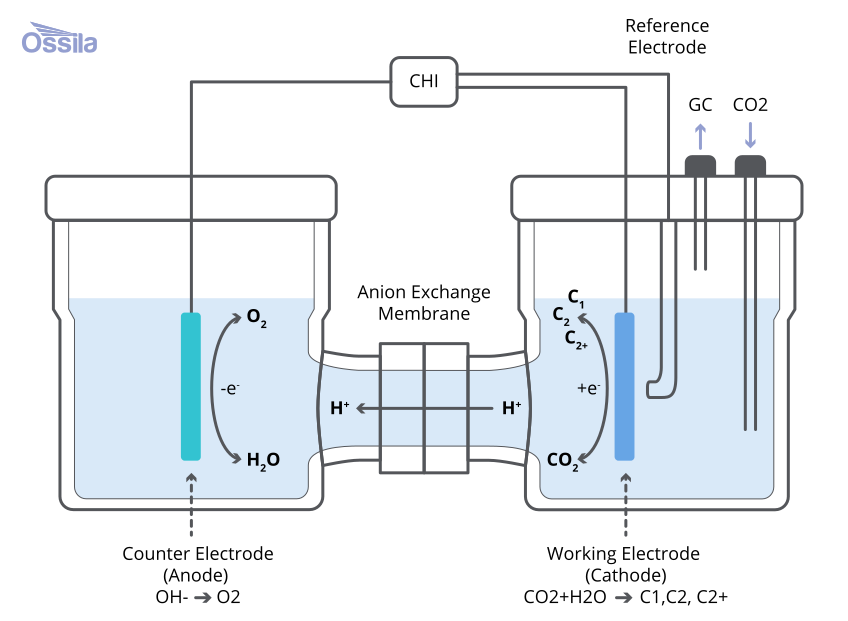 CO2 Reduction (CO2RR)
As investment in carbon capture technologies continues to grow, increasing attention is being paid to carbon utilization. Namely, how are we going to reuse this carbon to produce useful products? CO2 reduction presents a way of using this carbon to produce useful compounds used in fuel and chemical feedstock.
Read more...References
- Insights into electrocatalysis through in situ electrochemical surface-enhanced..., X.M. Lin et al., eScience (2025)
- Utilizing in Situ Electrochemical SHINERS for Oxygen Reduction..., T.A. Galloway & L.J. Hardwick, The Journal of Physical Chemistry Letters (2016)
- In Situ Raman Characterizations for Enhanced Understandings on..., Z. Liu, N. Zhang & Y. Xiong, The Journal of Physical Chemistry C (2024)
- Raman Spectroelectrochemistry for Batteries: Real-Time Insights into Electrochemical..., P. Panneerselvam, S-Y Lee & S.-J. Park, ACS Nano (2026)
Contributing Authors
Written by
Product Development Electrochemist
Graphics by
Graphic Designer