


CO2 Reduction (CO2RR)
Jump to: CO2 Reduction Reactions | Cell Design | Catalyst Materials | Electrolyte Cations | Reactions Table
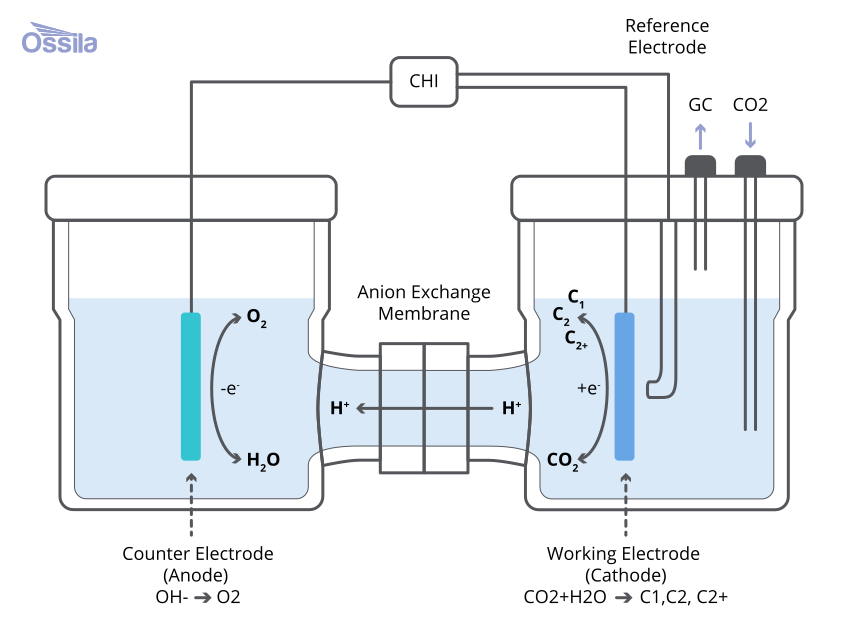
As investment in carbon capture technologies continues to grow, increasing attention is being paid to carbon utilization. Namely, how are we going to reuse this carbon to produce useful products? CO2 reduction presents a way of using this carbon to produce useful compounds used in fuel and chemical feedstock.
Electrochemical carbon dioxide reduction reactions (CO2RR) uses electrical energy to drive the reduction of CO2 in an aqueous or solid-state electrolyte environment. The process occurs at the cathode, where CO2 molecules accept electrons and protons to form products such as carbon monoxide (CO), formate/formic acid (HCOOH), ethylene (C2H4), or ethanol (C2H5OH). Simultaneously, an oxygen evolution reaction (OER) occurs at the anode to balance the charge.
In order to be commercially attractive, it is important that CO2 reduction is not extremely costly. This economic viability relies heavily on three core parameters
- Faradaic Efficiency (FE, selectivity toward the target molecule)
- Overpotential (energy efficiency)
- Partial current density (reaction rate)
This article introduces the science underpinning electrochemical CO2 reduction: how and why CO2 is reduced, what products are accessible, and how catalyst choice and electrolyzer design affects selectivity and efficiency.
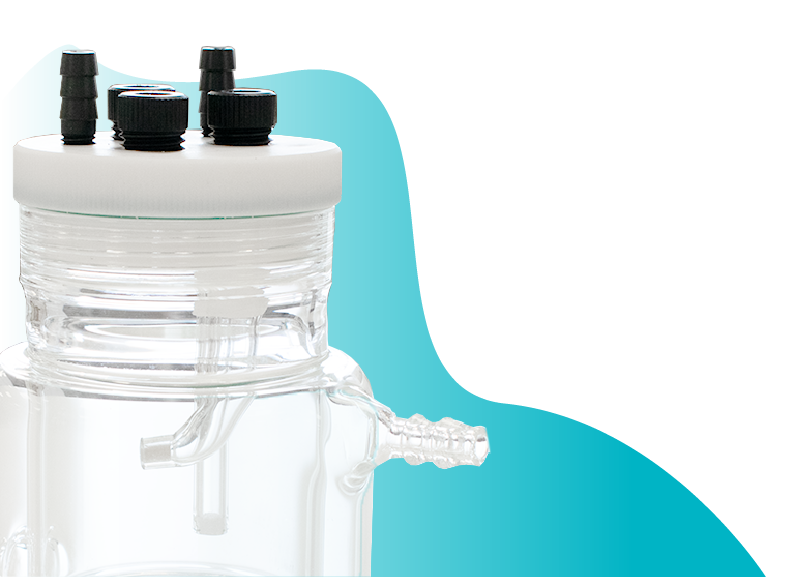
Electrochemical Cells For CO2RR
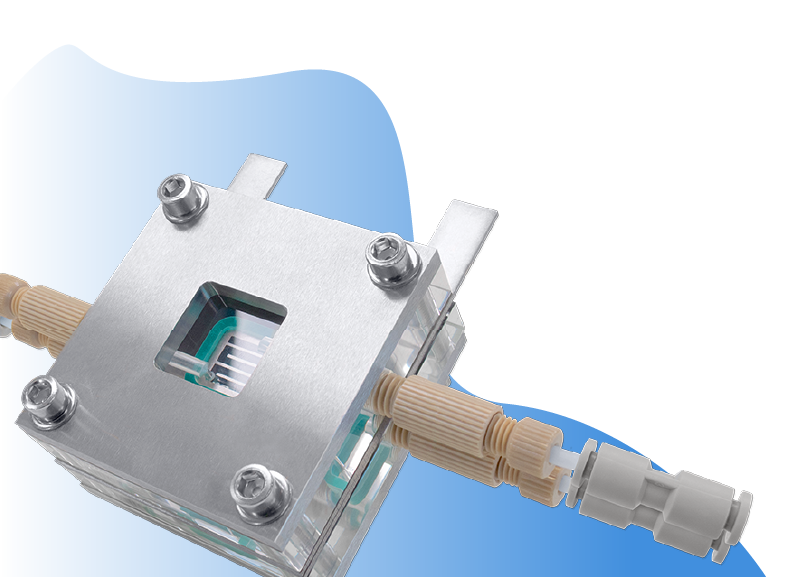
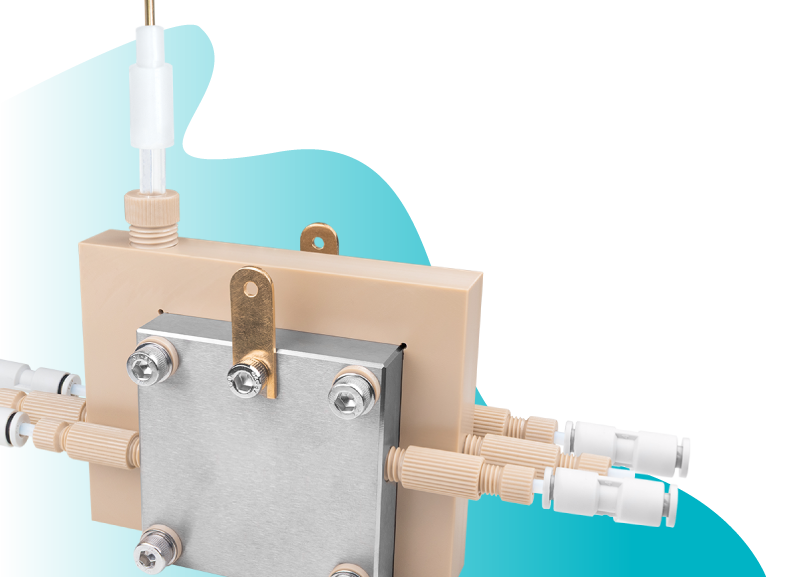
GDE Flow Cells
Gas Diffusion Electrode Flow Cells
Explore our range in Gas Diffusion Electrode Flow Cells
CO2 Reduction Reactions and Products
In all CO2RR cell configurations, the reactor consists of a cathode (where CO2 reduction occurs), an anode (where oxygen evolution occurs), and an optional reference electrode. Hydrogen Evolution Reaction (HER) competes with CO2RR at the cathode throughout. Therefore, suppressing HER without eliminating CO2RR activity is a central challenge.
The intrinsic stability of the linear CO2 molecule makes CO2RR energy-intensive. The initial activation step that forms the radical anion intermediate (*CO2⁻) requires significant energy. This makes catalyst identity and local reaction environment crucial for successful reductions.
Additionally, CO2RR involves complex, multi-electron and multi-proton transfer pathways, and closely spaced thermodynamic reduction potentials mean CO2 is frequently reduced to a mixture of products rather than a single compound.
The most common products are known as 2-electron products. These include CO and formate or formic acid. Thermodynamically and kinetically, these are the most favorable products and are widely used as baseline targets for new cell validation.
CO2 is reduced to CO via this reaction:

And CO2 is reduced to formate via the following reaction:

CO2RR can also produce multi-electron products such as methanol, ethanol, methane and ethylene. These products are highly desirable but complex, demanding precise local pH control. It also requires high concentrations of adsorbed CO intermediates at the catalyst–electrolyte boundary for C–C coupling to compete with desorption. Producing the specific CO2 product you want, requires careful control of the reactions that are occuring. Both catalyst material and cell design can help optimize these stages.
It is also important that production of each of these products through CO2RR can compete both economically and achieves comparible yields as the way they are currently produced.

| Product | Traditional Production Method | Equation |
|---|---|---|
| Formic Acid | Methyl formate hydrolysis |
  |
| Carbon Monoxide | Coal Gasification |  |
| Methanol | Syngas Conversion |  |
| Methane | Major Component of Natural Gas | |
| Ethylene | Steam Cracking |  |
| Ethanol | Ethylene hydration |  |
CO2RR Electrolyzer Design
Breakthrough catalyst formulations show excellent selectivity at low overpotentials under laboratory conditions. However, their performances are limited at larger scales, due to poor electrolyzer construction. This highlights that the electrochemical cell configuration also governs reaction rate, energy efficiency, and stability, not just catalyst chemistry alone.
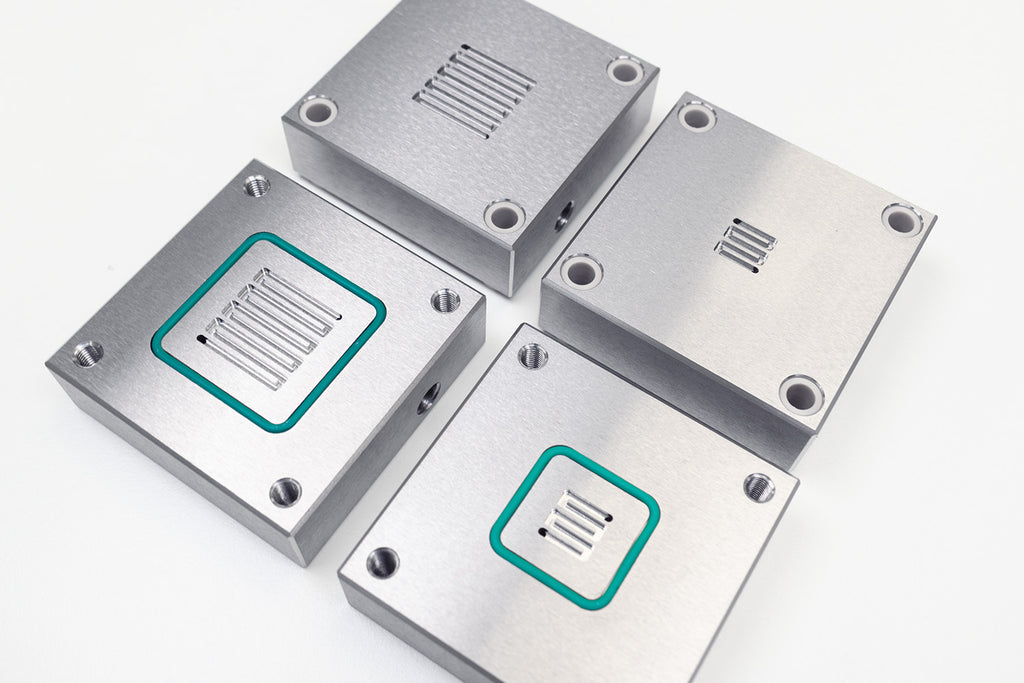
Currently, electrochemical CO2 reduction to carbon products cannot yet compete with alternative routes such as traditional fossil fuel-based processes. This is due to high cell potentials and low single-pass conversion efficiency associated with CO2RR. Low product yield, catalyst deactivation, flooding, and sluggish anodic reactions are critical bottlenecks at pilot scale, all of which have hardware rather than catalyst origins. These are all issues that current CO2RR research is trying to overcome.
Catalyst Materials and Selectivity
The yield of CO2RR is not determined by thermodynamics alone. Catalyst identity, surface morphology, local pH, electrolyte cation, and applied potential all impact the reaction. Understanding these levers is part of the challenge of CO2RR catalyst design.
Choosing the right catalyst is an important part of tuning your product yield in CO2RR. It is important these materials have the right selectivity and binding energy to increase yield of the target product.
Transition Metal Catalysts for CO production
A useful way to organize and select catalysts is according to CO binding energy. Metals like gold and silver bind weakly to CO, desorbing it before further reductions can occur. Zinc also has a low binding energy for CO, although it has reduced selectivity compared to silver and gold. This makes these metals intrinsically selective for the 2-electron CO products.
Silver performs best in neutral-to-alkaline KHCO3 or KOH electrolytes at −0.7 to −1.0 V vs RHE, while gold achieves comparable selectivity even in mildly acidic sulfate electrolyte. Zinc offers a more earth-abundant alternative but with lower selectivity and higher sensitivity to catalyst morphology.
Post-Transition Metal Catalysts for Formate & Formic Acid
Post-transition metal catalysts are an attractive option for formate and formic acid production. These bind more strongly to oxygen than carbon, preferentially stabilizing the precursors that lead to formate and formic acid, rather than other carbon-based products.
Bismuth is the benchmark catalyst for formate production. Nanostructured Bi and oxide-derived Bi achieve Faradaic efficiencies above 90% across a remarkably wide potential window (~1-100 mV). Bismuth-based GDEs have demonstrated near-100% FE at 300 mA/cm2 in flow cell configurations.
An alternative material is tin, which remains widely studied due to its abundance. However, its selectivity and stability fall consistently below bismuth.
Indium occupies a middle ground with excellent H-cell selectivity, scalable to 300 mA/cm2 in alkaline flow cells.
Copper Catalysts for Multi-Carbon Products
Copper is the only heterogeneous catalyst capable of producing multi-carbon products with meaningful efficiency. This efficiency arises from an intermediate CO binding energy that allows adsorbed CO to couple before desorbing. Exactly which products that copper catalyzes in CO2 reduction is largely dependent on environmental conditions and external potential:
- At moderate potentials (~ -1.0 V vs RHE) in neutral KHCO3, Cu produces a complex mixture of CO, formate, and C1-C2 hydrocarbons.
- However, alkaline KOH strongly suppresses methane production and HER, redirecting selectivity toward ethylene.
- Methane is favoured beyond −1.1 V, where high proton availability suppresses C–C coupling.
- Some of the copper microstructures have achieved methane Faradaic efficiencies >85% by modifying CO hydrogenation rates at the surface boundaries.
Electrolyte Cations

Cation identity acts as an independent selectivity lever on an electrode. In particular, the production of C2+ products like alcohol and C2H4 is dramatically enhanced with increasing the size of cations in electrolytes (Li+ < Na+ < K+ < Cs+). However, the exact mechanism that causes this effect isn’t well understood.
One theory is that larger, weakly-hydrated cations (K+, Cs+) accumulate at the outer Helmholtz plane (OHP). This inhibits the HER kinetics while stabilizing CO dimer intermediates.
However, alternative hypotheses suggest that larger cations have enhanced buffer compatibility or act as cation hydrolysis.
These electrostatic and buffering explanations aren't fully reconciled, and the exact mechanism remains debated. Despite this, the cation effect can be utilized to control CO2 products selectivity. For example, larger cations facilitate the production of ethylene over methane at moderate potentials. At very negative potentials, methane dominates regardless of cation identity.
Advanced Catalyst Engineering
Beyond microenvironment control, several parallel strategies are reshaping selectivity understanding. Surface and facet engineering has established that crystal orientation of a catalyst is mechanistically determinative. For example, on copper: Cu(100) preferentially produces ethylene, Cu(111) favours methane, Cu(110) is associated with ethanol, and interfacial sites between facets outperform either surface for C-C coupling. Chalcogenide and mixed-anion catalysts as copper sulfides, selenides, and phosphides introduce a further dimension where in-situ surface restructuring generates active configurations inaccessible in the as-synthesised material.
Bimetallic tandem architectures (particularly Cu-Ag systems) physically separate CO generation from C-C coupling across two catalytic domains, enabling C2+ FEs above 70% that neither metal achieves independently. Complementing these experimental directions, machine learning trained on DFT-computed binding energies and reaction intermediate descriptors is accelerating candidate identification across vast material spaces well beyond what trial-and-error screening can achieve. Across all directions, selectivity is increasingly treated as a systems-level property of catalyst structure, local environment, and cell architecture in combination.
Reduction Reaction Tables
There are specific conditions suited to producing each CO2 product including catalyst, electrolyte cell and ideal potential. Some of these are listed in the table below.
| Product | Catalyst | Potential (vs RHE) | Electrolyte | Cell Type | Key Conditions and Notes | Confidence |
|---|---|---|---|---|---|---|
| CO | Ag (nanostructured/ defect-rich) | -0.7 to -1.0 V | 0.5–1 M KHCO3 or KOH | H-cell / GDE |
FE >90% routinely. Defect-rich Ag reaches 93.5% at −0.8 V. At >200 mA/cm2 in GDE, CO2 availability becomes the limiting factor. Alkaline pH suppresses HER. |
High |
| CO | Ag (nanostructured/ rough) | -0.4 to -0.8 V | 0.5 M KHCO3 or ph 2-4 sulfate | H-cell / GDE |
FE 80–98%. Weakly hydrated cations (Cs⁺, K⁺) critical in acid. Lowest onset potential of any metal CO catalyst. |
High |
| CO | Zn (nanostructured) | -0.9 to -1.1 V | 0.5 M KHCO3 | H-cell |
FE 60–80%. Sensitive to morphology - dendrites and hexagonal platelets perform best. |
Medium |
| CO | Ag SAC (Ag–N on carbon) | -0.7 to -0.9 V | KHCO3 | GDE flow cell |
Emerging. 100 mA/cm² with extended stability. *COOH confirmed by DFT. MEA-compatible format. |
Medium |
| Formate | Bi (nanofoam / oxide-derived) | −0.6 to −1.0 V | 0.5 M KHCO3 | H-cell / GDE |
Best-in-class. FE >90% over ~1,100 mV window. Bi-GDE ~100% FE at 300 mA/cm². *OOCH pathway. |
High |
| Formate | Sn (nanosheets / nanorods) | −0.9 to −1.2 V | 0.1–0.5 M KHCO3 | H-cell / GDE |
FE up to 94% at −1.09 V. KHCO3 acts as CO2 reservoir. Nanostructure essential over bulk Sn. |
High |
| Formate | In / In2O3 (carbon-supported) | −0.9 to −1.2 V | 0.5 M KHCO3 / 1 M KOH | H-cell / GDE |
FE ~90% in H-cell. Scales to 300 mA/cm2 in KOH flow cell. Activity below Bi at high j. |
Medium |
| Formate | In–Bi alloy | −1.6 V vs Ag/AgCl | 0.5 M KHCO3 | H-cell |
FE 96.3%. In sites promote *OOCH Suppress *H. Stability >60 h above 90% FE. |
Medium |
| Ethylene | Cu (oxide-derived / Cu2O) | −0.9 to −1.1 V | 0.1 M KHCO3 | H-cell |
FE 34–39% at −0.99 V. Cu2O reduces to active Cu⁰ in situ. C2H4/CH4 ratio up to ~100. |
High |
| Ethylene | Cu NPs, alkaline GDE | −0.58 V | 1–5.5 M KOH | GDE / MEA |
j(C2H4) >150 mA/cm2. 5.5 M KOH: 60% C2H4 + 81% total C2 FE at 500 mA/cm2. |
High |
| Methane | Cu (polycrystalline) | −1.1 to −1.4 V | 0.1 M KHCO3 | H-cell |
FE peaks 35–43% at −1.2 to −1.3 V. Competes with H₂ at extreme potentials. |
High |
| Methane | Nanotwinned Cu | −1.0 to −1.3 V | 0.1 M KHCO3 | H-cell |
FE 86.1% - highest reported for CH4. Twin boundaries modify *CO hydrogenation rate. |
Medium |
| Acetate | Cu (amine-dendrimer) | −0.97 V | 1 M KOH | GDE flow cell |
FE 47%, partial j 202 mA/cm2. Amine network raises local pH and *CO coverage simultaneously. |
Medium |
Note: FE = Faradaic Efficiency; j = current density; SAC = single-atom catalyst; HER = hydrogen evolution reaction; RHE = reversible hydrogen electrode. Confidence ratings reflect reproducibility across independent laboratories.
Learn More
 Electrochemical CO2 Reduction: Cells and Membranes
Electrochemical CO2 reduction has moved decisively beyond proof-of-concept. As by mid-2026, a growing number of companies and national laboratories are operating continuous pilot-scale CO2RR systems, and the field has developed a reasonably clear picture of what needs to be solved at each level: catalyst, cell, stack, and system, before commercial deployment becomes viable.
Read more...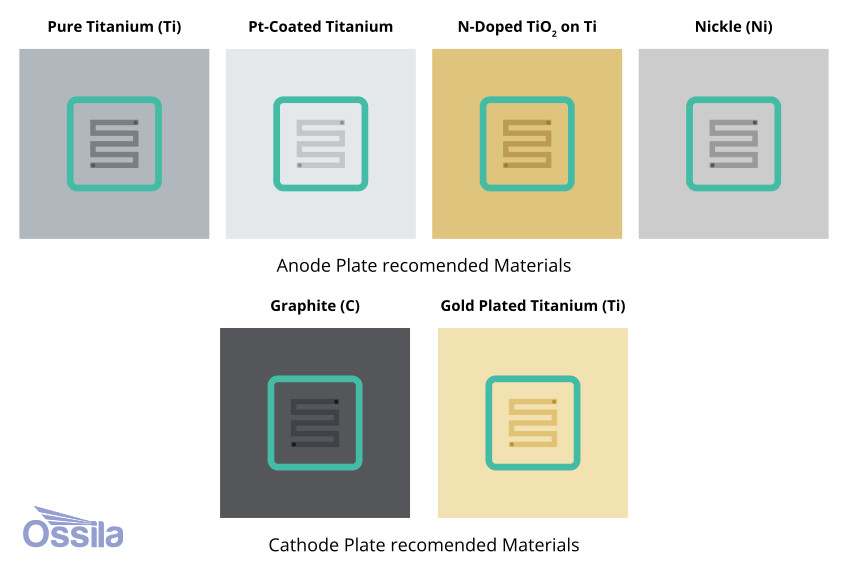 Troubleshooting CO2RR
Practical hardware decisions determine whether a CO2RR electrolyzer operates reliably at elevated current density. These include flow field plate material selection, flow field geometry, and the operational failure modes such as salt precipitation, GDE flooding, membrane degradation, and catalyst contamination that account for most lab-to-scale-up failures.
Read more...Contributing Authors
Written by
Product Development Electrochemist
Videography by
Graphic Designer