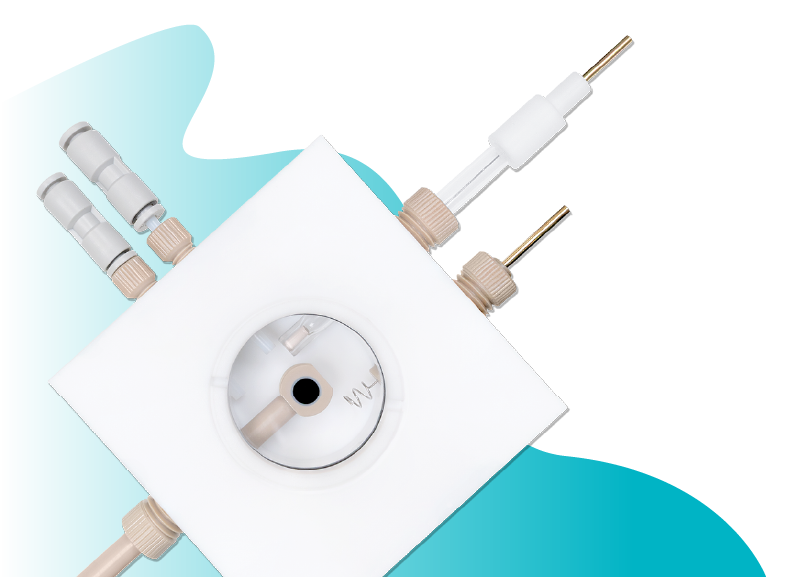
PTFE MEA and GDE Gasket
Pack of Five PTFE Gaskets for MEA and GDE Flow Cells
Reliable airtight sealing while securing electrode materials
Specifications | Gallery | Literature | Related Products | Technical Support
Chemically-inert PTFE gaskets designed for membrane electrode assembly (MEA) electrolyzers and gas diffusion electrode (GDE) flow cells. They provide sealing and containment as a leak barrier and electrical insulator with precise mechanical compression control. Available in various thicknesses and sizes, PTFE gaskets adjust the channel thickness in MEA and GDE which directly controls ohmic resistance and concentration boundary layer behaviour. A thinner gasket reduces the distance between the cathode and anode to drop the ohmic resistance, or vice versa.
PTFE gaskets are inert to reactant gases, acids, and alkaline environments, though there are degradable in strong acid or alkaline at elevated temperatures through prolonged uses. The gaskets maintain gas- and liquid-tight seals under variable pressures and temperatures up to 260 °C, and act as a mechanical stop or shim to prevent over-compression and physical damage to the fragile MEA and GDE. PTFE gaskets also prevent short circuits between bipolar plates due to the high dielectric strength.

Wide pH Stability
Suitable for many electrolyzers
including PEM, AEM, and BPM

Low Gas Permeability
Supports accurate gas-evolution tracking

Compression Control
Safe-guard your electrodes from
over-compression

Precision-Cut Gasket
Best suited for Ossila Electrolyzers
and GFE Flow Cells
Specifications
| Material | PTFE |
|---|---|
| Maximum Operating Temperature | 260 °C |
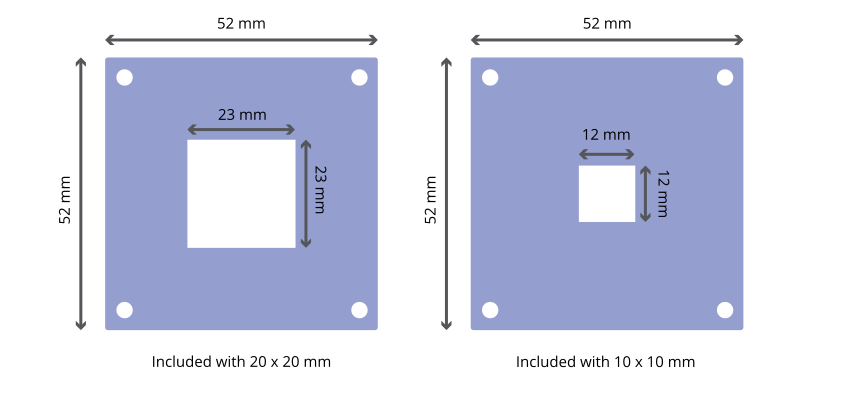
| Overall Dimensions | 52 mm x 52 mm |
| Available Window Dimensions | 12 mm x 12 mm, 23 mm x 23 mm |
| Pack Size | 5 |
Product Gallery


Literature and Reviews
- Y. Doh et al. (2025), Flooding-resistant gas diffusion electrode design for MEA-type CO2 electrolyzer, J. CO2 Util., 98, 103155; DOI: 10.1016/j.jcou.2025.103155.
- M. Zhang et al. (2026), Surface-immobilized cross-linking tetraalkylammonium cations networks mitigate hydrogen evolution for pure acidic CO2 reduction in proton-exchange membrane electrolyzers, J. Energy Chem., 112, 90-96; DOI: 10.1016/j.jechem.2025.08.050.
- Y. Wang et al. (2026), Strongly-Anchored Ionomer-Free Anode Catalyst Layer Fabricated via Joule Heating Achieves Efficient Electron/Mass Transfer for Acidic Water Electrolysis, Carbon Energy, e70330; DOI: doi.org/10.1002/cey2.70330.