Dual Channel GDE Flow Cell
Dual Flow Chambers for Independent Anolyte & Catholyte Control
Corrosion-resistant cell for asymmetric electrolysis in CO2RR, ORR, and NRR
Specifications | In the Box | Gallery | Literature | Related Products | Technical Support
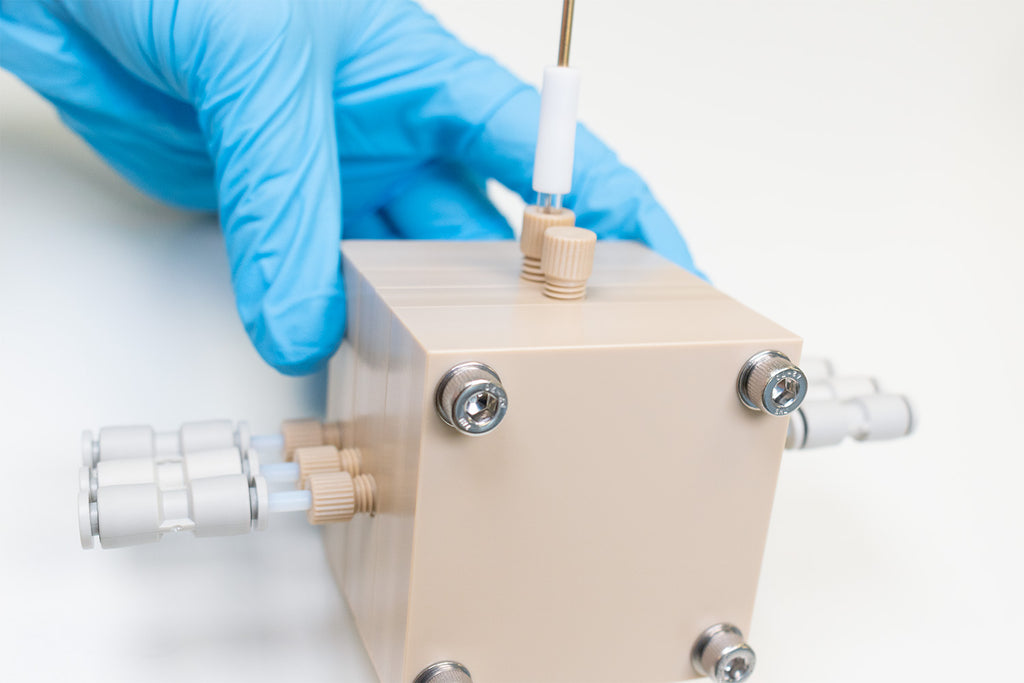
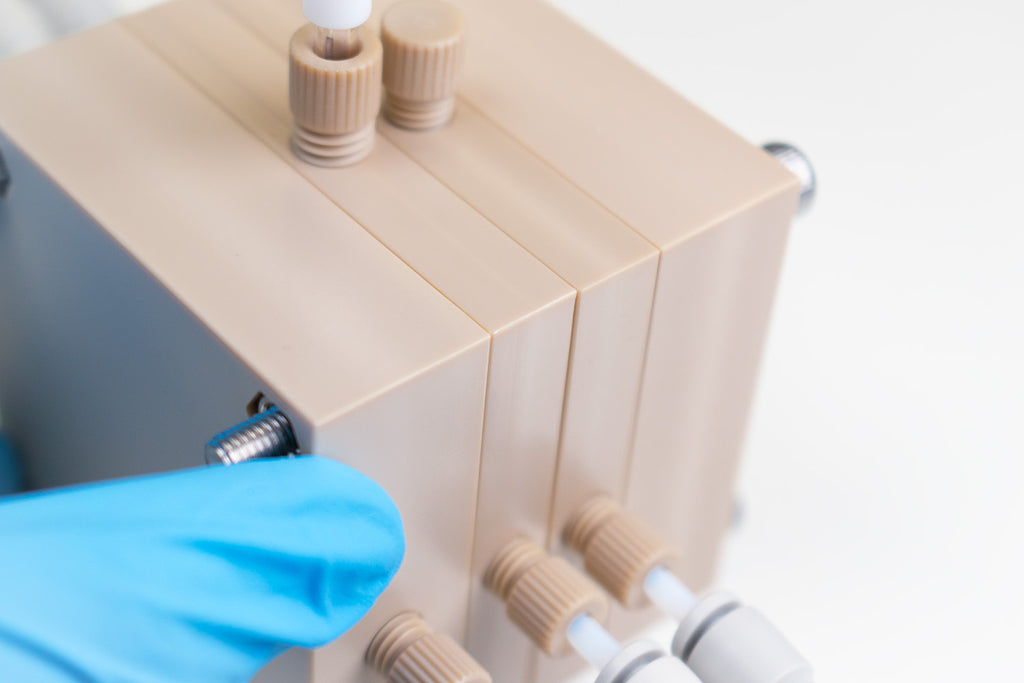
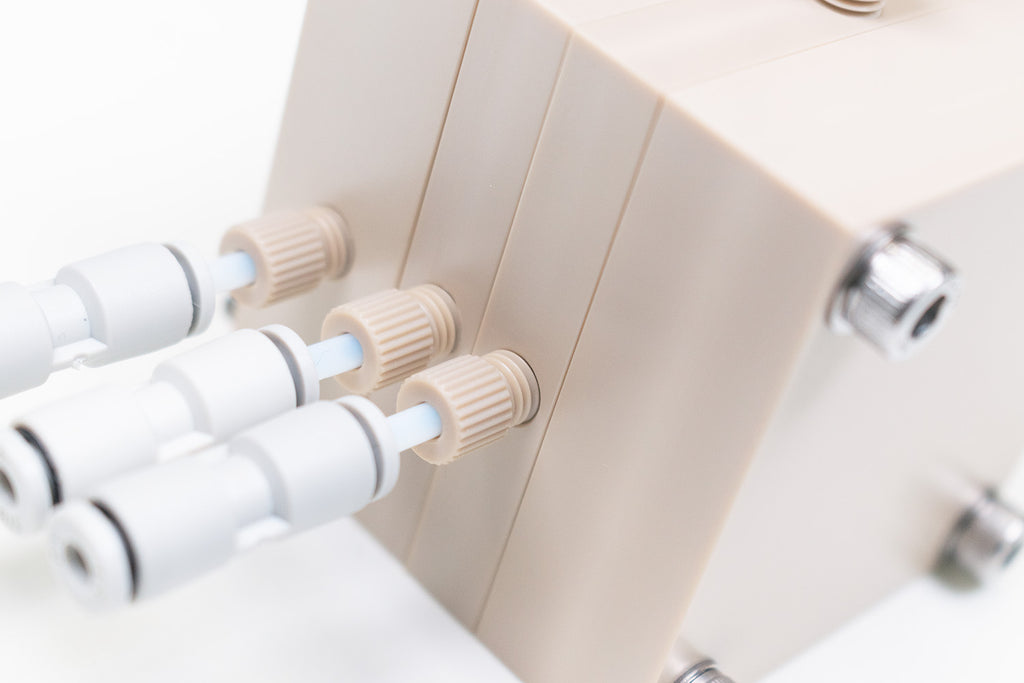
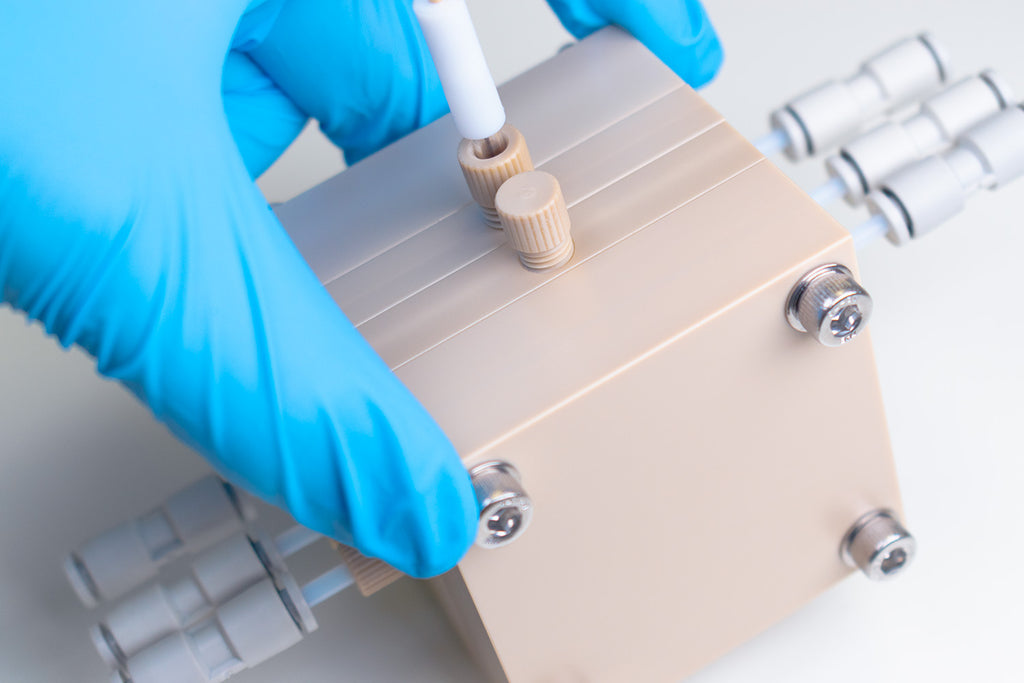
This full-cell design separates the anode and cathode into two independently pumped compartments, divided by an ion-exchange membrane, so each side can run its own electrolyte, flow rate, and even pH. Channel independence matters whenever the anode and cathode reactions have very different requirements. For instance, asymmetric bipolar-membrane operation, or pairing a demanding cathodic reaction with an anode that needs an entirely different electrolyte to run efficiently. An all-PEEK construction handles running each compartment at its own extreme without the pitting, corrosion, or metal-ion leaching that Ti or Ni bodies can suffer under acidic, alkaline, or halide-containing electrolytes.
As with our other flow cells, the cathode is a gas diffusion electrode consistng of: a porous conductive support, a PTFE-based hydrophobic microporous layer, and a catalyst layer, forming the three-phase boundary where gas, electrolyte, and catalyst meet. In this full-cell configuration, that boundary sits on the catholyte side of the membrane, while the anode runs independently in its own compartment. Reactant gas is supplied directly to the catalyst layer, bypassing solubility bottlenecks and preventing mass-transport limitations.

All-PEEK Body
Chemically inert across
a broad pH range

Three-phase Boundary Design
Preventing mass-transport
limitations

Dual Flow Chambers
Independent anolyte &
catholyte control

Expert Support
From in-house scientists & our
customer care team
Key Applications
- Asymmetric CO2RR/NRR: Where the cathode requires a specific catholyte composition that would otherwise be incompatible with the anode's electrolyte.
- Bipolar-membrane electrolysis: Acidic anode / alkaline cathode configurations, or the reverse, run simultaneously in one cell.
- Full-cell method development: Studying anode and cathode reactions together under independently controlled, realistic operating conditions.
- Green Chemical Synthesis: Enables the on-site, green electrosynthesis of hydrogen peroxide production through the 2-electron oxygen reduction reaction, and nitrogen reduction (N2RR) of ammonia from atmospheric nitrogen and water
Specifications
| Main Body | All 4 chambers; PEEK |
|---|---|
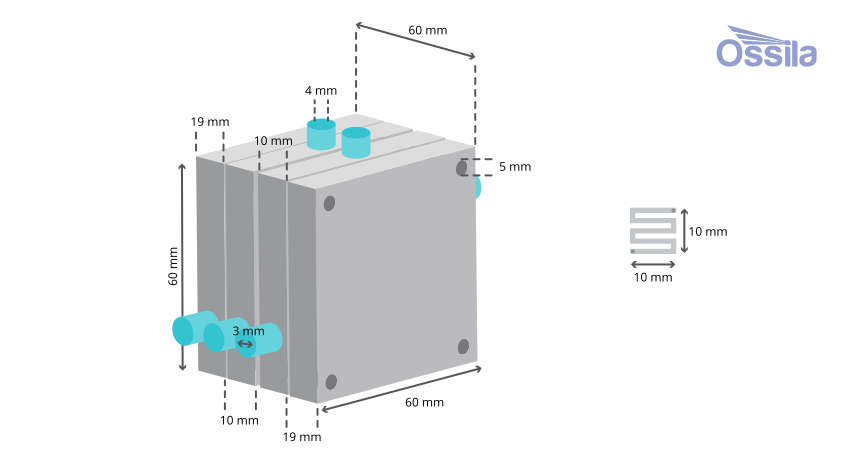
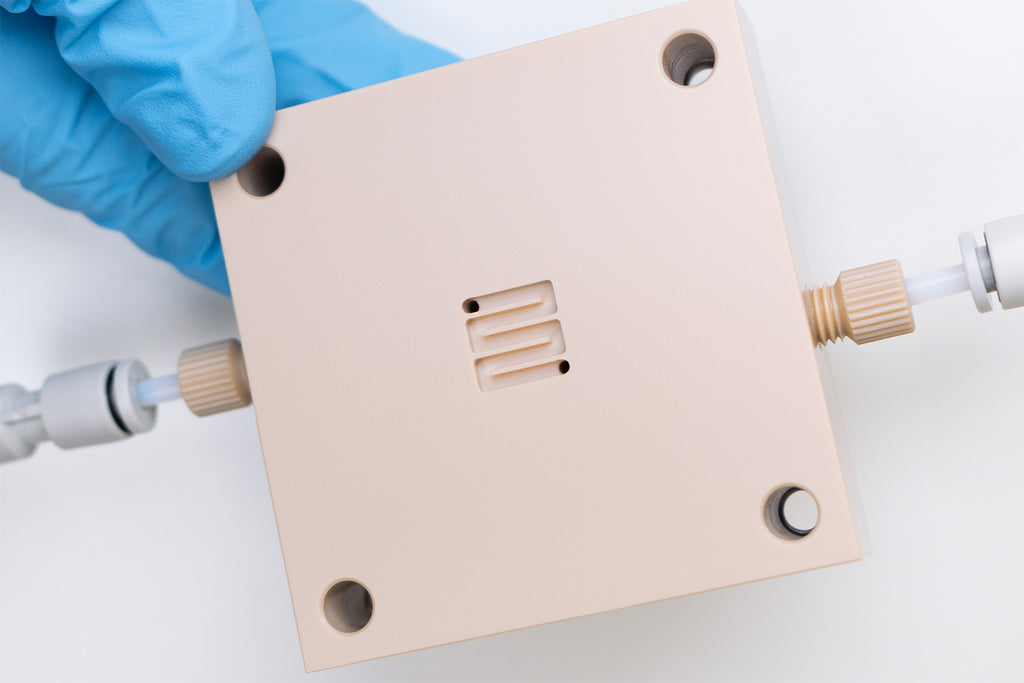
| Cathode and Anode Chambers | PEEK with Serpent Flow Fields(60 mm x 60 mm x 19 mm) |
| GDE Working Area | S-shaped, 1 cm x 1 cm with 1.5 mm width and depth |
| Catholyte and Anolyte Chambers | 60 mm x 60 mm x 10 mm (x2, independent) |
| Space Between Cathode and Anode Chambers | Approx. 12-24 mm, separated by two 10 mm thick independent flow chambers and gaskets and a membrane |
| Reference Electrode | Ag/AgCl (⌀4 mm) |
| Gaskets | FKM (52 mm x 52 mm, 1 mm thickness, and window sizes below) |
| FKM Gasket window sizes | 20 mm x 20 mm, 10 mm x 10 mm, Blank (for custom window size) |
| Current Collector Contact | 10 mm wide copper strips provided |
In the Box*
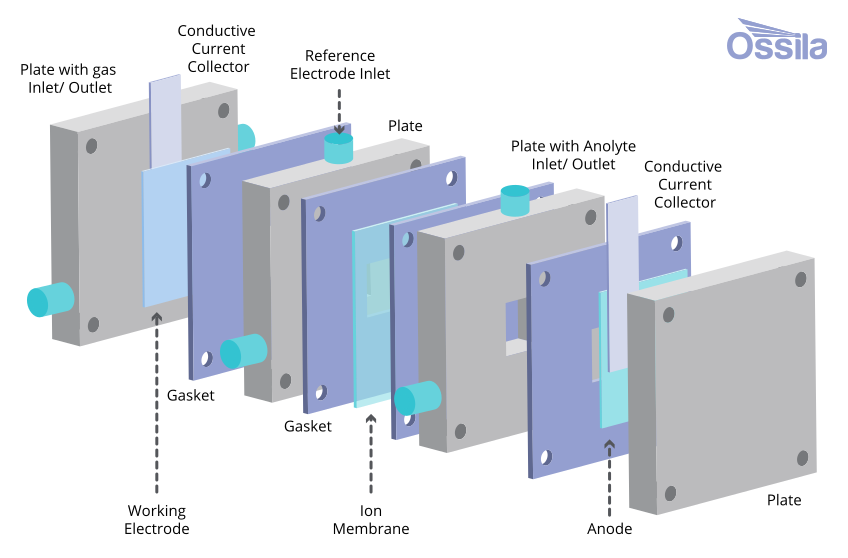
- Four PEEK chambers
- PTFE tube
- PTFE tape
- Copper tape
- FKM gaskets
- Tube cutter
- Gas locks
- PTFE gas & electrode stoppers
- 70 mm screws x 5
- 75 mm screws x 5
- Nuts & washers
- Assorted O-rings
- Gas & electrode secure screws
- Closed-off secure screw
*A working electrode or membrane is not included as standard accessories with the cell. You will need to source or fabricate a GDE compatible with your catalyst system, plus a suitable ion-exchange membrane to separate the two compartments.
Product Gallery
Literature
- Z. Li et al. (2026), High single-pass conversion of nitrous oxide to dinitrogen in gas-diffusion-electrolyzer, Nat. Commun. 17, 552; DOI: 10.1038/s41467-025-67244-z.
- K. Patra et al. (2023), CO2 electrolysis towards large scale operation: rational catalyst and electrolyte design for efficient flow-cell, Chem. Commun., 59, 6774-6795; DOI: 10.1039/D3CC01231J.
- C. Martens et al. (2025), Connecting Cell Structure and Current-Dependent Environment Changes in CO2 Electrolysis to GDE Operation Regimes and Multi-Cell Interaction, Electrochem. Sci. Adv., 5 (6), e202400013; DOI: 10.1002/elsa.202400013.
Related Products