


4cztps, 2954812-36-1
4CzTPS
CAS Number 2954812-36-1
Phosphorescent Host Materials, Latest Products, Host Materials, High Purity Sublimed Materials,
Host and Exciplex Host for Phosphorescent and TADF OLEDs
Linear host for highly efficient phosphor-sensitized deep-blue multiple resonance thermally activated delayed fluorescence devices
Specifications | Device Structures | MSDS | Literature
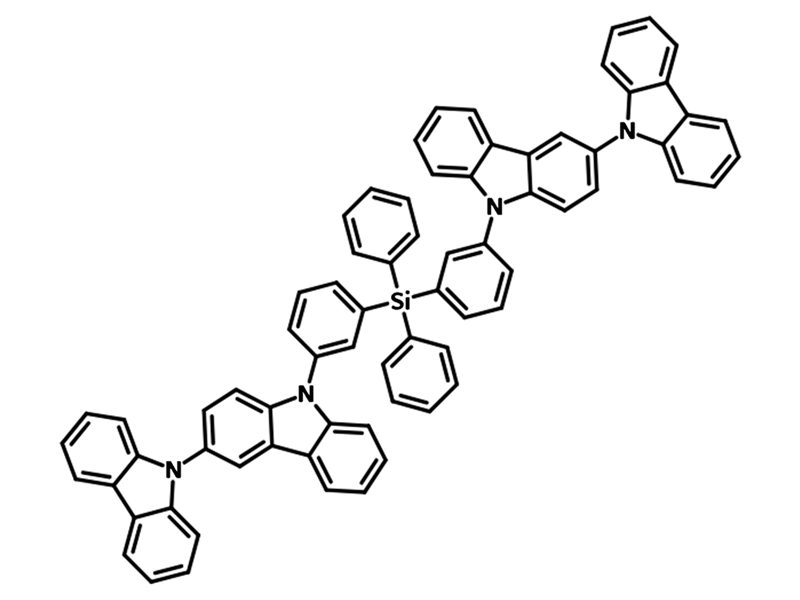
4CzTPS is a high performance phosphorescent and blue multiple resonance thermally activated delayed fluorescence (MR-TADF) host material with two bicarbazole units symmetrically attached to a tetraphenylsilane core. It demonstrates a linear molecular geometry which induces horizontal alignment on the substrate during film fabrication. This horizontal-oriented linear geometry featuring positive potential sites attracts emitters with negative potential sites via electrostatic interactions, resulting a horizontal dipole ratio (Θ||) up to 94.5% for the guest dopant.
A phosphor-sensitized MR-TADF device based on PtON-TBBI (BD-02) as the sensitizer and D1-DBN as the MR-TADF blue emitter achieves external quantum efficiency (EQE) of 40.5% with an exceptionally small full width at half-maximum (FWHM) of 16.3 nm and deep blue CIE coordinates of (0.116, 0.109). Moreover, by coupling 4CzTPS with SiTrzCz2 forming an exciplex co-host to further decrease electron injection barrier, the device achieves a record-breaking EQE of 42.0% and the operational stability with a LT50 of 3483 h at an initial luminance of 100 cd m−2.
General Information
| CAS Number | 2954812-36-1 |
|---|---|
| Full Name | Bis(3-(9H-[3,9'-bicarbazol]-9-yl)phenyl)diphenylsilane |
| Chemical Formula | C72H48N4Si |
| Molecular Weight | 997.26 g/mol |
| Absorption | λmax 341 nm (in toluene) |
| PL | 470 nm (in toluene, deep blue, featuring an ultra-narrow full width at half-maximum of 16.2 nm) |
| HOMO/LUMO | HOMO = - 5.51 eV, LUMO = - 2.09 eV [1] |
| Classification or Family | Carbazole derivative, Phosphorescent host, TADF host, Exciplex host, Sublimed materials, PhOLEDs |
Product Details
| Purity | Sublimed*≥99% (HPLC) |
|---|---|
| Melting Point | Tg = 170 °C, Td = 525 °C (5% weight loss) |
| Appearance | White to grey crystals/powder |
* Sublimation is a technique used to obtain ultra pure-grade chemicals, see sublimed materials for more sublimed materials.
Chemical Structure
Device Structure(s)
| Device Structure | ITO/HATCN (10 nm)/TAPC (70 nm)/TCTA (5nm)/mCP (5 nm)/4CZTPS:D1-DBN* (1.5wt%, 24 nm)/mSiTrz (5 nm)/ANT-BIZ (30 nm)/LiF (1 nm)/Al (150 nm) [1] |
|---|---|
| Color | Blue at 472 nm
|
| CIE (x,y) | (0.114, 0.114) |
| FWHM | 16.1 nm |
| Max. Power Efficiency | 28.2 lm/W |
| Max. Current Efficiency | 30.6 cd/A |
| Max. EQE | 36.0% |
| Device Structure | ITO/HATCN (10 nm)/TAPC (70 nm)/TCTA (5nm)/mCP (5 nm)/4CzTPS:5.0 wt% BD-02:1.5 wt% D1-DBN* (24 nm)/mSiTrz (5 nm)/ANT-BIZ (30 nm)/LiF (1 nm)/Al (150 nm) [1] |
|---|---|
| Color | Blue at 472 nm
|
| CIE (x,y) | (0.116, 0.109) |
| FWHM | 16.3 nm |
| Max. Power Efficiency | 34.3 lm/W |
| Max. Current Efficiency | 33.6 cd/A |
| Max. EQE | 40.5% |
| Device Structure | ITO/HATCN (10 nm)/TAPC (70 nm)/TCTA (5nm)/mCP (5 nm)/4CZTPS:BD-02 (5.0 wt%, 24 nm)/mSiTrz (5 nm)/ANT-BIZ (30 nm)/LiF (1 nm)/Al (150 nm) [1] |
|---|---|
| Color | Blue at 460 nm
|
| CIE (x,y) | (0.136, 0.112) |
| FWHM | 20.5 nm |
| Max. Power Efficiency | 24.0 lm/W |
| Max. Current Efficiency | 22.9 cd/A |
| Max. EQE | 22.9% |
| Device Structure | ITO/HATCN (10 nm)/TAPC (70 nm)/TCTA (5nm)/mCP (5 nm)/4CzTPS:SiTrzCz2:BD-02:D1-DBN* (7:3:5.0 wt%:1.5 wt%, 24 nm)/mSiTrz (5 nm)/ANT-BIZ (30 nm)/LiF (1 nm)/Al (150 nm) [1] |
|---|---|
| Color | Blue at 472 nm
|
| CIE (x,y) | (0.116, 0.112) |
| FWHM | 16.2 nm |
| Max. Power Efficiency | 39.9 lm/W |
| Max. Current Efficiency | 35.6 cd/A |
| Max. EQE | 42.0% |
*For chemical structure information, please refer to the cited references
Pricing
| Quantity | Price |
|---|---|
| 100 mg | £160 |
| 250 mg | £320 |
| 500 mg | £510 |
| 1 g | £810 |
MSDS Documentation
 4CzTPS MSDS sheet
Literature and Reviews
- M. Wang et al. (2026), Phosphor-Sensitized Deep Blue Narrowband OLED Devices With EQE Over 40% by Using a Horizontal-Oriented Host, Angew. Chem. Int. Ed., 128 (39), e9859395; DOI: 10.1002/ange.9859395.