oCBP
CAS Number 592551-54-7
Fluorescent Host Materials, Phosphorescent Host Materials, TADF Host Materials, Host Materials,
Host Material, Exciton Blocking Layer & Exciplex Host
Applications in OLED and TADF-OLED devices, CAS No. 592551-54-7
Specifications | Device Structures | MSDS | Literature | Related Products | Technical Support
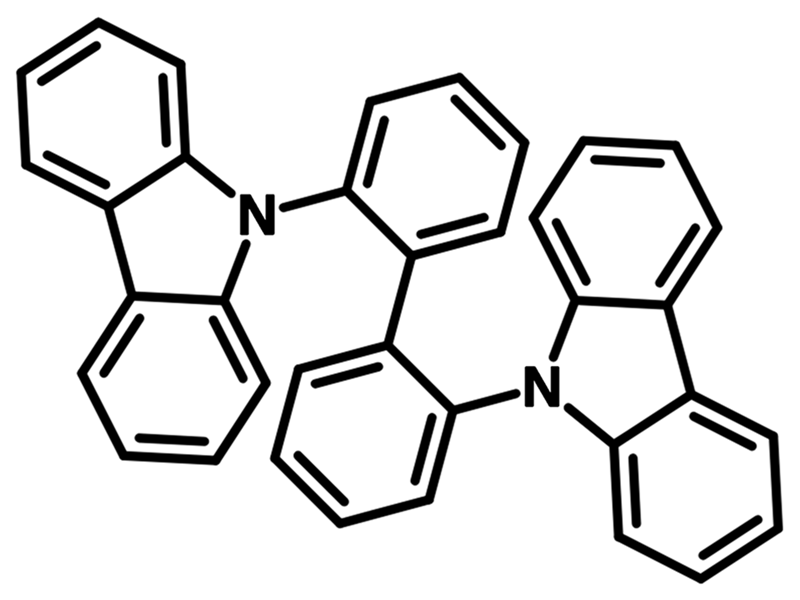
oCBP is an organic semiconducting host material for highly efficient phosphorescent OLED and TADF devices, featuring a biphenyl linker and two electron-rich carbazole units, and a sterically hindered isomer of the well-known OLED host materials CBP and mCBP. The bulky carbazolyl groups at the 2 and 2' (ortho) positions of the biphenyl backbone creates significant steric repulsion. To minimize this repulsion, the two phenyl rings of the biphenyl unit are forced into a non-planar, highly twisted orientation. This steric hindrance and non-planar configuration also disrupt conjugation to gain a higher triplet energy state suitable for hosting deep-blue emission.
Known for its high triplet energy, good thermal, and morphological stability that ensures efficient energy transfer to the phosphorescent emitter (dopant) and effectively confines excitons within the emissive layer of the device. Being electron donating, oCBP frequently forms exciplexes when mixed with triazine-based or pyridine-based n-type hosts like mSiTrz or CNCzPyDFCN. PhOLED based on CN–Ir as the blue phosphorescent emitter and oCBP:CNCzPyDFCN as the mixed exciplex host demonstrates a high external quantum efficiency (EQE) of over 29% and a device lifetime of LT50 = 33.9 h at an initial luminescence of 1000 cd m−2 with a low turn-on voltage.
Also, due to its high triplet energy and large energy gap, oCBP acts as exciton blocking later (EBL) to make it difficult for high-energy blue excitons to transfer, effectively confining them within the EML where they can recombine radiatively to produce light.
General Information
| CAS Number | 592551-54-7 |
|---|---|
| Full Name | 2,2′-Di(9H-carbazol-9-yl)-1,1′-biphenyl |
| Chemical Formula | C36H24N2 |
| Molecular Weight | 484.59 g/mol |
| Absorption | λmax 237, 295 nm in DCM |
| Photoluminescence | 381 nm in DCM |
| HOMO / LUMO | HOMO = 5.51 eV, LUMO = 1.91 eV, T1 = 2.95 eV [1] |
| Synonyms | 2,2'-Di(9H-carbazol-9-yl)biphenyl, 2,2'-bis(carbazol-9-yl)biphenyl, o-CBP |
| Classification or Family | Carbazole derivatives, fluorescent host materials, blue exciplex host materials, sublimed materials, OLED-TADF, Organic electronics. |
Product Details
| Purity | Sublimed* >99.5% (HPLC) |
|---|---|
| Melting Point | n/a |
| Appearance | White to light yellow crystals/powder |
* Sublimation is a technique used to obtain ultra pure-grade chemicals, see sublimed materials for more sublimed materials.
Chemical Structure
Device Structure(s)
| Device structure | ITO/HAT-CN (10 nm)/BCFN (60 nm)/SiCzCz (5 nm)/oCBP:CNmCBPCN*:PtON-TBBI (35 nm, 0.60:0.27:0.13 w/w/w)/mSiTrz (5 nm)/mSiTrz:Liq (31 nm, 5:5)/LiF (1.5 nm)/Al (80 nm) [1] |
|---|---|
| Color | Blue  |
| CIE (x,y) | (0.132, 0.147) |
| FWHM | 38 nm |
| Max. Current Efficiency | 26.3 cd/A |
| Max. Power Efficiency | 29.5 lm/W |
| Max. EQE | 26.4% |
| LT70 | 47.5 h |
| Device structure | ITO/(50nm)/HATCN (7nm)/PCBBiF* (45nm)/oCBP (10nm)/oCBP:CNCzPyDFCN*:12 wt.% CN-Ir (35nm)/DDBFT(10nm) /BPPB:Liq (30nm)/Liq(1.5nm)/Al |
|---|---|
| Color | Blue |
| CIE (x,y) | (0.15, 0.28) |
| Max. EQE | 29.2% |
| LT50 | 33.9 h |
| Device structure | ITO/HAT-CN (10 nm)/TAPC (40 nm)/mCBP (10 nm)/1.0 wt % g-Cb-B*:oCBP, (20 nm)/PPF (10 nm)/B3PyPB (40 nm)/Liq (1 nm)/Al (100 nm) [3] |
|---|---|
| Color | Blue |
| CIE (x,y) | (0.13, 0.13) |
| FWHM | 28 nm |
| Max. Current Efficiency | 17.8 cd/A |
| Max. Power Efficiency | 19.0 lm/W |
| Max. EQE | 19.0% |
*For chemical structure information, please refer to the cited references
Pricing
| Grade | Order Code | Quantity | Price |
|---|---|---|---|
| Sublimed (>99% purity) | M2582A1 | 250 mg | £190 |
| Sublimed (>99% purity) | M2582A1 | 500 mg | £330 |
| Sublimed (>99% purity) | M2582A1 | 1 g | £550 |
MSDS Documentation
 oCBP MSDS sheet
Literature and Reviews
- J. Sun et al (2022), Exceptionally stable blue phosphorescent organic light-emitting diodes, Nat. Photon. 16, 212–218; DOI: 10.1038/s41566-022-00958-4.
- S. Muruganantham et al. (2025), Unveiling a pyridine-based exciplex host for efficient stable blue phosphorescent organic light-emitting diodes, J. Mater. Chem. C, 13, 2923-2931; DOI: 10.1039/D4TC04553J.
- M. Yang et al. (2021), Wide-Range Color Tuning of Narrowband Emission in Multi-resonance Organoboron Delayed Fluorescence Materials through Rational Imine/Amine Functionalization, Angew. Chem. Int. Ed., 60 (43), 23142-23147; DOI: 10.1002/anie.202109335.
Related Products