


Solar To Hydrogen Production

Solar to Hydrogen Reactions | Routes to Solar Hydrogen Production | How and What To Measure | Scale-Up Challenges | Artificial Photosynthesis
Solar-to-hydrogen production, such as solar-powered water splitting, uses solar energy to convert H2O into hydrogen molecules (H2) and oxygen molecules (O2). This process can be useful in many different applications.

- Solar water splitting provides a route to renewable energy with significantly reduced carbon emissions compared to fossil fuels.
- Solar-to-hydrogen as a decarbonization route has drawn particular attention due to hydrogen’s versatility as an energy carrier.
- Green hydrogen (hydrogen produced using renewable energy sources) can be used in hydrogen fuel cells to produce electricity without greenhouse gas emissions.
- It can also be used in green chemical engineering such as in the hydrogenation of carbon dioxide (CO2) to hydrocarbons and nitrogen (N2) to ammonia (NH3).
Solar energy is abundant but does not provide a continuous energy supply. It also delivers excess electricity that is wasted within current grid systems. Therefore, efficient energy conversion processes, where solar energy is converted into chemical energy stored in different compounds, can be used to store this energy until it is required. These compounds include hydrogen, carbon monoxide and other high-value substances that minimize energy wastage. Hydrogen is a promising alternative fuel source, therefore combining solar energy and water splitting has attracted a lot of research interest.
Producing green hydrogen via solar water splitting has been carried out using established solar cell technology coupled with established electrolyzers. When compared to grid electrolysis, there is less consistent hydrogen production as activity level fluctuates based on sunlight exposure. In terms of cost, even though solar energy is comparatively cheap compared to fossil fuel-based grid energy, it limits electrolyzer productivity. The high utilization rate of grid-electrolysis spreads the equipment cost more thinly, but the higher price of grid electricity heavily inflates the operational cost. Therefore, the cost of PV-electrolysis and grid-electrolysis is similar ($4.00-7.00/kg).
Solar To Hydrogen Reactions
The overall water splitting equation is given as two water molecules producing two hydrogen molecules and an oxygen molecule:

The reaction is split into two half-reactions known as the hydrogen evolution reaction (HER) and the oxygen evolution reaction (OER). Thermodynamically, water splitting into hydrogen and oxygen is an energy intensive reaction due to the high stability of water molecules. There is a large positive change in the Gibbs free energy (ΔG = 238 kJ/mol), therefore the reaction is not spontaneous.
Hydrogen Evolution Reaction (HER)
The hydrogen evolution reaction involves the conversion of water into hydrogen gas. Water or protons are reduced to produce H2 depending on the pH of the reaction environment:


The chemical reaction rates (kinetics) are dependent on surface‐adsorption (Volmer), electrochemical desorption (Heyrovsky) and chemical recombination (Tafel) steps. In acidic media, the reaction proceeds through a voluntary proton absorption step (Volmer step) followed by either electrochemical desorption (Heyrovsky step) or chemical desorption (Tafel step). In alkaline or neutral media, the overpotential is dramatically higher because there is a severe shortage of free protons (H⁺). The catalyst must first force a stable water molecule to break apart to generate a reactive hydrogen atom. This slow water dissociation step acts as a heavy kinetic barrier, causing a high overpotential drop. This means there is a large potential difference (voltage) between the half-reaction's thermodynamically determined reduction potential and the potential at which the redox event is experimentally observed.
Oxygen evolution reaction (OER)
The oxygen evolution reaction (OER) the oxidisation of water to produce O2:


The OER proceeds through four sequential proton-coupled electron transfer (PCET) steps on an active site through an adsorbate evolution mechanism (AEM). Depending on the pH of the reaction, either water (H2O) or hydroxide ions (OH-) are the starting species and form adsorbed hydroxide, oxo and hydroperoxide intermediate species before forming oxygen. Each intermediate species undergoes oxidation to form the next species in the series until oxygen is formed.
The OER is thermodynamically demanding due to its large positive change in the Gibbs free energy (ΔG = 474 kJ/mol). Forcing a system to extract four electrons and four protons from water molecules to generate just one molecule of oxygen requires a huge amount of thermodynamic energy. The initial step requires breaking the extremely stable covalent oxygen-hydrogen (O-H) bonds in H2O or OH- which also requires a large amount of energy. The adsorption energies of the reactive intermediates are typically locked in a linear scaling relationship meaning there is energy mismatch. To make the most difficult step proceed, you must over-compensate by pumping in extra thermodynamic voltage.
Typically, a catalyst is used to increase HER and OER efficiency. Although the electrocatalytic water splitting reaction has great potential in energy conversion, its efficiency is limited by high overpotentials. The performance of a catalyst is primarily governed by the adsorption energies of reaction intermediates onto its surface-active sites. The electrocatalyst lowers the energy barrier for proton reduction and hydrogen desorption. To optimize efficiency, the electrocatalyst must lower the activation energy barriers for the underlying charge-transfer and desorption steps. The ideal catalyst should bind the reaction intermediates neither too strongly nor too weakly.
Overpotential
Overpotential (𝜂) is the additional voltage beyond the thermodynamic equilibrium potential (1.23 V vs. RHE) needed to drive an electrochemical reaction at a given practical rate:

In solar water splitting, the reason for additional voltage is mainly due to the activation overpotential. This stems from the high kinetic energy barriers associated with interfacial charge-transfer and intermediate phase transitions. Because the chemical steps of the oxygen evolution reaction (OER) are inherently slow, the interfacial reaction kinetics act as the primary rate-determining step.
For solar energy driven systems, elevated overpotentials directly dictate the device architecture. Because the catalyst surface demands this extra voltage to overcome kinetic barriers, the underlying solar absorber must deliver a significantly higher photovoltage than the thermodynamic baseline. This forces the use of wider band gap semiconductors or complex multi-junction PV cells to avoid severe efficiency drops. Optimizing the electronic structure and intermediate adsorption energies of the surface catalyst is vital to lowering overpotential, reducing solar-to-hydrogen (STH) energy losses, and making commercial solar fuel production viable.
Precious Metal vs. Emerging Non-Precious Catalysts
The current trend within both acidic and alkaline water electrolysis research is to move away from using rare and costly platinum group metals (PGMs). There has been a recent shift towards using more cost-efficient options employing earth-abundant elements such as nickel (Ni), cobalt (Co), and iron (Fe). In PEM architecture, acidic conditions have been used to enable rapid proton transport and high catalytic activity using noble metals like platinum (Pt) for the HER and iridium (Ir) for the OER. However, their large-scale practical application is limited by the high cost and scarcity of noble metals.
While acid environments optimize PGM performance, they cause catastrophic corrosion in non-precious alternatives. This forces a shift toward alkaline operating media to safely accommodate earth-abundant catalysts. Within these alkaline systems, Ni-based catalysts are particularly effective for the hydrogen evolution reaction due to their high conductivity and chemical robustness. The incorporation of Co (forming NiCo structures) further enhances HER activity by accelerating the initial water dissociation step and facilitating rapid interfacial charge transfer.
Routes to Solar Hydrogen Production
There are three important solar hydrogen generation techniques: photovoltaic electrolysis (PV-EC), photocatalysis (PC), and photoelectrochemical (PEC). Each technique uses a different method of converting solar energy into green hydrogen, but all share some common principles and components:
| Solar Hydrogen Technique | Photovoltaic Electrolysis | Photocatalysis | Photoelectrochemical Cells |
|---|---|---|---|
| Components |
|
|
|
| Solar-to-hydrogen (STH) Efficiencies | 30 % | ~ 2% (Target ~10%) | 13.4% (Target 25%) |
| Gas Separation (H2 and O2) | Automatic - Hydrogen and oxygen are safely generated in separate chambers. | Extremely Difficult - Hydrogen and oxygen gases mix immediately in the same space. | Easy - Gases evolve at physically separated flat electrodes. |
| Cost | High - Complex PV and electrolyzer technology | Low - Depends on the price of the catalyst only | Medium - depends on price of catalyst and cell |
Photovoltaic Electrolysis
Photovoltaic electrolysis couples a solar power generation system, such as a solar panel or solar cell, with a water electrolyzer such as a proton exchange membrane (PEM) electrolyzer, alkaline water electrolyzer (AWE), solid oxide electrolyzers (SOE), or an anion exchange membrane (AEM) electrolyzer.

One issue arises from the mismatch of the current–voltage (I-V) characteristics of PVs and water electrolyzers. In a typical triple-junction solar cell, Vmpp (the operating voltage that produces the maximum power output) is in the range of 2.0-3.5 V under 1-1,000 suns of illumination. However, the thermodynamic minimum voltage required to electrolyze water is only 1.23 V at 300 K, with practical operating voltages in the range of 1.5-2.0 V. Electrolyzing water using a voltage greater than the thermodynamic minimum voltage results in energy wasted as heat rather than stored in H2 chemical bonds. This misalignment issue is addressed by coupling multiple PV and/or electrolyzer units in series, to optimize the match between the voltage characteristics of the different device components.
There has been a huge amount of research into both photovoltaic technology and water electrolysis therefore this combination has reached the highest STH efficiencies. A laboratory-scale photovoltaic-powered electrolyzer has produced a solar-to-hydrogen (STH) efficiency of 30%. This system coupled one high-efficiency triple-junction solar cell with two series-connected polymer electrolyte membrane (PEM) electrolyzers to achieve very high STH efficiencies.
However, they are held back by the cost of both technologies. Current water electrolysis systems either require expensive rare metals (as with PEM technologies) or are not conducive to the intermittent nature of solar energy supply (as with AWE technologies).
Particulate/Suspension Photocatalysis
In photocatalytic solar water splitting, photocatalysts are suspended in water. Photocatalysts split water molecules through redox reactions to generate hydrogen and oxygen, harnessing solar energy directly.

Photocatalytic solar water splitting involves the generation of electrons and holes in the conduction and valence bands of a photocatalyst upon photoexcitation. The electrons carry out reduction reactions to produce hydrogen, and the holes carry out oxidation reactions to produce oxygen. Upon exposure to solar energy, the charge carriers must have the necessary electrochemical potentials to drive the water splitting half reactions. Due to the requirements of photocatalysts, there are different approaches to this technique, including one-step and two-step (Z-scheme or S-scheme) systems.
Photocatalysts for one-step systems must have a band gap narrow enough to absorb visible light and meet the thermodynamic requirements of the water splitting reactions. There must also be active sites for both hydrogen and oxygen evolution on the photocatalyst. Developing one photocatalyst that meets all the requirements is a tricky balancing act and often requires expensive processing techniques which ultimately increases the cost of the solar-hydrogen production.
Two-step systems use a hydrogen evolution photocatalyst (HEP) and an oxygen evolution photocatalyst (OEP) rather than one catalyst that does both. Separating the thermodynamic requirements between two semiconductors significantly expands the range of photocatalysts that are suitable for water splitting. Narrow band gap photocatalysts can be used if they drive the intended reaction. However, using two semiconductors doubles the number of photons needed for overall water splitting. In a Z-scheme, the holes and electrons remaining in the HEP and OEP recombine via aqueous redox-based or solid-state electron mediators.
In an S-scheme, the two semiconductors form a direct heterojunction without relying on a mediator. To achieve highly efficient water-splitting reactions, there must be efficient charge transfer between the HEP and OEP and control over the selectivity of the reaction. Whilst there are fewer requirements for each photocatalyst, the overall system needs more components which again increases the cost of photocatalytic water splitting.
Direct Photoelectrochemical (PEC) Cells
Photoelectrochemical cells convert solar energy into chemical energy directly like photocatalysis. Photocatalysts split water molecules through redox reactions to generate hydrogen and oxygen, harnessing solar energy directly. Thin films of photocatalysts are applied on electrodes within a cell to generate the photovoltage that drives the redox half-reactions. This is opposed to using external electrical input from PV as with photovoltaic electrolysis. Unassisted water electrolysis in this way requires not only the thermodynamic minimum voltage of 1.23 V but also an additional potential to overcome catalytic overpotentials and resistive losses. As a result, a high photovoltage of approximately 1.8 V or higher is required for practical operation. These photoelectrodes integrate light absorption and photocatalysis within a single device. The external circuit allows the flow of electrons between the two photoelectrodes rather than the need for mediators as with the two-step photocatalysis suspension method.

There are instances where PECs are stacked with or assisted by a photovoltaic cell (PEC-PV) to provide the extra voltage required for water splitting. The photovoltage of many photoelectrodes is insufficient to drive water splitting without additional bias. As mentioned, the tandem connection of multi-photoabsorbers that cover complementary fractions of the solar spectrum can provide sufficient photovoltage to drive overall water splitting. A PEC-PV tandem configuration is another promising approach, with the potential to surpass the efficiency of PV-electrolysis systems using the same PV cells. In an ideal PEC-PV tandem arrangement, a wider-band gap and stable photoelectrode (1.8-2.4 eV) should be placed on top of a smaller-band gap PV cell (1.0-1.5 eV) in a series connection.
How and What to Measure In Solar Hydrogen Production
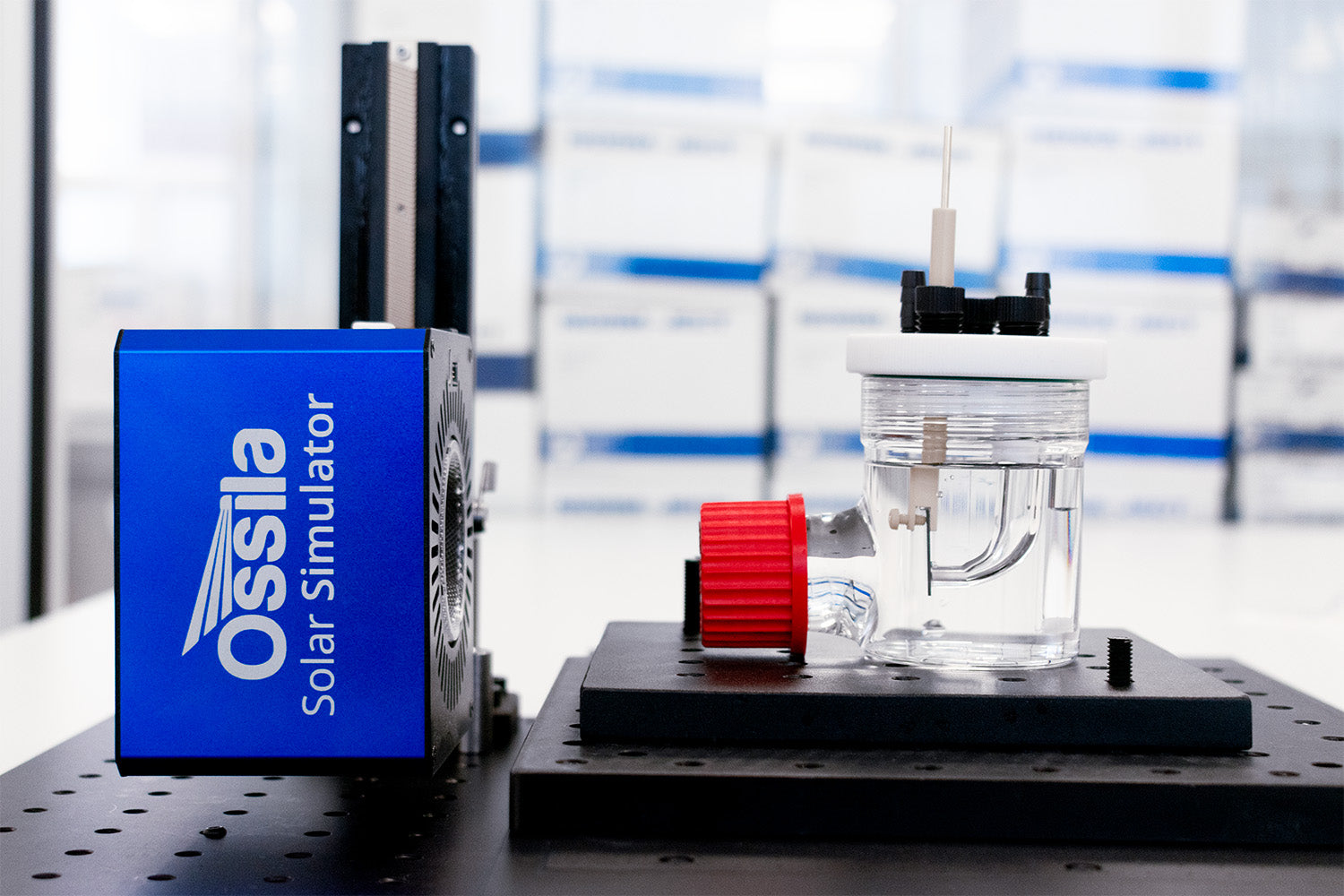
Solar-to-hydrogen (STH) efficiency is the ultimate measure of a solar water splitting device to determine its capacity to generate hydrogen. It evaluates the efficiency of photo-conversion under irradiation by artificial light sources with a solar spectrum AM 1.5 at a stable illumination power density (100 mW/cm2) and constant intensity. STH energy conversion ratio is defined as the energy of the net hydrogen produced divided by the full-spectrum solar energy consumed. For systems utilizing solar energy input only, the consumed energy is calculated based on the incident irradiance over the total area of the solar collector. The ratio of the chemical potential energy stored in the form of hydrogen molecules to the incident radiative energy is the most important output to determine.
The United States department of energy has set a target of 25% STH for photoelectrochemical and 10% STH for photocatalytic water splitting to be commercially viable.
The incident photocurrent conversion efficiency (IPCE) and the applied bias photon-to-current efficiency (ABPE) measurements are essential for determining the limiting factors of the photoelectrode performance. IPCE and ABPE measurements act as diagnostic tools that isolate light harvesting, bulk transport, and surface injection as the three primary limiting factors of photoelectrode performance. By tracking how efficiently a material absorbs photons and moves charges, these metrics reveal whether energy is being lost to a wide band gap or internal charge recombination. Finally, by evaluating the system under an external voltage, they pinpoint whether sluggish chemical kinetics at the water interface are stalling the overall reaction.
Incident Photon-to-Current Efficiency (IPCE)
Incident photon-to-current efficiency (IPCE) is defined as the ratio of the number of photo-generated electrons (Nelectrons) that flow in the external circuit to the number of incident photons (Nphotons) for a given wavelength. IPCE is a measurement of the output current for a given number of incident photons at a given wavelength. The practical IPCE equation is:

- Jph: Measured photocurrent density (mA.cm-2) at a specific wavelength.
- λ: Wavelength of incident monochromatic light. (nm)
- Pmono: Light power density of monochromatic light (mW.cm-2).
- 1240: Simplified constant grouping Planck’s constant (h) and the speed of light (c) converted to electron-volts (eV · nm)
Under standard conditions, the IPCE is measured as a function of wavelength and integrating over the AM1.5 solar spectrum. Alternatively, by measuring under sunlight with a similar zenith angle to that of the AM1.5 spectrum.
Applied Bias Photon-to-Current Efficiency (ABPE)
Applied bias photon-to-current efficiency (ABPE) is the ratio of incident solar energy converted to hydrogen energy under certain bias conditions. ABPE calculates the conversion efficiency under a continuous solar spectrum (usually AM 1.5G) while subtracting the electrical energy contribution supplied by the external bias. For unassisted thermodynamic water splitting at standard conditions, the redox potential is fixed at 1.23 V versus the RHE. ABPE can be calculated using the following formula:

- Jph: Measured photocurrent density (mA.cm-2) at a specific wavelength.
- Vapp: Applied external potential (V vs. RHE).
- Ptotal: Total incident light intensity (typically 100 mW.cm-2 for 1 sun).
Scale Up Challenges
Laboratory-scale PV-EC can exhibit an STH efficiency of 30% and pilot-scale plants based on this technology have been constructed worldwide. Despite this, large-scale production of solar hydrogen is still more expensive than generating hydrogen from fossil resources. This is due to complex multi-junction systems, expensive materials, and the low equipment utilization imposed by solar intermittency. PEC water splitting faces similar challenges in cost and scalability because current approaches incorporate photovoltaic-grade materials to achieve high STH efficiencies. The operating conditions and system design must be optimized to minimize the concentration overpotential between photocathodes and photoanodes during scale-up while allowing them to receive sunlight effectively. Particulate photocatalysts are much simpler, less expensive and can be readily scaled up but they suffer from very low STH efficiencies.
Electrocatalyst Scale-Up
- Iridium limitations: PEM electrolyzers rely heavily on iridium for the OER to survive their highly acidic internal environments. Because iridium is one of the rarest precious metals on Earth with a restricted supply there are severe risks of high costs when scaling PEM systems to global, multi-gigawatt levels.
- AEM alternative : AEM electrolyzer systems operate in alkaline-like environments, allowing the substitution of noble metals with low-cost transition metals like nickel, iron, and cobalt. AEM combines the rapid dynamic performance of PEM with the cheap, earth-abundant material benefits of traditional alkaline systems.
- Earth-abundant systems : Transitioning both photoelectrochemical (PEC) and particulate systems to non-precious catalysts drastically lowers manufacturing costs, making large-scale deployment economically viable.
Intermittency Issues
Fluctuating solar input reduces conversion efficiency, increases transient overpotentials and accelerates degradation in both photovoltaic modules and electrolyzer stacks. Traditional alkaline electrolyzers (AEW) are mature and affordable but were engineered to run on stable, continuous industrial power. At low operating capacities (below 20-40%), internal pressures drop, allowing generated hydrogen and oxygen to diffuse across the porous separator membrane. This creates flammable or explosive gas mixtures, forcing frequent system shutdowns.
Water Purity
Traditional water splitting requires high-purity, deionized freshwater to prevent catalyst poisoning and membrane scaling. In arid, sunny regions where solar-to-hydrogen farms are most viable, freshwater is scarce, and adding desalinization infrastructure adds cost. Advanced PEC systems are bypassing this by utilizing industrial wastewater, sewage, and agricultural runoff directly as chemical inputs. The field is evolving into a solar-refinery platform that converts abundant or hazardous waste resources into high-value chemicals.
Swapping Out OER
Researchers are replacing OER with thermodynamically preferred oxidation reactions that feature much lower energy barriers, such as oxidizing glycerol (biodiesel byproduct), HMF (biomass derivative), or industrial pollutants. This shift drops the required reaction voltage, allowing the system to produce hydrogen at a significantly higher STH efficiency. It also replaces oxygen production with profitable industrial chemicals (like bio-plastic intermediates).
Artificial Photosynthesis: Hydrogen Production Competing with CO2 Reduction
Like solar water splitting, the electrochemical reduction of carbon dioxide has the potential of storing excess renewable electricity as chemical energy through artificial photosynthesis. This also has the added benefit of reducing the amount of CO2 in the atmosphere, which is another goal of many climate efforts. However, electrochemical CO2 reduction reactions (CO2RR) in artificial photosynthesis face challenges of selectivity and poor reaction kinetics. Competition from the hydrogen evolution reaction (HER) is one of the key factors that lead to low reaction efficiencies.
There is a strong thermodynamic correlation between the reduction of carbon dioxide and the reduction of protons to produce hydrogen. The reduction potential for H2 production (-0.41 V) falls in the range of the reduction potential of CO2 required to form common carbon-based products (-0.61 to -0.24 V), using a normal hydrogen electrode (NHE) at pH 7 under room temperature and pressure circumstances as the reference point. Accounting for this specific environment is essential because the Nernst equation, which dictates that increasing the pH drives the thermodynamic potential of both competing reactions downward by equal measures. As a result, it becomes extremely important for the photoelectrocatalyst and reaction conditions to be as selective as possible. Alkaline conditions starve the electrode surface of free protons (H+) which suppresses the kinetics of the hydrogen evolution reaction and forces the system to selectively favor the CO2RR path.
Investigating the CO2RR as a decarbonization route has attracted a range of researchers. Understanding the relationship between HER and CO2RR is crucial for developing both technologies. Ossila's modular CO2RR hardware range, spanning H-cells, gas diffusion electrode electrolyzers, and MEA electrolyzers is designed to also support its development.
Learn More
 CO2 Reduction (CO2RR)
Electrochemical carbon dioxide reduction reactions (CO2RR) uses electrical energy to drive the reduction of CO2 in an aqueous or solid-state electrolyte environment. The process occurs at the cathode, where CO2 molecules accept electrons and protons to form products such as carbon monoxide (CO), formate/formic acid (HCOOH), ethylene (C2H4), or ethanol (C2H5OH). Simultaneously, an oxygen evolution reaction (OER) occurs at the anode to balance the charge.
Read more... Photoelectrode Materials and PEC Cell Design
Most photoelectrochemical reactions, like solar water splitting, use a variation of the three-electrode electrochemical cell. However, there are several important features within a photoelectrochemical cell (PEC) that distinguish it from a typical electrochemical cell.
Learn more...Contributors
Written by
Application Scientist
Diagrams by
Graphic Designer
References
- Solar water-splitting devices: Architectures, design principles, and scale-up..., Wang, Y. et al., International Journal of Hydrogen Energy (2026)
- Review of the Hydrogen Evolution Reaction—A Basic Approach, Ferriday, T. et al., Energies (2021)
- DOE Technical Targets for Hydrogen Production from Photoelectrochemical..., Alternative Fuels and Feedstocks Office, U.S. Department of Energy ()
- Integrated halide perovskite photoelectrochemical cells with solar-driven water-splitting..., Fehr, A. M. K. et al., Nature Communications (2023)
- Solar water splitting by photovoltaic-electrolysis with a solar-to-hydrogen..., Jia, J. et al., Nature Communications (2016)