


Photoelectrode Materials and PEC Cell Design

Photoelectrochemical Cell Design | What is a Photoelectrode? | Photocatalytic Water Splitting Reactions | Photoelectrode Materials | Stability
Most photoelectrochemical reactions, like solar water splitting, use a variation of the three-electrode electrochemical cell. However, there are several important features within a photoelectrochemical cell (PEC) that distinguish it from a typical electrochemical cell.
The most obvious and important difference is the optically transparent window that allows transmission of visible light onto the photocatalyst material, driving the electrochemical reaction. Furthermore, the cell architecture, choice of photocatalyst material, electrolyte material and electrode positioning must be optimized for each desired reaction.
Photoelectrochemical Cell Design
Single Photocatalytic Material
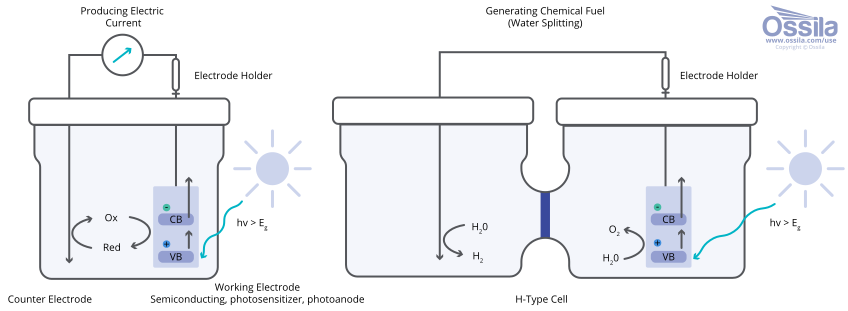
For testing a single photocatalytic material, photoelectrochemical cells can use this material as the working electrode in a three-electrode system. The photoelectrode is usually made from or coated in a photocatalytic material, often a p- or n-type semiconductor. The counter electrode is made from a standard material (e.g. platinum wire) and its primary function is just to close the circuit. The incoming radiation is focussed on the photocatalytic materials which drives the reaction.
Photoelectrochemical H-Cells
Many photoelectrochemical reactions benefit from a membrane separating the anode and cathode. In green hydrogen production for example, the membrane should transmit ions to facilitate the reaction, but maintain separation of the oxygen or hydrogen produced. This can be facilitated using a photoelectrochemical H-Cell.
Dual Photoelectrode Reactions
In some situations, you need a photoactive anode and cathode material to drive two half-photocatalytic reactions. For example, this is often beneficial in solar hydrogen production.
This either requires a larger light source to ensure both the photocathode and photoanode are exposed to light equally. However, any imbalance in this may lead to a unequal reaction rates at the two photoelectrodes, limiting overall reaction rates.
Alternatively, H-cells with two optical windows allow for two light sources to stimulate the photoanode and photocathode separately. This may help maintain an equal reaction rate.
What is a Photoelectrode?
Photoelectrode are electrodes made of or with photocatalyst materials. They play a crucial role in all methods of solar water splitting. To maximize solar energy absorption, these materials have been designed to absorb photons across the visible light spectrum.
Photocatalysts are photoactive semiconductors that capture photon energy emitted by sunlight. These materials then create photo-excited charge carriers (electrons and holes) needed to perform the two half-reactions of water splitting. The four major photocatalyst requirements for efficient water splitting include:
- Optimized band gap energy: A band gap value less than 3.0 eV (to ensure sufficient absorption within the visible solar spectrum) but larger than the 1.23 eV theoretical minimum corresponding to the water-splitting potential.
- Band edge alignment: The catalyst band structure should satisfy the energy requirements set by the redox potentials for H2O. The conduction band minimum (CBM) must be more negative than the proton reduction potential (0 V versus reversible hydrogen electrode (RHE)) and valence band maximum (VBM) must be more positive than the water oxidation potential (+1.23 V versus RHE).
- Excellent chemical and photochemical stability: The photocatalyst must resist photocorrosion and chemical degradation in aqueous electrolytes under continuous, long-term solar illumination.
- High charge separation and interfacial kinetics: The material must possess excellent charge carrier mobility to minimize bulk electron-hole recombination, coupled with efficient surface-active sites (or co-catalysts) to accelerate sluggish interfacial charge transfer.
Photocatalytic Water Splitting Reactions
Photocatalytic reaction pathway for solar water splitting:

- A photocatalytic reaction is initiated by the absorption of photons with energy higher than the band gap (Eg) of a semiconductor material. Thermodynamically, the band gap energy should be larger than 1.23 V and band positions below 1.23 V vs Normal Hydrogen Electrode (NHE) to abstract electrons from O2− anions of water. Alternatively, the band positions need to be above 0.0 V vs NHE to reduce H+ ions of water.
- Following light absorption, electrons are transferred to the conduction band (CB) with simultaneous generation of holes at the valence band (VB).
- The charge carriers diffuse to the surface of the photocatalyst to carry out the redox reactions. The recombination of photogenerated charge carriers in the bulk or on the surface competes with this step.
- At the energy level of the valence band, electrons are abstracted from O2− anions of water to close the cycle. Excited electrons reduce H+ ions to atomic hydrogen that then recombine to make H2.
- Finally, the reaction products desorb from the catalyst surface and are transferred to the medium to complete the overall process.
In a PEC cell using two photocatalyst materials (a photoanode and a photocathode), the same steps of light absorption, charge separation and surface reaction apply, but the oxidation and reduction half-reactions take place on separate electrodes. For an n-type photoanode, for example, band bending at the semiconductor–electrolyte interface drives photogenerated holes to the electrode surface to oxidize water, while electrons travel through the back contact and external circuit to the counter electrode or photocathode, where HER takes place. This spatial separation suppresses recombination and keeps the H2 and O2 products apart. It also means each photoelectrode only needs a band edge suited to its own half-reaction, since an applied bias or a second photoelectrode in tandem can supply the remaining voltage.
Photocatalyst and Photoelectrode Materials
Several semiconductors have been developed that are catalytically active for such photochemical reactions. Some of the key photoabsorber materials include silicon, III-V semiconductors, metal oxides and perovskites.
Silicon
Silicon is a semiconducting material that is widely used in commercial photovoltaic devices. It absorbs light broadly across the solar spectrum due to its narrow band gap (~1.12 eV), has high abundancy and low charge carrier recombination rates. These properties make silicon highly effective for solar energy conversion. The integration of p-n silicon junctions with water splitting technology facilitates the direct capture and conversion of solar energy into hydrogen fuel. The surface of silicon can also be functionalized with various co-catalyst nanoparticles, enhancing its photocatalytic activity and efficiency in water-splitting reactions. Nanostructured silicon, including silicon nanowires, black silicon, silicon nanosheets, and silicon carbide or nitride, along with their composite heterojunctions, show promise for solar water splitting. .
Silicon exhibits a different water splitting mechanism compared to conventional semiconducting materials. This alternative hydrosilylation pathway involves the cleavage of surface Si-H bonds facilitated by the localization of photogenerated holes at the silicon surface. The hydrogen atom is then replaced with a hydroxyl group on the silicon center (Si-OH) in the presence of water. This process results in the generation of molecular hydrogen without following the traditional HER-OER pathway. The interaction between oxygen species and the silicon surface contributes to efficient charge separation through the formation of OH− and O2− radicals, suppressing recombination losses.
The catalytic activity of silicon is enhanced through advanced synthesis techniques such as carbothermal and magnetiothermic reduction to optimize structural and electronic properties. The shape, size, geometry, and crystal phases of silicon, directly impact its photocatalytic activity. These parameters can affect the availability of surface-active sites, electron transport, and mass transfer within the photocatalyst. The incorporation of specific impurities can alter the band structure, charge carrier dynamics, and surface properties of Si, thereby enhancing its photocatalytic performance. Modifications to silicon particles or incorporation of co-catalysts can rapidly increase the cost of manufacturing which is a crucial barrier for the commercial adoption of silicon within solar-to-hydrogen production.
III-V Tandems
III-V tandem semiconductor compounds are alloys that contain elements from group III and group V of the periodic table such as gallium arsenide (GaAs). Their properties include direct band gaps, suitable valence band maximum and conduction band minimum. They have the ability to form multiple solid-state junctions with ideal band gap combinations for absorbing sunlight and can support a wide range of redox potentials. The exact design and control over synthesis of these III–V compound semiconductors makes them highly versatile. The band gap and lattice parameters can be precisely adjusted using ternary alloying.
Gallium indium phosphide (Ga0.51In0.49P, referred to as GaInP2) is a ternary alloy that accesses an ultrahigh (>20%) solar-to-hydrogen efficiency due to its near-ideal band gap energy (~1.8 eV, i.e. between 3 – 1.23 eV). GaInP2 is typically the top junction and is directly exposed to liquid electrolyte within solar water splitting systems. It is the first optical interface for absorbing sunlight and drives one of the water-splitting half reactions. Therefore, minimizing optical losses and electrochemical instability within corrosive electrolytes is crucial to maximize STH efficiency. Often antireflective coatings (ARCs) are used within photovoltaic devices to minimize incident solar energy losses due to reflection, but they are unstable within the electrolyte conditions of photoelectrochemical devices.
III-V semiconductors are inherently thermodynamically unstable against corrosion under relevant electrochemical potentials in a wide range of pH. They are also limited by the cost of production, as they require expensive technologies such as molecular beam epitaxy.
Metal Oxides
Metal oxides are well-established semiconductor materials extensively modified to address issues of large band gap energy and low solar energy absorption rate. Due to their robustness in oxidative environments, they are typically used as a photoanode material and to target the oxygen evolution reaction. Bismuth vanadate (BiVO4), iron oxide (α-Fe2O3), titanium dioxide, and tungsten trioxide have all been used to target OER.
While less common, certain metal oxides can also be engineered as photocathodes to drive the hydrogen evolution reaction (HER). Metal oxides have a restrictive electronic nature due to their highly ionic crystals structures. Charge carrier species often move slowly through the material due to "hopping". Therefore, their mobility is poor which leads to high recombination rates.
A co-catalyst is often used in addition to the metal oxide semiconductor to help improve the kinetics of the reaction, by facilitating charge transfer between semiconductor and the reactants. Metal particles, such as gold or platinum, help to scavenge the excited electrons from the conduction band of the semiconductor to stop their recombination with the hole formed in the valence band. Reducing metal oxide dimensions improves recombination rates as the charge species have small distances to travel to the target active sites. Doping is used to improve electron diffusion as well as heterojunctions to create internal electrical fields to separate charge carriers.

Perovskites
Perovskite photoabsorbers have been at the forefront of research due to their exceptional optoelectronic properties, including low exciton binding energy, high charge transport efficiency, long carrier diffusion length, and tunable band gaps. They have low moisture tolerance therefore various conductive encapsulation strategies have been developed to prevent water exposure. Perovskite-based photoelectrochemical cells have achieved an unbiased solar-to-hydrogen (STH) efficiency of 13.4% in aqueous environments.
However, even with complete prevention of water permeation through fully encapsulated structures, perovskite water splitting systems remain operationally unstable. Extended exposure to heat, UV light, and electric fields can deteriorate the operational stability of perovskite devices.
Stability Challenges
The key reason stability and corrosion remain persistent challenges in solar water splitting is photocorrosion. Under illumination, photogenerated holes at photoanodes or electrons at photocathodes often react with the semiconductor surface itself rather than driving water redox reactions. Moreover, while water splitting proceeds efficiently under strongly acidic or basic conditions, most high-performance absorbers (such as III-Vs and silicon) are thermodynamically unstable in these environments, leading to rapid dissolution, passivation, or structural degradation.
To overcome these trade-offs, recent trends in photoabsorber design focus on:
- Ultra-thin protective layers: Utilizing atomic layer deposition (ALD) of conformal, corrosion-resistant oxides (e.g. TiO2) to physically shield unstable semiconductors from electrolytes while permitting efficient tunneling/charge transport.
- S-Scheme charge transfer mechanisms: Transitioning from traditional Z-schemes to step-scheme (S-scheme) heterojunctions, which leverage internal electric fields and band bending to drive superior spatial charge separation.
- Advanced perovskite & III-V tandem integration: Pairing halide perovskites or III-V compounds with lower-cost silicon or metal-oxide bottom cells to achieve record solar-to-hydrogen (STH) efficiencies (>20%) while utilizing robust physical/conductive encapsulation.
Read More
 Electrochemical CO2 Reduction: Cells and Membranes
Electrochemical CO2 reduction has moved decisively beyond proof-of-concept. As by mid-2026, a growing number of companies and national laboratories are operating continuous pilot-scale CO2RR systems, and the field has developed a reasonably clear picture of what needs to be solved at each level: catalyst, cell, stack, and system, before commercial deployment becomes viable.
Read more... Solar To Hydrogen Production
Solar-to-hydrogen production, such as solar-powered water splitting, uses solar energy to convert H2O into hydrogen molecules (H2) and oxygen molecules (O2). This process can be useful in many different applications.
Learn more...Contributors
Written by
Application Scientist
Diagrams by
Graphic Designer
References
- Review of photoelectrochemical water splitting: From quantitative approaches..., El ouardi, M. et al., International Journal of Hydrogen Energy (2024)
- Efficient solar hydrogen production by photocatalytic water splitting:..., Jing, D. et al., International Journal of Hydrogen Energy (2010)
- An Overview of the Photocatalytic Water Splitting over..., Nadeem, M. A. et al., Catalysts (2021)
- Progress in silicon-based materials for emerging solar-powered green..., Islam, A. et al., Advances in Colloid and Interface Science (2025)
- High performance III-V photoelectrodes for solar water splitting..., Lim, H. et al., Nature Communications (2019)