


What is a Proton Exchange Membrane Electrolyzer?
Why Use PEM Electrolyzers? | What is a PEM Electrolyzer? | PEM Fuel Cells vs PEMWE | PEM Electrolysis Reactions
Advantages of PEM Electrolyzers | Technical Challenges | Industrial & Commercial Considerations

Proton exchange membranes (or polymer electrolyte membranes) are semi-permeable membranes that allow the passage of protons while providing a barrier to anions, gases and electrons. They are incredibly useful in both water electrolysis and as PEM fuel cells.
Proton exchange membrane electrolyzers were built on the solid polymer electrolyte concept developed by General Electric in the 1960s for aerospace and naval applications. This technology has since gained a growing share of electrolytic hydrogen production by overcoming alkaline water electrolysis (AWE) limitations.
Namely:
- PEM electrolyzers deliver higher-purity hydrogen at higher current densities.
- PEM can respond faster to changing power input, which makes it well suited to pairing with variable renewable electricity.
However, what PEM has not yet overcome is cost: both electrodes depend on expensive noble-metal catalysts, iridium at the anode and platinum at the cathode. Finding cheaper, equally durable replacements remains an open research problem.
Why use PEM Electrolyzers?
Hydrogen is the lightest and most abundant element in the universe, and on a mass basis it stores more energy than almost any other fuel, with a gravimetric energy density around 120 MJ/kg. This is roughly three times that of gasoline.
Hydrogen is also a major industrial commodity, independent of its role in energy storage. Nearly 40% of global hydrogen demand comes from ammonia production for fertilizers, and it is essential to petroleum refining (hydrocracking and desulfurization), methanol synthesis and metal processing.
Currently, around 95% of global hydrogen is produced via thermochemical processes, principally steam methane reforming (SMR) of natural gas. These routes are carbon-intensive, releasing roughly 9 to 12 kg of CO2 per kilogram of hydrogen produced. Growing scrutiny of this footprint has driven the development of genuinely low-carbon routes, and water electrolysis is the leading alternative. Because oxygen is the only co-product, powering the process with renewable electricity adds no direct carbon emissions, which is what defines the output as "green" hydrogen.
Alkaline Water Electrolysis (AWE) has historically been the method of choice for water electrolysis. However, AWE is less suited to a fluctuating energy source such as solar or wind power. Additionally, the use of liquid electrolyte introduces safety issues and requires corrosion-resistant parts that require more frequent maintenance.
With a solid electrolyte, PEM electrolyzers are compact, high efficiency and can respond quickly to fluctuating energy levels without damaging the cell. Therefore, these are an attractive choice for hydrogen production via PEM water electrolysis (PEMWE).
What is a PEM electrolyzer?

A PEM electrolyzer is a type of membrane electrode assembly cell which is capable of performing water electrolysis using a PEM. These cells use a solid polymer membrane (also known as a solid polymer electrolyte) sandwiched between an anode and cathode end plate. In a single laboratory cell, these end plates provide an external connection to a power source and enable electrochemical measurements, while also acting as bipolar plates allowing the flow of water through the cell. The polymer membrane is typically made from perfluorosulfonic acid (PFSA) which conducts protons (or H+ ions) while almost entirely blocking H2 or O2.
This polymer membrane is coated either side with catalysts that drive either the oxygen evolution reaction (anode side) or the hydrogen evolution reaction (cathode side), both of which are needed for water electrolysis.
The anode and cathode plates have channels that direct the flow of water through the cell, and most PEM electrolyzers use porous transport layers to allow water, hydrogen and oxygen to diffuse towards or away from the catalyst coated membrane. Common catalyst materials used in PEM electrolyzers are IrO2 and Pt for the anode and cathode respectively.
These individual cells can be stacked to create a PEM stack for industrial applications.
PEM Fuel Cells vs PEM Water Electrolyzers
Proton exchange membrane fuel cells use the same underlying architecture as PEMWE, but operate with the exact reverse process, consuming hydrogen and oxygen to produce electricity and water. PEM electrolyzers operate above 1.23 V which drives water splitting, and PEM fuel cells operate below 1.23 V to draw current. Both electrolyzers and fuel cells require careful water and gas management to avoid flooding or dry-out.
However, the materials used in these devices differ as each process demands different things. PEMWE requires high anode potentials, so PEM electrolyzers need iridium-based catalysts and titanium transport layers. PEM fuel cells can use cheaper alternatives such as carbon-supported platinum and carbon gas-diffusion layers.
PEM Electrolysis Reactions
De-ionized water is pumped into the anode side of the cell. This flows through the electrolyzer until it reaches the surface of the proton exchange membrane. This side is coated in a platinum group metal (such as iridium) which drives the oxygen evolution reaction.

These protons (H+) travel through the PEM, where they interact with the catalysts on the other side of the membrane (mostly platinum based). There, the hydrogen evolution reaction takes place, once the protons are combined with electrons from the power supply.

Both half-reactions together give the overall water splitting reaction

Cleanly producing hydrogen and oxygen from water.
Volmer Step, Heyrovsky Step and Tafel Step

Hydrogen evolution at the cathode in an acidic medium doesn't occur in a single event. It proceeds in two steps and can follow different pathways.
- Every pathway begins with the Volmer step, in which a proton is discharged and adsorbs onto an active site of the catalyst surface (denoted by * in the equations).
H+ + e− + * → H*
(eq. 4: Volmer step, adsorption)
- After adsorption, hydrogen can leave the surface by one of two mechanisms.
- In the Heyrovsky step, an additional proton from the solution reacts with the adsorbed hydrogen to release H2 (electrochemical desorption).
H* + H+ + e− → H2 + *
(eq. 5: Heyrovsky step, electrochemical desorption)
- Alternatively, in the Tafel step, two adsorbed hydrogen atoms recombine (chemical recombination).
2 H* → H2 + 2 *
(eq. 6: Tafel step, chemical recombination)
Which route dominates depends on the catalyst, the surface coverage of adsorbed hydrogen and the local pH.
In PEM's acidic environment, high-performing catalysts typically favor the Volmer–Heyrovsky pathway at practical operating current densities, although Volmer–Tafel can contribute at high hydrogen coverage.
Volmer-Heyrovsky does not dominate for every catalyst. For Pt in acid, a slope of about 30 mV/dec is usually read as Volmer–Tafel at low overpotential, with Heyrovsky taking over at higher current density. Measuring the Tafel slope from a catalyst's polarization curve is a standard diagnostic for inferring the catalyst's rate-limiting step. This method is used a lot in PEM catalyst research.
Advantages of PEM Electrolyzers
There are several advantages of PEM for water electrolysis when compared to other systems such as AWE.
- They have high operating current densities (typically 1.0–10.0 A/cm²) which allows a lot of hydrogen to be produced from a small stack.
- PEM produces high-purity hydrogen. The main contaminants are water and a little crossover oxygen, both easy to remove downstream, giving purities of up to 99.99%.
- PEM electrolyzers have a compact physical footprint, thanks to the thin zero-gap cells and solid electrolyte.
- PEM technology has a fast dynamic response. This is important for green hydrogen production as the cell can follow the fluctuations of more intermittent power sources, such as wind and solar power. AWE systems do not perform well with fluctuating energy sources.
Technical Challenges & Active Research
| Challenge | Details | Research Response |
|---|---|---|
| Catalyst Cost and Scarcity |
Iridium supply is a genuine global scarcity constraint. |
Using less iridium per unit of hydrogen, by dispersing the catalyst on stable supports to raise its electrochemically active surface area (ECSA). Alternatively, replacing iridium with a non-precious metal catalyst, but this proves difficult in practice. |
| Cheaper/ More Abundant Catalyst Alternatives |
PEM's acidic, highly oxidizing anode environment dissolves or passivates most non-precious-metal OER catalysts suitable for AEM or alkaline systems. |
Acid-stable non-precious catalysts are still at an early stage. Current efforts focus on reducing iridium loading rather than replacing it outright. |
| Bubble Management |
Gas evolution, or bubbling, at both electrodes blocks active catalyst sites and increases the effective cell resistance. |
Engineering the transport layers, flow-field geometries and surface wettability treatments to promote faster bubble detachment. |
| Membrane Hydration / Dry-out |
Localized drying can occur at PFSA membranes as gas bubbles or uneven flow distribution block the water supply. It degrades the conductivity, causes mechanical stress or pinhole formation. |
This is more likely at high current density and with thinner membrane grades. Developing active hydration-management strategies. |
| Pressurized Operation |
Differential pressure operation (where the anode and cathode are held at different pressures) is attractive commercially, but adds mechanical stress and increases H2 crossover into the O2 stream. |
Developing reinforced and composite membranes for pressurized stacks. |
| Ultra-pure Water Requirement |
PEM electrolyzers need de-ionized, ultra-pure water for continuous operation. Cationic impurities such as transition metal ions exchange with H+ in the membrane and reduce its conductivity, while organics and other contaminants can coat the catalyst layer and block its active sites. |
Exploring contaminant tolerant materials and cell recovery strategies. Research is exploring the possibility of seawater electrolysis, or using alternative production routes like glycerol or urea oxidation. |
Industrial & Commercial Considerations
PEM systems are already being scaled for industrial and commercial use. These are much larger than the lab systems, with commercial PEM stacks typically ranging from about 200 kW to 1 MW per individual stack. However, 1-5 MW turn-key plug-and-play modules are also available, delivering hydrogen at roughly 10–30 bar, which reduces the compression needed downstream.
Key industrial players driving multi-megawatt deployment include ITM Power (UK), Plug Power (US) and Siemens Energy (EU). ITM Power is building a new 1 GW automated manufacturing line for PEM stacks in Sheffield, UK and Plug Power reports a 100 MW PEM installation at Galp's Sines refinery in Portugal.
Cost is very important when considering commercial technology, both in capital expenditure (CAPEX) and operating expenditure (OPEX). PEM technology has a higher upfront CAPEX than alkaline water electrolysis because of the reliance on titanium hardware, platinum and iridium. OPEX is dominated by the cost of electricity, followed by maintenance. This maintenance cost mainly consists of stack replacement cycles and water polishing units. Future cost reductions are expected to come from lower iridium loadings, larger-scale manufacturing and access to cheaper renewable electricity.
More Resources
 What is Green Hydrogen Production?
Green hydrogen production refers to the production of hydrogen through water electrolysis using entirely renewable (or "green") power sources. This hydrogen is produced without also creating harmful by-products like carbon dioxide.
Read more...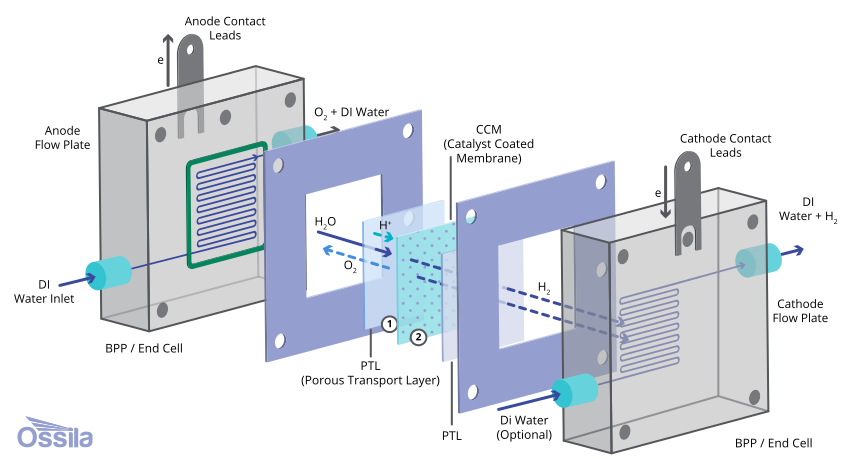 How Does A PEM Electrolyzer Work?
Proton exchange membranes (PEM) electrolyzers sandwich multiple components in a membrane electrode assembly cell. These components include a PEM, end plates, bipolar plates, porous transport layers and various gaskets, inlets and channels. When these elements all work together this creates an efficient system, which can efficiently conduct water hydrolysis under the right environments.
Read more...Contributing Authors
Written by
Product Development Electrochemist
Videography by
Graphic Designer
References
- Scaling green hydrogen: Production, storage, techno-economics and global..., H. B. Aditiya, T.M.I. Mahlia and Z. Huang, Renewable and Sustainable Energy Reviews (2026)
- Global Hydrogen Review 2025, International Energy Agency (2025)
- Hydrogen Production From Steam–Methane Reforming and Electrolysis: A..., H. Togun et al., International Journal of Energy Research (2026)
- Transforming Nature’s Bath Sponge into Stacking Faults-Enhanced Ag..., C.R. Ratwani, S. Karunarathne, A.R. Kamali and A.M. Abdelkader, ACS Appl. Mater. Interfaces (2024)
- £86.5 million equity and grant package for Chronos..., ITM (2026)