


How Does A PEM Electrolyzer Work?
How PEM Electrolyzers work: Step-by-step | PEM Electrolyzer Components | Stacking PEM Electrolyzers | Measuring PEM Water Electrolysis
Proton exchange membranes (PEM) electrolyzers sandwich multiple components in a membrane electrode assembly cell. These components include a PEM, end plates, bipolar plates, porous transport layers and various gaskets, inlets and channels. When these elements all work together this creates an efficient system, which can efficiently conduct water hydrolysis under the right environments.
How PEM Electrolyzers work: Step-by-step

-
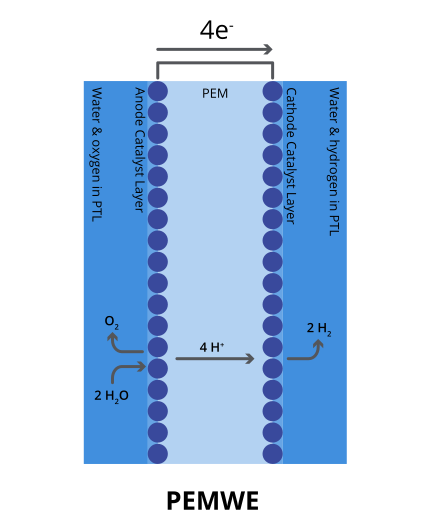
De-ionized water is pumped into the anode side of the cell. It flows along the channels of the bipolar plate or flow fields, and through the porous titanium transport layer (PTL) to the anode catalyst layer, where the catalyst particles (mostly iridium-based) oxidize it. This oxygen evolution reaction (OER) releases oxygen gas, protons and electrons

- The oxygen returns back through the same PTL into the flow field to be carried out with the excess water. This flow also takes away the heat the cell generates. The electrons produced cannot cross the membrane, so they travel through an external circuit via the PTL and the bipolar plate. The protons, meanwhile, are conducted through a hydrated perfluorosulfonic acid (PFSA) membrane, such as Nafion, Aquivion®, Gore-Select®, Fumatech®, etc. This channels the protons toward the cathode, dragging several water molecules with them via electro-osmotic drag. The development of hydrocarbon membranes is also a topic of active R&D.
-
At the cathode, the catalyst particles (mostly platinum-based) combine the arriving protons with the returning electrons to form hydrogen gas. This hydrogen evolution reaction (HER) produces gas that leaves through the carbon PTL and the cathode flow field. It carries along the water dragged across the membrane, so it is dried downstream and the recovered water is recirculated to the inlet.


Combining the two half-reactions gives the overall water splitting reaction which needs a theoretical minimum of 1.23 V at standard conditions.

In reality, roughly 1.8–2.2 V is needed to reach a reasonable current density, because of kinetic overpotentials, ohmic resistance and mass-transport losses. All of this happens in a thin, zero-gap sandwich of components known as a membrane electrode assembly cell.
Even though the feed water is neutral, the local environment within the cell near the membrane is highly acidic, with a pH of roughly 0 to 2. Two things contribute to this.
- One is the continuous generation of large amounts of H+ at the anode.
- The other is the membrane itself. The sulfonic acid groups (–SO3H) of the PFSA dissociate when they meet water and release a high concentration of free H+. This is also what allows the membrane to conduct protons.
This highly acidic environment determines almost every material choice in a PEM electrolyzer. Many common materials cannot operate sustainably in such an environment, so the technology has to rely on expensive, acid corrosion-resistant noble metals.
PEM Electrolyzer Components
Each component within the cell has specific functions and specific requirements. Therefore, each component requires certain materials that are suited for these needs.
The membrane electrode assembly (MEA) is the core functional unit where the electrochemical reactions take place. Its quality decides whether the electrolyzer can produce hydrogen efficiently at meaningful current densities without leaks or bottlenecks.
A standard cell sandwich consists of :
Bipolar & end plate / Gasket / Porous transport layer (PTL) / Catalyst layer / PEM / Catalyst layer / PTL / Gasket / Bipolar & end plate.
Usually, the PEM are coated in different catalysts on either side to facilitate both half reactions of electrolysis. Theses are called catalyst-coated membranes (CCM).
Membranes
The membrane does two jobs at once, and each is governed by a different property.
- As a barrier, it keeps electrons and product gases from crossing between the two compartments, which is governed by its gas permeability.
- As an electrolyte, it conducts protons from the anode to the cathode, which is governed by its ionic resistance.

A membrane's ionic resistance depends on its ion exchange capacity (IEC), its equivalent weight, its water uptake and thickness. Ionic resistance is usually reported either as an area resistance or as a resistivity.
| Property | Unit | Description |
|---|---|---|
| IEC | mmol/g | mmol of ions per gram of polymer) |
| EW | g/mol | Grams of polymer per mole of ions |
| Area Resistance | Ω·cm² | The measured resistance multiplied by the geometric area |
| Resistivity | Ω·cm | The area resistance divided by the thickness |
Gas crossover, on the other hand, is a barrier property that depends on membrane permeability and thickness, and the pressure difference between the compartments.
There is a tradeoff between these two properties. A thinner membrane will conduct protons more efficiently but leaks more and is mechanically weaker.
Some membranes or CCMs require pre-treatment before use.
Electrodes & Electrocatalysts
The ideal catalyst materials for PEMWE are iridium and platinum. However, this increases the cost of the technique because iridium and platinum are precious metals so cell designers try to get the most out of the smallest amount of material by maximizing the electrochemical surface area (ECSA). This is the part of the catalyst surface that is actually reaction-active.
Electrodes can be manufactured as a catalyst-coated substrate (CCS), where the catalyst is sprayed onto the PTL, or as a catalyst-coated membrane (CCM), where it is deposited directly onto the ion-exchange membrane. Industry favors the CCM approach because it gives a better catalyst–ionomer interface, lower contact resistance and a lower risk of layer delamination during operation.
The catalyst is therefore spread as a thin layer on a porous medium or support. Porous titanium or a Magnéli-phase titanium suboxide are often used at the anode. Carbon-based supports work well at the cathode, but they cannot survive the acidic, highly oxidizing environment at the anode because their corrosion resistance is too low.
Porous Transport Layers (PTL)
The PTL sits between the catalyst layer and the bipolar plate. It conducts electrons, delivers water to the catalyst and carries the product gases away.
Most PEM systems use sintered titanium for the PTL closest to the anode and a carbon-based material (paper or cloth) at the cathode. However, these can degrade through temperature variations and the acidic environment, as well as mechanically through compression.
An additional micro-porous layer (MPL) can be added to the catalyst-facing side of the PTL, reducing interfacial contact resistance and physically protecting the membrane from being punctured by the coarser PTL structure. Under differential-pressure operation, the PTL also provides mechanical support to the membrane against the pressure gradient.

Current Collectors, Bipolar Plates (BPP) and End Plates
In laboratory cells, one component can perform three functions: current collection, flow distribution (bipolar plates) and end plate.
These bipolar plates link adjacent cells electrically, so they must be electrically and thermally conductive, gas-tight and corrosion-resistant. To distribute water, clear gases and heat, they use machined flow-field channels, or alternatively a multilayer expanded metal mesh to distribute and control the movement of water, gas and heat through the electrolyzer.
End plates structurally cap and compress the stack. They are typically made of titanium, platinum-coated or gold-coated titanium (at R&D level) or coated stainless steel.

Stacking PEM Electrolyzers
To raise hydrogen output, multiple cells are stacked and connected electrically in series (and hydraulically in parallel), with a bipolar plate between neighboring cells acting as the anode of one and the cathode of the next. Industry favors this design because it keeps the physical footprint compact and lets the cells share the balance-of-plant infrastructure.
Measuring PEM Water Electrolysis
Because all the reactions and transport happen in this compressed, zero-gap MEA electrolyzer, the stack acts as a "black box" that limits direct observation of what is happening inside during operation. Hence, we have to rely on what we can set and measure from outside the system.
Further Resources
 What is a Proton Exchange Membrane Electrolyzer?
Proton exchange membranes (or polymer electrolyte membranes) are semi-permeable membranes that allow the passage of protons while providing a barrier to anions, gases and electrons. They are incredibly useful in both water electrolysis and as PEM fuel cells.
Read more... Gas Diffusion Electrodes (GDE)
A gas diffusion electrode (GDE) is a porous, multilayer electrode that facilitates the meeting of a gaseous reactant, a liquid electrolyte, and a solid catalyst at a single, well-defined interface, known as the triple-phase boundary (TPB).
Read more...Contributing Authors
Written by
Product Development Electrochemist
Videography by
Graphic Designer
References
- EU harmonised protocols for testing of low temperature..., G. Tsotridis and A. Pilenga, Publications Office of the European Union (2021)
- Fabrication of self-supported catalysts via electrodeposition for proton..., J. U. Jang et al., EcoEnergy (2024)