


Droplet Vibration Technique for Surface Tension Measurements

Surface Tension and Viscosity | How to Measure Droplet Vibrations
Pendant or Sessile Droplets? | Preparing a Hydrophobic Surface | Measuring Viscoelastic Properties
Droplet vibrations can be used to measure properties such as the surface tension and viscosity of simple liquids, as well as the rheological/flow properties (both surface and bulk) of viscoelastic materials. A standard vibrational viscometer measures the damping of an oscillating electromechanical resonator when it is immersed in a bulk liquid. The technique discussed here uses an approach where the vibrations of a single droplet are used to measure its own properties.
Surface Tension and Viscosity
In simple liquids, the excess energy associated with their surfaces results in a so-called surface tension or surface energy. These are essentially the same quantity and have identical units (Nm−1). Surface tension is what allows very small droplets (below the capillary length) to retain a spherical shape. When a droplet is deformed relative to its equilibrium state, surface tension provides a restoring force to pull it back to its equilibrium shape. This restoring force has similar dynamics to those associated with a mass on a spring.
This shape change or deformation can be caused by an external force, such as a puff of air or a small mechanical tap on the surface that supports the droplet. These initial deformations cause the droplet to oscillate about its equilibrium shape and the physical units of the surface tension (Nm−1) are identical to those of the spring constant. Measurements of a small droplet's shape oscillation frequency can be used to determine its surface tension, in a similar way that oscillations of a mass on a spring can be used to determine spring constant.
Moreover, the decay of these oscillations provides information about energy dissipation or damping in the droplet. The decay constant associated with the damped oscillations is directly related to the droplet's viscosity which is a measure of a liquid's resistance to flow.
Surface Tension and Vibrational Frequency
The vibrational frequencies associated with the surface modes of a spherical liquid droplet of radius, R, can be related to the surface tension, γ, and density, ρ, of the liquid by the equation:
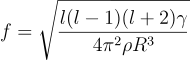
where l=2,3,4… is the mode number of vibration.
Viscosity and Damping Constant
Similarly, the damping constant, α, associated with the decay of the oscillation of a spherical liquid drop are given by

where η is the viscosity of the fluid.
These equations have been successfully used to measure the surface tension and viscosity of diamagnetically levitated droplets.
How To Measure Droplet Vibrations

Droplet vibrations can be detected using a high-speed camera or by passing a low-power laser beam through the droplet and allowing the refracted light to fall on the surface of a photodiode (or other type of photo detector). Using a high-speed camera, image analysis techniques can analyze movies of the droplet motion frame-by-frame. In the light scattering approach, droplet vibrations result in the deflection of the refracted light beam across the surface of the photodetector. This generates an electrical signal, V, that tracks the variations in light intensity, I, measured by the detector and hence the oscillations of the droplets.

Fitting the data obtained for the exponentially decaying voltage oscillations allows the frequency, f, and decay constant, α, to be obtained using the equation

where Vo is the initial voltage, t, is the elapsed time and, ϕ, is a phase factor (a fit parameter). Alternatively, the time dependent voltage data can be Fourier transformed and the frequency position and full width at half maximum of the resulting vibrational peaks can be used to obtain f and α respectively.
Pendant or Sessile Droplets?
Vibrations of pendant droplets with radii smaller than the capillary length of the fluid assume a near spherical shape. They have also been shown to display vibrational properties that are very similar to those described above for perfectly spherical liquid droplets. As such, they provide a convenient geometry for measuring the surface tension and viscosity of small drops.
In this geometry, a small droplet is suspended from the bottom of a pipette tip. The volume or radius of the droplet can be controlled using a syringe pump. A simple camera can then be used to take images of the droplet at rest and determine its radius. A small puff of air can be used to disturb this equilibrium while the camera is recording. From this video, you can find the vibrational frequency and damping constant, and subsequently surface tension and viscosity.
Placing a droplet on a surface, changes both its vibrational frequency and its damping properties in a way that depends strongly on the three-phase contact angle, θ.

Note that the value of θ is in radians and m is the mass of the droplet in the above equation. Hence measurements of the vibrational frequencies of surface supported (sessile) droplets can be used to extract the surface tension of the liquid if the contact angle and mass of the droplet are measured independently. The contact angle can be determined using a contact angle goniometer and the droplet mass can be determined by performing the vibration measurements in the enclosure of an analytical balance.
However, extracting the viscosity from measurements of sessile droplet vibrations can be extremely challenging. A number of additional factors contribute to the damping of droplet oscillations on surfaces that are not present in the bulk liquid or in levitated and pendant droplets such as:
- Increased damping due to the presence of surface contaminants and boundary effects. Surface contaminants can often be picked up from the surface on which the droplet is supported.
- The presence of the substrate causes the velocity gradients associated with the motion of the fluid to decay over shorter distances than they would in the bulk fluid in a levitated or pendant droplet. The increased velocity gradients give rise to higher energy dissipation rates in the droplets and increase the damping coefficients. These effects become more prominent as the contact angle of the droplet on a surface decreases.
One way to circumvent (at least in part) the difficulties associated with boundary effects is to support the droplets on superhydrophobic or super-amphiphobic surfaces. These surfaces contain small scale structures and tailored chemical properties that increase the interfacial energy between the surface and a liquid droplet. This increase in interfacial energy causes the droplet to adopt a spherical shape similar to that observed for levitated droplets. The use of these surfaces greatly simplifies data analysis, allowing surface tension and viscosity more easily than would be possible on surfaces with smaller contact angles.
Preparing a Hydrophobic Surface
It is relatively easy to create a superhydrophobic surface and many commercial products are available that allow researchers to treat e.g. glass surfaces to make sure that water droplets do not stick to them.
A relatively simple approach to the production of super-hydrophobic surfaces involves simply placing a substrate such as a glass slide in the flame of a paraffin candle (make sure to wear heat proof gloves and goggles if you try this). The soot collected on the surface forms complex microscopic and hydrophobic structures that repel water droplets and make them adopt a near spherical shape. These are ideal for demonstrating the drop vibration technique, but caution should be used when analysing any data obtained using untreated candle wax surfaces. Over time, the soot will migrate on to the surface of droplets, changing the measured values of surface tension and viscosity. Obtaining better control over the substrates surface properties allows them to be more stable and reliable for droplet vibration experiments. For example, you can treat a substrate treatment with silane-based chemicals and additional heat treatment before droplets can be placed on them. The use of fluorinated silanes also allows these substrates to repel organic liquids and solvents and hence create super-amphiphobic substrates.
Measuring Viscoelastic Properties
The droplet vibration technique described above has also been used to extract the viscoelastic properties of diamagnetically levitated and super-amphiphobic substrate supported droplets containing water-based solutions of high molecular weight polymers.
Extraction of the viscoelastic properties from droplet vibration experiments is slightly more challenging than extracting the surface tension and viscosity of simple liquids. In principle, anything that contributes to the stiffness of the droplet (both surface tension and viscoelastic effects) will affect its vibrational frequency.
Similarly, anything that has an effect upon energy dissipation in the droplet will change the damping constant associated with the decay of the droplet oscillations. Fortunately, if the effects of surface contaminants and boundary effects can be removed, then the viscosity remains the dominant factor in affecting the decay constant of the droplet oscillations.
The viscoelastic properties of a liquid can be characterized in terms of the real and imaginary parts of the frequency (ω) dependent complex shear modulus

where the real part describes the elastic component of the response of the fluid and the imaginary part is related to the viscosity by the equation

Here ω=2πf is the angular frequency of the vibrations.
For a liquid with a known/independently measured surface tension, the real part of the shear modulus can be calculated using the frequency and damping constant obtained from the droplet vibration experiments, such that

Similarly, the imaginary part of the shear modulus can be obtained using the formula

The frequency dependence of G' and G'' can be obtained by changing the radius of the droplet being studied or by extracting the frequencies and damping constants obtained for higher order vibrational modes of the same droplet. In practice, varying the droplet size using a syringe pump or by manually adding small amounts of liquid to the droplet by some other means seems to work better than analysing higher order modes. These higher frequency modes are damped more quickly that the fundamental (lowest order) mode and it is difficult to extract reliable data from them.
Learn More
 Surface Energy: Formula & Definition
Surface free energy is a measure of the excess energy present at the surface of a material, in comparison to at its bulk. It can be used to describe wetting and adhesion between materials, but is not often used quantitatively. This article will explain the fundamental definition of surface energy, how to calculate it directly using contact angles, and to tune it to fit your needs.
Read more... Contact Angle: A Guide to Theory and Measurement
This guide will explain what a contact angle is and how it is measured. It will also show you how the Ossila Contact Angle Goniometer works and how to get the best measurement results.
Read more...
References
- Vibrations of a diamagnetically levitated water droplet, R. J. A. Hill and L. Eaves, Phys. Rev. E (2010)
- Mechanical vibrations of pendant liquid droplets, RH Temperton, MI Smith, JS Sharp, The European Physical Journal E, 79 (2015)
- Contact angle dependence of the resonant frequency of..., JS Sharp, DJ Farmer, J Kelly, Langmuir (2011)
- Resonant properties of sessile droplets; contact angle dependence..., JS Sharp, Soft Matter (2011)
- Mechanical vibrations of magnetically levitated viscoelastic droplets, RH Temperton, RJA Hill, JS Sharp, Soft Matter (2014)