


Lithium Nickel Manganese Cobalt Oxide


Buy NMC powder | Compare NMC materials | Resources | Technical support
Lithium nickel manganese cobalt oxides, also known as NMC or NCM, are a cathode material for ternary lithium batteries. These materials have a layered structure, with each metal bringing its own properties to battery performance. By adjusting the ratio of nickel, manganese, and cobalt, the properties of the cathode material can be tuned.
Our range includes both polycrystalline and single crystal powder in a variety of Ni:Mn:Co ratios, from 25 g to 250 g depending on your research requirements.
Buy NMC Powder
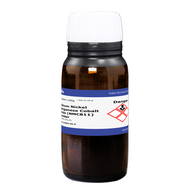
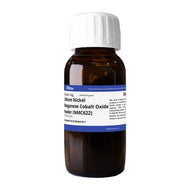

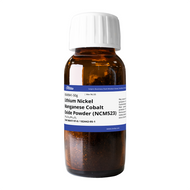


Choose the Right Material
Understanding the properties each metal brings to the cathode material is important when deciding which NMC material is best for your research.
- Nickel enhances energy capacity by acting as the primary redox-active element. Its redox activity occurs at a high potential, resulting in greater energy density. Therefore choosing an NMC materials with a higher nickel content increases the battery's capacity.
- Cobalt provides structural integrity to the cathode, stabilizing the layered structure of the material. This stability helps maintain battery performance over numerous charge-discharge cycles, preventing capacity degradation. It is also redox-active, contributing to a higher cathode voltage.
- Manganese increases safety, stability, and cyclability by reducing the risk of thermal runaway and reinforcing structural integrity. It provides outstanding rate capability, allowing for high current discharge while maintaining low temperatures.
| Advantages | Challenges | |
|---|---|---|
| NMC811 | Highest capacity and energy density among common NMC grades; lower cost due to lowest cobalt content | Lowest thermal stability with greater risk of thermal runaway; highest sensitivity to moisture and air; fastest capacity fade over cycling |
| NMC622 | Higher capacity than NMC111 and NMC523, with reasonable stability; lower cobalt content than NMC111 so more affordable; extensive literature and benchmarking data | Lower stability and safety than NMC111; lower capacity than NMC811 |
| NMC631 | Higher capacity than NMC111 and NMC523, with reasonable stability; good safety and rate capability due to higher manganese content | Less common and not as well characterized than NMC622 or NMC811; cobalt content means only a marginal cost reduction |
| NMC523 | Modest capacity increase over NMC111; similar stability and safety profile to NMC111 | Relatively high cost due to high cobalt content |
| NMC111 | Highest stability and safety among common NMC grades; best cycle life and thermal stability; well-characterized chemistry | Lowest capacity and energy density among common NMC grades; highest cost due to highest cobalt content |
Poly or Single Crystal
Polycrystalline NMC consists of secondary particles made up of small primary grains fused together. The performance of polycrystalline variants are well researched and they offer good rate capability due to shorter lithium diffusion paths. However, the grain boundaries between primary particles are prone to microcracking during cycling, which exposes fresh surface to the electrolyte and accelerates capacity fade over time. This is increased for high Ni polycrystalline NMCs, preventing them from being used in high energy density Li batteries.
Single crystal NMC is made up of individual, monolithic particles with no internal grain boundaries. The absence of boundaries makes single crystal variants far more resistant to mechanical degradation, providing better structural integrity, cycle life, and thermal stability. However, the rate capability is slightly reduced, since lithium ions must diffuse further within each larger particle. At lower Ni content, single crystal variants often offer superior performance than polycrystalline variants.
Resources
 What is a Ternary Lithium Battery?
A ternary lithium battery is a type of lithium-ion battery that has a cathode composed of three different metals: nickel, cobalt, manganese or aluminum. Each one brings its own properties to the overal crystal structure. This means the properties can be tuned through both the selection of the different metals and also the ratio the metals are in.
Read more...Technical Support