PNDIT-F3N
CAS Number 1800206-46-5
Cathode Interlayer Materials (CIMs), Interface Polymers, Luminosyn™ Polymers, Semiconducting Polymers,
n-Type Semiconducting Polymer for Electron Transport Layer
Alcohol soluble cathode interlayer material for polymer organic solar cells and perovskite solar cells
Specifications | MSDS | Literature and Reviews | Related Products | Technical Support
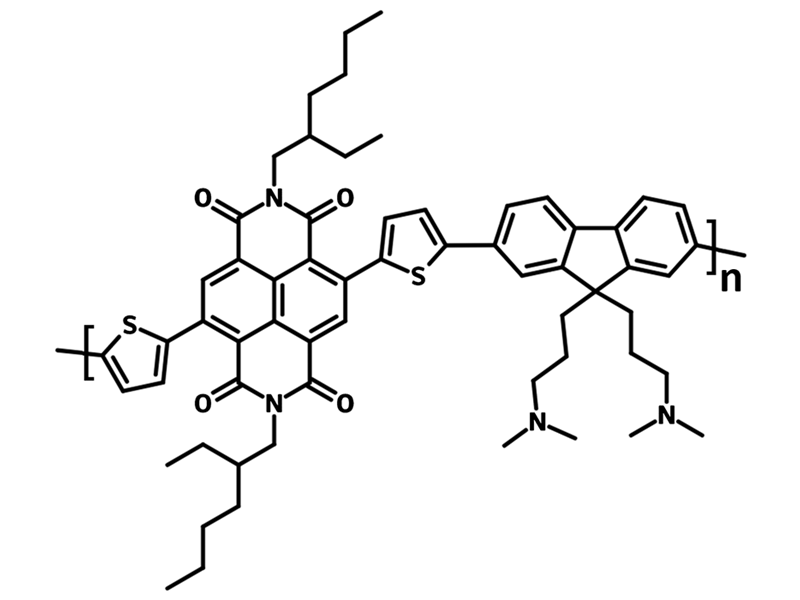
PNDIT-F3N is an alternating n-type conjugated copolymer of electron deficient naphthalene diimide and electron rich fluorene backbone units. As a semiconducting polymer, it is used in high performance polymer organic solar cells as an electron transport layer (ETL) interface between the active layer and the cathode.
The presence of amine groups on the side chains of the polymer can n-dope the acceptor in contact (i.e. to improve the electron extraction properties) and also induce self-doping to generate highly conductive ETLs with reduced ohmic loss for electron transport and extraction. Power conversion efficiency of 19.32% was achieved for a ternary active layer D18:BTP-3FBr:IDIC based device using PNDIT-F3N as the electron transport and PEDOT:PSS as the hole transport.
By mixing two electron transport materials, PNDIT-F3N and PDINN (4:1 wt%), the mixed electron transport layer shows better energy level alignment with the active layer and an improved film morphology, leading to better charge selectivity, enhanced charge extraction, suppressed exciton recombination, and finally a boosted PCE in the PM6:Y6-based solar cells. Additionaly, a polymer organic solar device based on PM6:Y6 as the active layer and PNDIT-F3N and PDIN (3:2 wt%) as the hybrid cathode interlayer yielded higher FF of 74.45% and JSC of 27.12 mA cm2, resulting in a high PCE of 17.4%.

Electron Transport Layer
For polymer & perovskite solar cells

Simple Worldwide Shipping
Reliable delivery via tracked courier

n-Type Conjugated Polymer
With better energy alignment

1.64 eV Bandgap
HOMO = −5.55 eV, LUMO = −3.91 eV
The Luminosyn™ Range
 High Purity Materials: Purified by Soxhlet extraction with methanol, hexane, and chlorobenzene under argon atmosphere.Batch-Specific Data: Confidence in your materials with batch-specific GPC data for your thesis or publications.Large Quantity Orders: Plan your experiments with confidence using polymers from the same batch.
General Information
| CAS Number | 1800206-46-5 |
|---|---|
| Full Name | Poly[(9,9-bis(3′-(N,N-dimethylamino)propyl)-2,7-fluorene)-alt-5,5′-bis(2,2′-thiophene)-2,6-naphthalene-1,4,5,8-tetracaboxylic-N,N′-di(2-ethylhexyl)imide] |
| Chemical Formula | (C61H70N4O4S2)n |
| HOMO/LUMO |
HOMO = −5.55 eV LUMO = −3.91 eV [1] |
| Processing Solvents | Methanol (typically 0.5 mg/ml in methanol with 0.5% vol acetic acid) |
| Synonyms | PF3N-2TNDI |
| Classification or Family | Hole transport material (HTL), Hole injection material (HIL), OLEDs, Perovskite solar cells, Polymer solar cells |
Batch Details
| Batch Number | Mw | Mn | PDI | Stock Info |
|---|---|---|---|---|
| M2472A1 | 42,808 | 11,847 | 3.6 | In stock |
Chemical Structure
Pricing
| Product Code | Quantity | Price |
|---|---|---|
| M2472A1 | 100 mg | £310 |
| M2472A1 | 250 mg | £620 |
| M2472A1 | 500 mg | £1060 |
| M2472A1 | 1 g | £1760 |
MSDS Documentation
 PNDIT-F3N MSDS Sheet
Literature and Reviews
- C. Sun et al. (2017); Interface Design for High-Efficiency Non-Fullerene Polymer Solar Cells, Energy Environ. Sci., 10, 1784-1791; DOI: 10.1039/C7EE00601B.
- Z. Wu et al. (2016); n-Type Water/Alcohol-Soluble Naphthalene Diimide-Based Conjugated Polymers for High-Performance Polymer Solar Cells, J. Am. Chem. Soc., 138 (6), 2004-2013; DOI: 10.1021/jacs.5b12664.
- S. Ding et al. (2021); Boosting the Efficiency of Non-fullerene Organic Solar Cells via a Simple Cathode Modification Method, ACS Appl. Mater. Interfaces, 13, (43), 51078–51085; DOI: 10.1021/acsami.1c16550.