


Spectrophotometry
Spectrophotometry vs. Spectroscopy | Absorption and Fluorescence Spectrophotometry
Spectrophotometry Applications | Instrument Limitations | More Resources

Spectrophotometry examines the interactions between visible light and matter through measurements like absorbance, transmission and reflectance spectroscopy.
A spectrophotometer is a piece of spectroscopy equipment measures the amount of light absorbed by a sample. Some wavelengths of light will be more strongly absorbed by the sample than others, and this information can reveal its molecular structure. This measurement can be useful in many research applications:
- To identify materials by mapping molecular absorption profiles.
- To work out solute concentrations in solutions.
- For detecting trace impurities in samples
- Following the progress of chemical reactions.
By measuring the light intensity transmitted at each individual wavelength, a spectrophotometer builds an absorbance spectrum.
Spectrophotometry vs. Spectroscopy
The terms spectrophotometry and spectroscopy are often used interchangeably. However, there is a subtle difference between them.
| Spectrophotometry |
The study of interaction between light and matter, often measuring transmission or reflection as a function of excitation wavelength. These measurements are usually taken with spectrophotometers. |
|---|---|
| Spectroscopy |
The study of an interaction between radiative energy and matter. This includes techniques that measure light energy (e.g. optical spectroscopy, infrared spectroscopy and Raman spectroscopy) or those that evaluate the energy of charged particles (e.g. mass spectroscopy, radiation detection). |

Spectrophotometer vs. Spectrometer
Like spectroscopy and spectrophotometry, these terms are often used interchangeably but have slightly different definitions.
A spectrometer is the general term for a piece of equipment that can separate and measure spectral components of a physical phenomenon. Spectrometers can measure various phenomena such as electromagnetic light, mass, or nuclear magnetic resonance. This encompasses many tools including mass spectrometers, NMR spectrometers and spectrophotometers.
A spectrophotometer is an instrument used for spectrophotometry measurements. This include for absorbance, fluorescence and transmission spectroscopy.
In optical spectroscopy, spectrophotometers and spectrometers differ in design and ideal applications. Spectrophotometers are commonly associated with biological, life science and chemistry measurements, whereas spectrometer is the general term used in physical sciences.
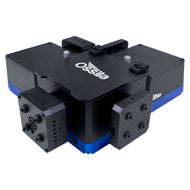
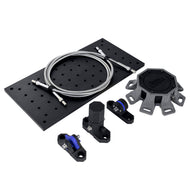
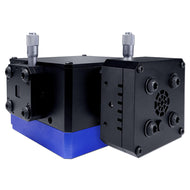
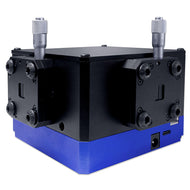
Browse Spectrophotometry Equipment

Absorption and Fluorescence Spectrophotometry
Spectrophotometry investigates how light interacts with matter through measurements like transmittance, absorbance, or reflectance spectroscopy. Some spectrophotometry instruments (often called spectrofluorometers) can also perform fluorescence measurements. However, this often requires the use of a second monochromator.
Absorbance
Absorption spectroscopy measures the attenuation of light as it passes through a material. As light travels through a substance, photons of high enough energy can be absorbed by electrons, transferring them into higher energy states. In most optically active materials, UV and visible photons can promote electrons to higher energy electronic orbitals, while IR photons can increase the vibrational energy of electrons.
Absorbance is measured on a logarithmic scale, representing the ratio of incident light intensity (I0) to transmitted light intensity (I) as it passes through a sample:

Absorbance measurements rely on the Beer-Lambert Law, relating the light absorbed by a sample to an absorbance coefficient, concentration and the path length of the light. There are multiple ways to define absorbance, one of which is described with Beer-Lambert law

Where:
- ε is the molar absorptivity (an absorbance constant for a given substance at a given wavelength)
- c is the concentration of the absorbing species
- l is the path length of the sample (usually the width of a cuvette)
Absorbance measurements are wavelength dependent. Molecules will absorb specific wavelengths of light based on their electronic structure. Therefore, a material’s absorbance spectrum serves as a molecular fingerprint, allowing for both qualitative identification and quantitative analysis of compounds. This technique can track changes in systems or materials in a non-invasive manner (i.e. phase changes, glass transitions in polymers, or changes in pH).
Transmittance
Transmittance and transmission spectroscopy simply measures transmission of light through a sample. The transmittance, T, of a sample is defined as the ratio of light incident on the sample, I0 , to the intensity of light emerging from the other side of the sample, I:

Transmission measurements are related to absorbance measurements via this relationship.

Assuming no reflectance or other optical losses. Transmittance spectroscopy is used to measure the optical transparency of materials. This is necessary for many coatings and thin films. For example, in the case of optoelectronic devices, the top contacts and top facing transport layers need to be transparent across visible wavelengths.
Fluorescence Spectroscopy
Fluorescence spectroscopy, also known as photoluminescence spectroscopy, measures radiative emission from a sample. A sample or material absorbs electromagnetic energy in the form of a photon, then re-emits this energy as another, lower-energy photon.
There are two main types of photoluminescence: fluorescence and phosphorescence. Unlike chemiluminescence or electroluminescence, photoluminescence requires the absorbance of a photon.
Fluorescence measurements are often used alongside absorbance measurements to further understand a molecule's electronic configuration. Absorption is sensitive to the ground state of a molecule, but fluorescence is sensitive to it's excited states. Fluorescence measurements are also more useful for detecting trace impurities in samples.
Fluorescence spectroscopy instruments require a few additional components, compared to those used for just absorbance and transmission measurements:
- Photoluminescence occurs isotropically. Fluorescence can be measured at many angles but the signal intensity at any specific angle is likely to be low. Therefore, these fluorescence systems require optimized configurations to maximize signal intensity while reducing reflection effects and other noise.
- Photoluminescence measurements require a specific excitation source, usually a high-energy light source. The most used sources are UV lasers or other monochromatic light sources.
- Fluorescence measurements require a second monochromator between the sample and the detector to measure the emission spectrum. This also limits stray light, and helps omits the excitation wavelength.
- Often, calibrated spectrofluorometers are the best tools for taking fluorescence and phosphorescence measurements.
Fluorescence vs Phosphorescence
Fluorescence spectroscopy involves the relaxation of an electron through a singlet-singlet transition and happens on a nanosecond timescale. This means that once an electron has absorbed a photon, it almost immediately relaxes and re-emits another, lower-energy photon. This short lifetime means that fluorescence emission occurs only while the sample is being illuminated.
Phosphorescence occurs over a longer time scale. Phosphorescence requires a triplet-singlet transition, which is much less likely to occur than a singlet-singlet transition. The longer lifetime of phosphorescence means that phosphorescent materials emit light use to several minutes after being illuminated. Therefore, these materials glow.
Spectrophotometry Applications
Spectrophotometric Assays
Spectrophotometry is incredibly useful for studying biological samples. It’s non-invasive methodology means you can probe delicate biological materials without damaging them or interrupting key processes you want to measure.
One of the most common applications of spectrophotometry is the spectrophotometric enzyme assay, which tracks how an enzyme catalyzes a reaction. The absorbance spectrum of certain compounds in organic molecules, sometimes known as cofactors, changes when it is bound to an enzyme. Therefore, by monitoring the absorbance spectrum of a sample, you can track enzyme activity in real time.
For example, in the spectrophotometric assay of ascorbic acid oxidase, spectrophotometry quantifies the amount of absorbance at a specific wavelength (usually at 358 nm). This signal signifies the oxidation of ascorbic acid to dehydroascorbic acid and therefore can be used to measure the enzyme's activity. These methods often use microplate reader spectrometers, specialized for spectrophotometric assays.
Molecule Identification
Each molecule has a specific absorbance and fluorescence spectrum. At the very least, molecules often have characteristic peaks or features. Therefore, spectrophotometry can be a simple and easy way to identify molecules in a sample. If reactions are occurring in a solution or if different products form during annealing of a film, this can result in the emergence or disappearance of peaks in absorbance profiles. The location of these peaks can help identify what phases or new compounds are forming.

For example, in the above spectrum of an OPV film, peaks from both o-IDTBR and P3HT can be clearly identified. From the location and intensity of absorbance peaks, the relative concentration of each component can be estimated and some information about their molecular interaction can be inferred. If these peaks are less sharp, this can indicate a better blending of these two materials.
At a low enough concentration, spectrophotometry can investigate the formation of new complexes or signify aggregation in a sample.
Conjugated Organics and Semiconductor Properties
With careful measurement, spectrophotometry can be an accessible and powerful tool to investigate many semiconductor properties.
For organic semiconductors, an increase in the amount of conjugation in an organic molecule will cause a bathochromic shift (where an absorbance peak shifts to a higher wavelength than expected).
For more traditional semiconductors, users can measure the band gap using absorbance spectroscopy, using the Tauc equation.

Where A is an optical constant, h is Planck's constant, α is absorption coefficient, Eg is the material's band gap, and v is the frequency of the photon. γ is a factor that varies depending on the nature of the electronic transition (0.5 for direct band gap semiconductors, 2 for indirect). For indirect bandgap transitions, it is equal to 2.
For direct band gap semiconductors, the band gap can be estimated by plotting (αhν)2 against hv and applying a linear fit to the absorbance edge of this plot. The x-intercept will equal the material’s band gap energy.
For several composite semiconductors, like perovskite solar cells, the band gap changes with different material composition. For example, the incorporation of bromine into a perovskite crystal lattice blue shifts it’s absorbance edge.
Solution Concentration, Optical Density and Impurity Measurements
Beer-Lamberts law provides a simple way to quantify the concentration of an absorbing material in a solution. It is easy to create a reference for a material and a certain spectrophotometry set up, simply by measuring the absorbance intensities of the target material at known concentrations. This method is used in many applications both in laboratories and in the field, from optical density measurements of bacterial cultures to measuring trace impurities in water samples.
Characterizing Device Layers
Most optical or optoelectronic devices require additional layers to function effectively in a device. The desired optical properties of these layers may differ from the optically interesting material. Additionally, extra interlayers can be introduced into a device, specifically to improve its optical properties. Examples of these layers include:
- Antireflective coatings: To increase absorption of light.
- Charge transport layers: To ensure that these layers transmit light of desired wavelength through to the absorbing molecules.
- Up- or down-shifting molecules: To convert wasted light into useful light.
It is important to characterize these independently from the rest of the device.
Spectrophotometry Limitations
While spectrophotometers are valuable in a wide array of applications, there are some measurements that are outside of their ability. Principle amongst these are fluorescence measurements. Fluorescence measurements are often used alongside absorbance measurements to gain a better picture of a molecule's electronic configuration. Absorption is sensitive to ground state of a molecule, but fluorescence is sensitive to its excited state structure. Fluorescence measurements are also more useful for detecting trace impurities in samples.
Furthermore, they struggle to measure absorption of very fluorescent samples. The broadband excitation light may stimulate some fluorescence emission from the sample. This fluorescence is mixed in with the transmitted light, ‘contaminating’ the transmission spectrum.
Both limitations can be overcome by the spectrofluorometer, which includes monochromators, detectors and light sources aligned to measure absorbance and fluorescence measurements with one instrument.
More Resources
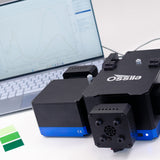 How Does A Spectrophotometer Work?
Spectrophotometers are analytical instruments that measure the intensity of light as a function of wavelength. This measurement is usually taken after a broadband light source is transmitted through a sample for either an absorbance or transmittance measurement. The four most important components that a spectrophotometer needs are:
Read more...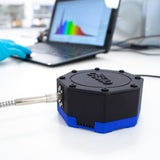 Choosing Spectroscopy Instruments
UV-Vis spectroscopy (or optical spectroscopy) is a simple but effective technique used to probe the molecular structure of a material. Measuring absorbance and emission of light from a sample can give you vital data about:
Read more...