


Microrheology

Microrheology uses the motion of small (nanometre to micron scale) particles to probe the viscoelastic properties of materials. This technique can be applied to the study of polymer solutions, biological fluids and cellular environments, gels and polymer networks such as elastomers.
There are a number of different approaches to performing microrheology experiments. These include (but are not limited to):
- Video particle tracking experiments
- Dynamic light scattering studies
- Diffusing wave spectroscopy.
In all of these techniques, small particles are suspended in the material of interest and measurements of their motion are used to extract information about the local mechanical (viscoelastic) properties.
Active vs. Passive Microrheology
In passive microrheology, optical methods, like dynamic light scattering (DLS), diffusing wave spectroscopy (DWS) or simply observation under a microscope, are used to track the motion of particles suspended in the material of interest. Rheological properties are determined by tracking the thermally driven diffusive motion of these tracer particles.
Active microrheology techniques use an external stimulus (such as a magnetic field or direct force) applied to the particles. Their resulting motion is used to investigate the local rheological properties of the material in which they are suspended. Active techniques include methods such optical tweezers or atomic force microscopy (AFM).
This article with focus on passive microrheology techniques.
Theory of Microrheology
In a passive microrheology experiment, the particles move purely under the influence of thermal (Brownian) motion.
A typical passive microrheology experiment involves taking measurements of the mean square displacement, < r2(t)>, of the particles as a function of time, t. In the case of a particle diffusing in a purely viscous liquid, the mean square displacement is linear in time,

where D is the diffusion coefficient of the particles and the factor of six assumes diffusion in three dimensions.
If the material is an elastic solid then the particles will not be able to move, there will be no net translation of the particles and their mean square displacements will remain constant, but non-zero. i.e.

The motion of tracer particles in viscoelastic materials will show some characteristics of both viscous liquids and elastic solids. Viscoelastic materials have time dependent mechanical properties. They will behave like solids at short time scales i.e. time scales lower than the molecular relaxation time of the suspending materials. However, they flow like liquids on longer time scales. The mean square displacement < r2(t)> will also display behaviour that is intermediate between that of solids and liquids, which depends non-linearly on time, t, with a power law somewhere between zero and one. Moreover, the time-dependence of viscoelastic materials means that the power law associated with the mean square displacement, n(t), is itself time-dependent, giving the result that

where 0 < n(t) < 1.

Regardless of which technique is used to extract the mean square displacement, the process of calculating the microrheological properties is the same. In all cases, the frequency dependent complex shear modulus, G*(ω), of the material in which the particles are suspended can be calculated using the equation

where ω (=2πf) is the angular frequency, kB is the Boltzmann constant, T is the temperature in Kelvin, a is the radius of the probe particles, i is the square root of minus one and F(Δr2(t)) is the unilateral (one-sided) Fourier transform of the mean square displacement of the probe particles.
The shear modulus can then be separated into it’s real and imaginary parts, where G’(ω) is the frequency dependent elastic shear modulus and G’’(ω) is the loss modulus. This latter parameter can be related to the frequency dependent viscosity, η(ω), of the material via the equation

Particle Tracking Microrheology
Particle tracking microrheology uses a high-speed camera and appropriate optics to capture the motion of micron scale particles suspended in the medium under investigation. This needs high frame rates and good quality optics to be able to measure the small, time-dependent position fluctuations of multiple particles as they move around under the influence of Brownian motion. This can be observed with an optical microscope. The particles sizes need to be on the micron scale so that they are visible, but small enough and as closely matched in density to the surrounding medium as possible in order to eliminate sedimentation effects.

In a typical measurement, movies of the particle motion are taken using the high-speed camera and then the position of the particles in each frame is determined. The position of the particle at some time, τ, after the starting time, t, of the experiment is r(t+τ). The mean square displacement of each particle relative to a given time, t, is then calculated using this formula.

where the triangular brackets denote an average over multiple time intervals within the data, each of duration τ. The average value of the
Two-Point Microrheology
In the case of two-point microrheology, multiple particles are tracked and the correlations in the relative positions of two neighbouring particles are used to determine the local value of G*(ω) such that

where R is the separation between the particle centres and F(Δr1(t)Δr2(t)) is the Fourier transform of the cross-correlation of the two particle displacements.
Dynamic Light Scattering
In a dynamic light scattering (DLS) experiment, laser light is scattered from a suspension of nanoscale particles in the solution of interest.
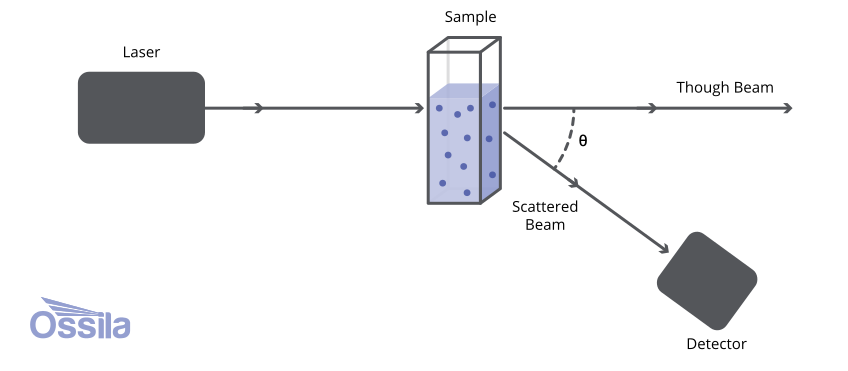
Time dependent fluctuations in the intensity of the scattered laser light, I(t), are used to calculate an intensity autocorrelation function, g2(τ), of the form

where τ is a correlation time and the triangular brackets again denote an average taken over multiple time periods within the scattering signal. This intensity autocorrelation function can then be written in terms of an intermediate scattering function, g1(τ)

where

and

Exponential fits to the intensity autocorrelation data obtained during a DLS experiment can then be used to extract the mean square displacement of the particles if the refractive index, n, of the suspending medium, the wavelength, λ, and the scattering angle, θ are all known. Once obtained, the mean square particle displacement can be used to determine the complex frequency dependent shear modulus of the suspending material, G*(ω).
Diffusing Wave Spectroscopy
Diffusing wave spectroscopy (DWS) is an extension of the dynamic light scattering (DLS) approach described above. The key difference being that the particle concentrations in DWS are significantly higher than in DLS, leading to multiple scattering effects. The theory underpinning DWS considers these multiple scattering events whereas the assumptions underpinning DLS are that the particles are so dilute that only single scattering events occur.
Important Experimental Considerations
Particle size and concentration are important factors when it comes to optimizing microrheology experiments.
- The particles have to be large enough to scatter light or be imaged using video microscopy.
- The particle also need to be concentrated enough to allow good statistics for the mean square displacement data to be obtained.
- However, the particle concentration cannot be too high as this will introduce hydrodynamic interactions between the particles.
- In solutions containing large molecules, bridging effects between neighbour particles are likely to have a significant effect upon particle dynamics.
Read More
Dynamic Light Scattering Instrument
Dynamic light scattering (DLS) is a non-invasive measurement technique used to measure the size of colloids or nanoparticles suspended in a liquid.
Read more... Rheology
 is the study of the flow properties of materials. For simple liquids, this involves measuring the viscosity (or resistance to flow) of a fluid. In the case of viscoelastic materials such as polymers, polymer solutions, dense granular suspensions, and biological materials, the flow behaviour is much more complex.
Read more... Contact Mechanics: Measuring Adhesive and Mechanical Properties
Contact mechanics provides a simple but effective method for measuring the elastic and adhesive properties of soft materials. It has applications in the characterization of rubbers, elastomers, adhesive formulations, biological and other soft, polymeric materials such as gels.
Read more...