


Rheology
Rheology is the study of the flow properties of materials. For simple liquids, this involves measuring the viscosity (or resistance to flow) of a fluid. In the case of viscoelastic materials such as polymers, polymer solutions, dense granular suspensions, and biological materials, the flow behaviour is much more complex. This is because these materials display some characteristics of both liquids and solids depending upon how fast the materials are deformed, i.e. the measurement time scale.
Rheological properties, such as viscosity, yield stress and elasticity, are often measured using a rheometer. For materials with complex fluid dynamics, such as viscoelastic materials, it is important to measure these properties under a variety of conditions (different time scales, different temperatures) as these properties are dependent not only on the magnitude of stress or strain, but also the way that stress or strain is applied.
Viscoelastic Behaviour and Deformation Timescale
The frequency/time dependent nature of the flow properties of viscoelastic materials originates in the fact that the molecules, or particles in the case of a granular suspension, are relatively large (~10 nm – 1 μm). The size of the components, relative to small molecules (less than a few nanometers) means that they move very slowly.
The relaxation times of a material can loosely be defined as the time it takes for a molecule/particle to move a distance equivalent to its own diameter. In dense granular systems and entangled polymer melts, this time can be on the order of milliseconds (10-3 seconds) to seconds, possibly even higher. These timescales are significantly higher than the relaxation times associated with simple liquids, where the molecules typically relax on timescales of order one picosecond (10-12 seconds).
The longer timescales observed in polymeric and granular materials are comparable to the time scales on which we, as humans, can deform them. When the relaxation time of a material becomes comparable to the time scale of deformation, new and interesting behaviour is observed. For example, if we deform a material faster than its component parts can rearrange (or relax) then by definition the material cannot flow. In this case, we observe an elastic response from the material. However, if we now take the same material and deform it on a timescale longer than the relaxation time, the polymer molecules or granular particles will be able to re-arrange and the material will flow like a simple liquid. When the experimental timescale and relaxation time are comparable, then intermediate behaviour is observed.
Viscoelastic materials pervade our lives and they include (but are not limited to) things like glues, soaps and other personal care products. Biological fluids can also display visco-elastic properties. Familiar examples of viscoelastic materials include silly putty and oobleck.
For example, silly putty is a highly entangled polymer melt made of large molecules of the polydimethylsiloxane (PDMS). When rolled up into a ball and thrown against a wall or the floor, it bounces and displays an elastic response. However, if the same ball is placed on a table it will flow under its own weight and start to form a puddle.
Oobleck on the other hand is essentially a dense suspension of cornflour particles suspended in water. The concentration of particles is so high that they are touching and the interstitial spaces are filled with liquid. When deformed slowly, the large cornflour particles can move around and the material will flow. Hitting the suspension or stirring it quickly causes the cornflour particles to jam, supporting the applied deformation and giving an elastic response. This has resulted in a number of rather fun applications of Oobleck where people run, jump and cycle across large pools filled with this interesting material as well as placing it in the cones of loud speakers and watching it dance in response to acoustic excitation.
Rheometer Working Principles
The complicated nature of the mechanical response of viscoelastic materials necessitates the use of a geometry that can measure the viscosity of runny liquids, the elastic properties of simple solids and everything in between.
The most common approach is to measure the frequency dependent shear properties of the material of interest using a rheometer. Shear deformations can readily be performed on solids, liquids and viscoelastic materials whereas other types of deformation e.g. elongational and compression make no sense for things like liquids which are incompressible and fall apart during elongational flow.
A typical rheology measurement involves sandwiching the material of interest between two plates. The most common setups use parallel plates or a cone and plate geometry.

In both cases, the bottom plate is flat and held fixed. It can be heated to control the temperature of the sample if required. The top plate (flat or conical) is then rotated backwards and forwards repeatedly, in order to create a rotational shearing effect in the material. The frequency and/or amplitude of the oscillatory deformation are varied while torque and strain sensors mounted above the top plate recorded the frequency dependent shear stress, σ(ω), and strain, ε(ω), that are applied to the sample. Here, ω=2πf, is the angular frequency of the applied deformation.
Using a conical top plate with a small cone angle is often the preferred geometry because this ensures that the strain rate is uniform everywhere in the sample. In contrast, the use of parallel plates results in a variable strain rate that increases with the distance from the centre of rotation.
This can be illustrated with a relatively simple example. If we assume that the bottom plate is fixed and the top plate rotates with a constant angular speed, ϕ , then the shear strain in the sample at a distance, r, from the centre of rotation is

In the parallel plate geometry, the separation of the plates, y, is constant everywhere and hence the strain rate increases linearly with distance from the centre of rotation.
However, if a conical top plate is used with a cone angle, θ (see diagram), then the local plate separation is

and the shear strain rate becomes independent of, r,

This is also true when an oscillatory deformation is applied to the sample.
Defining Rheological Properties
Rotational rheometry measurements can either be stress-controlled or strain-controlled, depending upon the application. In a stress-controlled measurement, an oscillatory, time-dependent stress of the form

is applied to the sample, where σo is the maximum amplitude of the applied stress and i is the square root of minus one. This results in a time-dependent strain of the form

being generated in the sample, where εo is the strain amplitude and δ is a phase factor that is dependent upon the properties of the sample. In a strain-controlled measurement an oscillatory strain is applied to the sample and the stress is measured.
The complex shear modulus, G* , can then be determined by taking a ratio of the stress and strain in the sample such that

Separating G* into its real and imaginary components and re-writing the complex exponential in terms of trigonometric functions gives

where

is the shear storage modulus which describes the in-phase (elastic) component of the response of the sample and

is the (out of phase) shear loss modulus of the sample.
This latter parameter is related to the viscosity of the sample by the equation

Another, potentially useful parameter is the loss tangent

which gives a ratio of the viscous and elastic properties of a sample. When tan δ<1, the material behaves more like an elastic solid, when tanδ δ>1, the sample will flow more like a liquid, and tan≈1 is indicative of viscoelastic behaviour.
If the frequency of the applied stress/strain is varied, then the frequency dependence of the shear storage and loss moduli can be determined. Moreover, if the temperature of the sample is controlled by heating the bottom plate, the rheological properties can be mapped over a wide frequency range by using time-temperature superposition.
Learn More
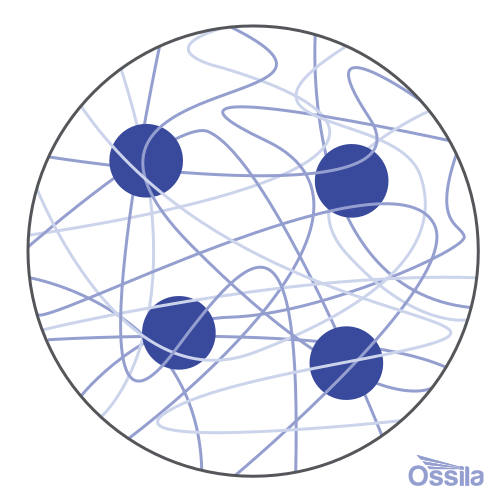 Microrheology
 uses the motion of small (nanometre to micron scale) particles to probe the viscoelastic properties of materials. This technique can be applied to the study of polymer solutions, biological fluids and cellular environments, gels and polymer networks such as elastomers.
Read more... Dynamic Light Scattering Instrument
Dynamic light scattering (DLS) is a non-invasive measurement technique used to measure the size of colloids or nanoparticles suspended in a liquid.
Read more...