


Dynamic Light Scattering Instrument
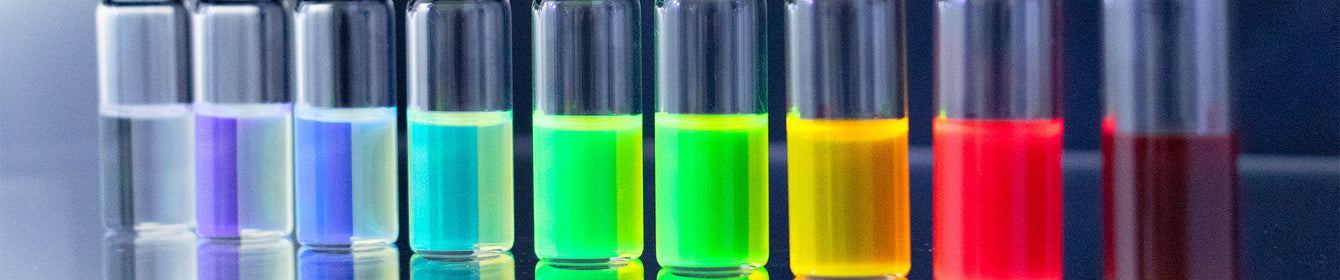
Dynamic light scattering (DLS) is a non-invasive measurement technique used to measure the size of colloids or nanoparticles suspended in a liquid.
The basic components of a dynamic light scattering (DLS) instrument are a coherent, collimated light source ( such as a laser), a sample holder, a detector and a correlator. The laser is directed into a liquid sample containing particles. Light is scattered by the particles in the liquid and the intensity of this scattered light is measured over time. Analysis of the time dependent fluctuations in intensity can be used to determine the average particle size and polydispersity.
Dynamic light scattering is a fast, versatile technique that is capable of measuring a range of particle sizes. It is widely used across fields such as polymer science, analytical chemistry, and colloidal and quantum dot research.
How Does A DLS Instrument Work?
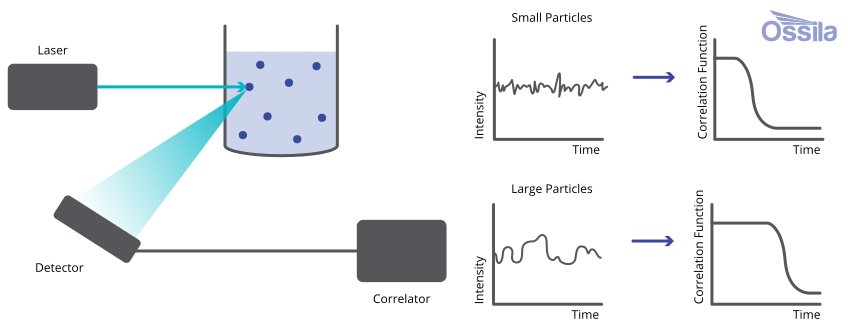
A coherent beam of monochromatic light (usually a laser) is used to illuminate a small region of a liquid sample containing the particles of interest. In many cases, the suspending liquid is water or an organic solvent with a low viscosity.
- The light scattered by the particles is collected and measured using a very fast and sensitive detector. This is usually an avalanche photodiode.
- As the particles in the liquid move around, their relative positions inside the liquid change and the measured scattered light intensity changes. Large particles move more slowly than smaller particles and this has a corresponding effect upon the rate of change of the scattered light intensity.
- The rate of change of the intensity (and hence the relative change in particle positions) can be used to determine the size of the particles - particularly if their shape is known. This is achieved by calculating an intensity autocorrelation function using the time dependent light scattering data. This is often done in hardware using a piece of equipment called a correlator.
- The decay constant of the autocorrelation function is directly proportional to the diffusion coefficient of the particles. If the particle shape is known, then an equation that relates the diffusion coefficient to the size of an object can be used to extract the particle dimensions.
Dynamic Light Scattering Theory
Conventional light scattering is a technique that can be used to extract information about the arrangement (relative positions) of particles or other structures in a sample. In fact, the scattered light intensity is essentially a Fourier transform of the relative positions of the particles that are illuminated by the incident beam of light. The incident light needs to be coherent in order to produce coherent scattering and this is why lasers are often used. In the case of visible radiation, scattering is caused by spatial variations in the dielectric constant, ε, (or refractive index, n) in a material. A set of particles will often have a different dielectric constant to the suspending liquid and will hence generate enough contrast to scatter light.
If the scattered light provides information about the local arrangement of particles, then it follows that the scattered light intensity will change if this local arrangement changes due to their random thermal (or Brownian) motion. Time dependent changes in the arrangement of the particles generate time dependent fluctuations in the local dielectric constant (averaged over the size of the light beam incident upon them). This results in time dependent changes in the scattered intensity. This is the physical principle that underlies dynamic light scattering.
The wavelength dependent light scattering intensity is proportional to the mean square of the spectral density (essentially the square of the modulus of the Fourier transform) of spatial variations in dielectric constant i.e.

where q is the so called scattering wavevector and is related to the wavelength, λ, of the incident light by the relation
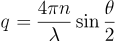
Here, n is the refractive index of the surrounding medium (in our case the suspending liquid) and, θ, is the angle between the scattered and incident light beams.
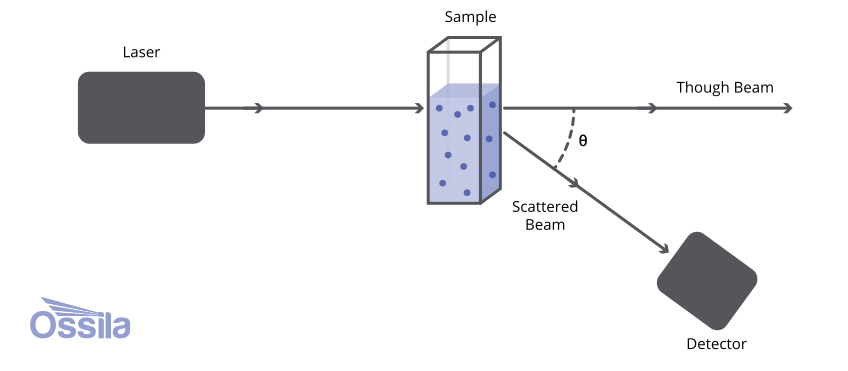
Given that random thermal (Brownian) motion gives rise to time-dependent changes in the arrangement of particles, then to a reasonable approximation the time-dependent fluctuations in local particle concentration, c, can be described by a diffusion equation of the form

where, D, is the diffusion coefficient.
Fourier transformation of this equation into q space gives the relatively simple result that

This is a simple first order differential equation which can be solved by separation of the variables (c(q) and t) and by integration. Doing this gives the result that

where co(q) is a constant (when t=0). This suggests that correlations in the concentration of particles decay exponentially when considered in q space.
The scattering intensity is directly proportional to spectral density of the fluctuations in dielectric constant and the dielectric constant is directly proportional to the concentration of particles i.e.

The intensity autocorrelation function  should therefore have the form

In this simple derivation, we have arbitrarily defined a time, t=0. In reality, particles are always diffusing and correlations in light scattering intensity are always decaying. To circumvent this difficulty we use the true definition of the intensity autocorrelation function. Rather that calculating the correlations in intensity at some time, t, relative to an arbitrary time t=0, this calculates the correlation function of the intensity at some time, t+τ , relative to a time t (where τ is a correlation time). This is obtained from the time dependent intensity scattering data by numerical computation of the integral.

Clearly it is not possible to calculate the integral over an infinite range of times as this equation suggests. As a result, a numerical approximation is often obtained from an intensity signal with as long a duration as possible.
The advantage of using the true definition of the autocorrelation function is that the entire time dependent scattering intensity signal can be used. In this case, the concentration (and dielectric constant) fluctuations still decay exponentially (as described above), but the intensity autocorrelation function takes the form.

where α and β are constants.
Hence an exponential fit to the computed intensity autocorrelation function can be used to obtain values for the parameters α, β, and the decay rate, R(q),

If the refractive index, n, of the suspending medium, the wavelength of light, λ, and the scattering angle, θ, are known, then an exponential fit to the intensity autocorrelation function can be used to extract the diffusion coefficient of the particles. Moreover, if the shape of the particles is known then an equation that relates the diffusion coefficient to their size can be used to extract their dimensions.
The most simple example that we can consider is that of a diffusing spherical nanoparticle. The Stokes-Einstein equation states that the translational diffusion constant, Dτ, of a spherical particle in a liquid can be related to its hydrodynamic radius Rh.

where kB (=1.38 x 10⁻²³ JK-1) is Boltzmann’s constant, T is the temperature (in Kelvin) and η is the viscosity of the suspending liquid (in Pas). Hence, by controlling these parameters it is possible to use the decay rate of the intensity autocorrelation function to extract the size of the particles in a suspension.
DLS Microrheology
DLS can also be used to extract information about the rheological (flow) properties of the suspending fluid if the particle size is well known. It does this by tracking the motion of tracer particles suspended within the medium of interest. These techniques are known as microrheology techniques.
Time dependent fluctuations in the intensity of the scattered laser light are used to calculate an intensity autocorrelation function, g2(τ), of the form

where the triangular brackets represent an average taken over multiple time periods within the scattering signal. This intensity autocorrelation function is related to the intermediate scattering function, g1(τ) by

Where g2(0) is the value of g2 when τ=0 and,

Exponential fits to the autocorrelation function obtained from the DLS can then be used to extract the mean square displacement <∆r2(τ)> of the particles as they diffuse around in the medium. An analogous equation to that used to extract the particle size in a normal DLS experiment can then be used to extract the frequency-dependent complex shear modulus, G*(ω), of the material in which the particles are suspended, such that,

where ω (=2πf) is the angular frequency, kB is the Boltzmann constant, T is the temperature in Kelvin, a is the radius of the probe particles, i is the square root of minus one and F(Δr2(t)) is the unilateral (one-sided) Fourier transform of the mean square displacement of the probe particles.
DLS Measurement Range
Most instruments are equipped to handle a broad range of particle sizes between 0.3 nm - 10 μm. To maximize your signal, you can vary the concentration of suspended particles. However, care should be taken to make sure that your particle concentration is not too high. Too high a concentration can result in multiple scattering events which significantly complicate the data analysis. The optimal concentration can often be worked out empirically, with DLS capable of measuring signals from samples of a few ppm to 40 vol%.
DLS can also measure the distribution of size (or polydispersity) of particles in a suspension. Most DLS systems will provide this information with a polydispersity index (PDI). This provides a measure of how heterogenous your particle sizes are. This is especially useful if you are trying to create or synthesize uniform particles of a specific size such as with gold nanoparticles. If your sample is too polydisperse your results might be unreliable.

Why Use Dynamic Light Scattering?
There are many reasons to use dynamic light scattering to characterize your solution.
 FastNon-invasiveEasyWide measurement rangeVersatileNot sample dependent
The broad measurement range means DLS can be used to estimate sizes of many different materials in many different industries, including:
- Polymer Synthesis
- Characterizing protein sizes
- Quantum dot characterization
- Study of Nanoparticles and Colloids
More Resources
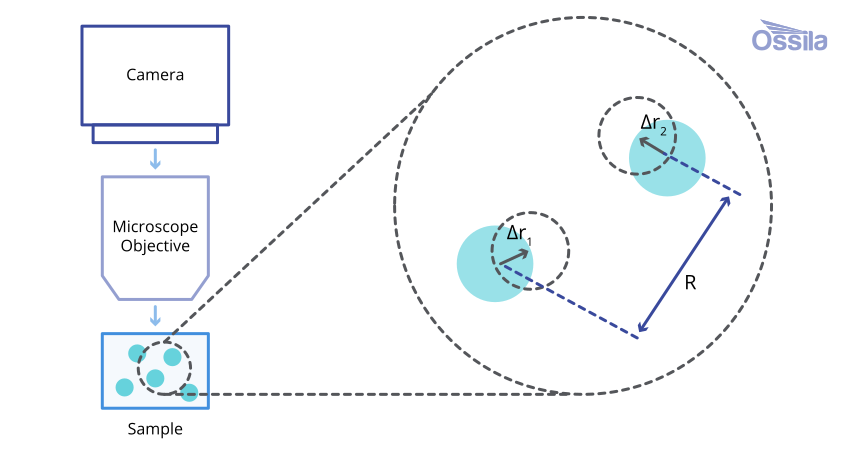 Microrheology
Microrheology uses the motion of small (nanometre to micron scale) particles to probe the viscoelastic properties of materials. This technique can be applied to the study of polymer solutions, biological fluids and cellular environments, gels and polymer networks such as elastomers.
Read more...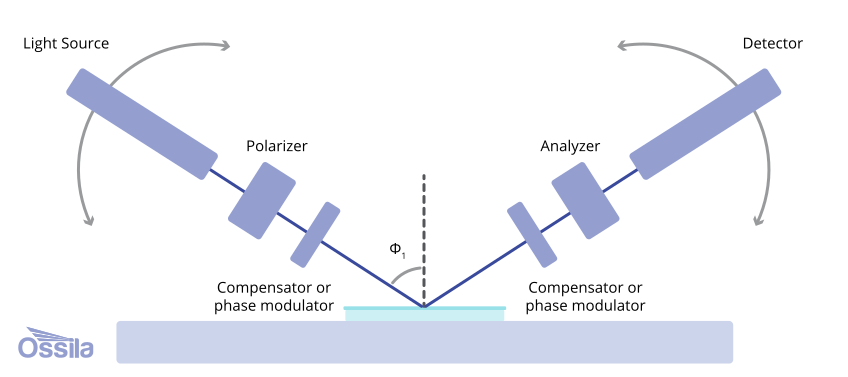 What is an Ellipsometer? An Introduction to Ellipsometry
Ellipsometry is an optical technique that can be used to measure the thickness and optical properties of thin films. An ellipsometer measures the change in the polarization state of light after interacting with a sample. This helps determine sample properties (including film thickness, roughness and extinction/absorbance coefficients) at each wavelength of interest.
Learn more...Contributors
Application Scientist
Associate Professor, University of Nottingham