


Contact Mechanics: Measuring Adhesive and Mechanical Properties
Contact mechanics provides a simple but effective method for measuring the elastic and adhesive properties of soft materials. It has applications in the characterization of rubbers, elastomers, adhesive formulations, biological and other soft, polymeric materials such as gels.
The principles that underpin contact mechanics are relatively simple and are based upon a theory that was originally developed by Johnson, Kendall and Roberts, also known as the JKR theory. This original theory dealt with the contact mechanics of rigid non-adhesive objects. Maugis and Barquins later developed this theory to include adhesive interactions.
Contact Mechanics Set Up
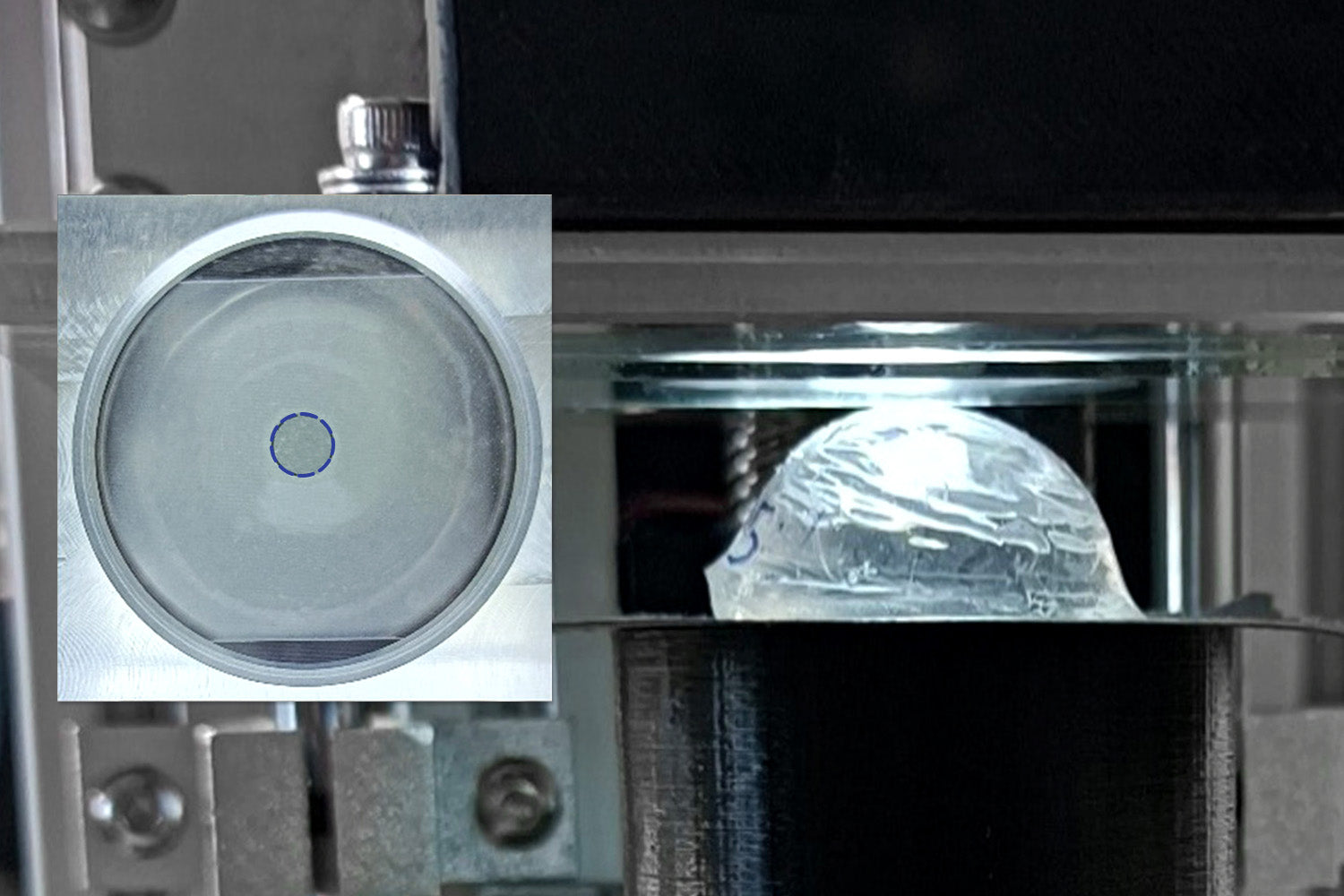
In a typical JKR contact mechanics experiment, a hemispherical object with a well-defined radius of curvature (e.g. a glass lens) presses into a soft deformable object such as an adhesive, gel or elastomer layer. Alternatively, a hemispherical cap of a soft material can be pressed into contact with a hard surface such as a glass slide.

When the two surfaces are pressed into contact, they will both deform and a small contact patch will develop between them. The geometry of this setup means that the contact patch formed has a circular shape. The radius of this contact patch increases with the applied load and is dependent upon the mechanical properties of the contacting objects and the adhesive forces between them.
For either set ups, surface treatments can be applied to the glass (using e.g. silane chemistry) to facilitate measurement of the adhesive interactions between the softer material and surfaces with different chemistries.
Theory Of Contact Mechanics
During dynamic loading and unloading experiments, where the two materials are pressed together and then pulled apart, researchers can measure the displacement, the radius of the contact patch, a, and the applied load, F. These three parameters can be used to extract the elastic (or Young’s) modulus of the soft material and the harder contacting object, as well as the energy release rate, G using the two following equations:


Where h is the initial thickness of the soft material layer, E is the Young’s Modulus of the soft material and ν is it’s Poisson ratio. Materials such as gels, elastomers and rubbers are usually close to being incompressible and typically have a value ν=0.5.
It is possible to perform a two-parameter fit (E and G) to the force versus contact radius data using the second equation above. However, this often leads to less reliable results. Results will often be more reliable if the displacement versus force data (first equation) is initially used to obtain the value of E. This can then be followed by a fit to the force versus contact radius data to obtain G once E has been determined.
What Will Contact Mechanics Measurements Tell You?
The Youngs Modulus, E, provides information about the mechanical properties of the soft material while, G, is a measure of the strength of the adhesive interactions between the surfaces. This latter parameter depends on how fast the contact patch between the two surfaces grow.
In the limit of small growth/retraction speeds, G provides a measure of the thermodynamic work of adhesion, w, between the two surfaces. This is a fundamental property of the interface between the two materials. Here, w can be related to the surface and interfacial tensions of the materials under investigation.

Where γa and γb are the surface energies of the hard and soft materials and ab is the interfacial energy of an interface between them.
Treatment of one or more of the surfaces results in a change in the measured parameter G. Hence, by manipulating the surface chemistry of the hard glass surface using silane chemistry, or by depositing of a thin layer of material on its surface (e.g. spin coating), it is possible to further manipulate and probe the strength of the adhesive interactions between soft materials and different surfaces.
Further Resources
 Collimated Light Source
Collimated light sources emit light in a parallel beam which can be used in many areas of spectroscopy. A well-known example of collimated light is a laser, which produces collimated light of a single wavelength.
Read more... Contact Angle: A Guide to Theory and Measurement
This guide will explain what a contact angle is and how it is measured. It will also show you how the Ossila Contact Angle Goniometer works and how to get the best measurement results.
Read more...