


RS-2
CAS Number 3058284-08-2
Self-Assembled Monolayers (SAMs), Latest Products, Perovskite Interface Materials, Charge Transport Layer Materials,
For Perovskite Solar Cells with High Photothermal and Electrochemical Stability
Suitable for large-area solution processing
Product Information | MSDS | Literature | Related Products | Technical Support
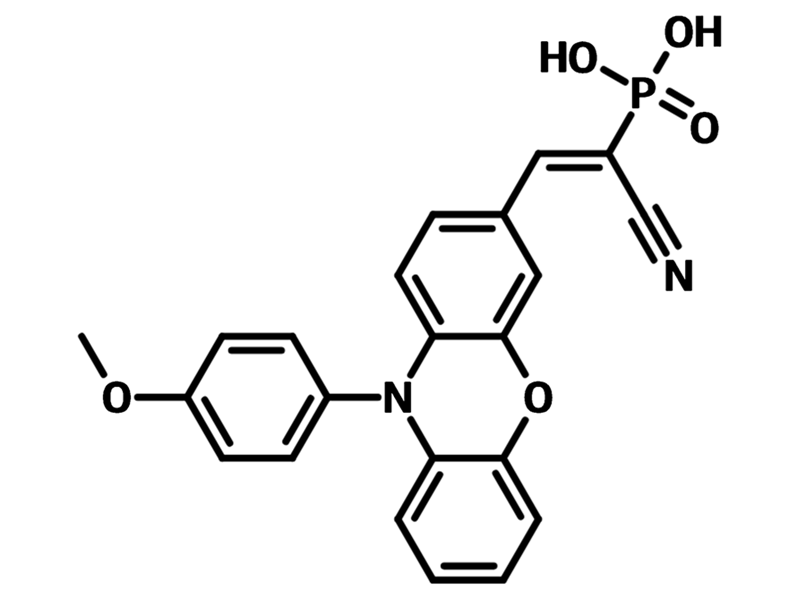
RS-2 is a self-assembled monolayer material with a cyanovinyl phosphonic acid (CPA) anchor group, a rigid conjugated phenyl linker, and a phenoxazine terminal. Adopting a coplanar donor-acceptor strategy, the electron-rich methoxyphenyl phenoxazine acts as the donor and cyanophosphonic acid as the acceptor to facilitate hole transport across the self-assembled thin layer between the substrate and perovskite active layer. With the introduction of the molecular steric hindrance, RS-2 diradical thin film exhibits improved assembly uniformity and large-area solution processability with high photothermal and electrochemical stability.
A perovskite solar cell based on RS-2 as the hole selection layer demonstrates a champion power conversion efficiency (PCE) of 26.3% while retaining >97% of its initial efficiency after 2000h of operational tracking at 45°C. In addition, a perovskite-silicon tandem device (1 cm2) with RS-2 as the hole selection layer shows a PCE of 34.2%.
Serving as hole selective contact for organic solar cells and perovskite solar cells, RS-2 is an alternative to PEDOT:PSS with superior performance and the convenience of solution deposition at low concentration, i.e. 1 mM.
General Information
| CAS Number | 3058284-08-2 |
|---|---|
| Chemical Formula | C22H17N2O5P |
| Molecular Weight | 420.35 g/mol |
| Absorption* | λmax 426 nm (in THF) |
| Fluorescence | λem (N/A) |
| HOMO/LUMO | HOMO = - 5.04 eV, LUMO = - 2.00 eV |
| Synonyms | (E)-(1-Cyano-2-(10-(4-methoxyphenyl)-10H-phenoxazin-3-yl)vinyl)phosphonic acid, (E)-(2-(10-(4-methoxyphenyl)-10H-phenoxazin-3-yl)-1-cyanovinyl)phosphonic acid, MOP-PTZ-3CPA |
| Classification or Family | Phenoxazine derivatives, Self-assembly monolayers, Hole transport layer, Hole selection layer, p-i-n Perovskite solar cells |
Product Details
| Purity | > 98% (HPLC) |
|---|---|
| Melting Point | N/A |
| Appearance | Red powder |
Solution Processing Procedure
Typical processing solvents: Methanol, ethanol
Typical suggested concentration: 1.0 mg/ml or 1.0 mM
Typical processing procedure: RS-2 solution (1.0 mg/ml) in anhydrous ethanol is spin-coated onto ITO surface for 30 s at the speed of 3000 rpm in a nitrogen filled glovebox, followed by annealing for 10 min at 100 ℃ on a hotplate. The substrate is cooled down to room temperature and then dynamic cleaned by 100 μL EtOH at 3000 rpm. Then the substrate is annealed at 100 °C for another 5 min (from normal bandgap PSCs fabrication DOI: 10.1126/science.adv4551).
Chemical Structure
MSDS Documentation
 RS-2 MSDS Sheet
Literature and Reviews
- W. Wu et al. (2025), Stable and uniform self-assembled organic diradical molecules for perovskite photovoltaics, Science 389, 195; DOI: 10.1126/science.adv4551.
- A. Ullah et al. (2026), Self-Assembled Monolayers in p–i–n Perovskite Solar Cells: Molecular Design, Interfacial Engineering, and Machine Learning–Accelerated Material Discovery, Adv. Mater., e20220; DOI: 10.1002/adma.202520220.
- X. Zhou et al. (2025), Recent Advances in Self-Assembled Molecules for Inverted Perovskite Photovoltaics, Sol. RRL, 9 (22), e202500684; DOI: 10.1002/solr.202500684.
Related Products




Licensed by Helmholtz-Zentrum Berlin für Materialien und Energie GmbH in Germany and Kaunas University of Technology in Lithuania.