


How to Use a Spectrophotometer?
How To Measure Absorbance | How To Measure Transmission | Preparing Samples | Optimizing Measurements
Spectrophotometers provide a reliable and accessible way to characterize optical properties from a thin film or of a species in solution. When done correctly, this technique can reveal intricate details about the molecular structure and optical properties of a sample.
This guide provides an outline in how to use a spectrophotometer for absorbance and transmission measurements, along with some advice about sample characterization and optimizing variables.
How to Measure Absorbance with A Spectrophotometer
To measure absorbance using the Ossila Spectrophotometer:
- Open the Ossila Spectrophotometry software on the Absorption tab.
- To measure an absorbance spectrum, start by defining start wavelength, end wavelength and wavelength step.
- Take a reference spectrum with no sample in place. This will appear as a dotted line (axis right).
- You can adjust light power and slit width to maximize the reference response.
- Once happy with the reference, select it as the reference spectra.
- Place your sample in the dedicated sample holder and start the absorbance measurement.
- Measured data appears as a solid line, with absorbance axis on the left.
How To Measure Transmission Using a Spectrophotometer
To measure transmittance, you simply pass light from a broadband light source through a sample and measure the resulting intensity compared to a background or reference spectrum. This can also be easily measured with the Ossila Spectrophotometer or Spectrofluorometer.
- Open the Ossila Spectrophotometry software on the Transmission tab.
- To measure a transmission spectrum, start by defining start wavelength, end wavelength, wavelength step and other parameters.
- Take a reference spectrum with no sample or a reference sample in place. This will appear as a dotted line (axis right).
- Once happy with the measurement parameters, select this as the reference spectrum.
- Place your sample in the dedicated sample holder and start the transmission measurement.
- Measured data appears as a solid line, with axis on the left.
Preparing Samples for Spectrophotometry
Good sample prepration is important for obtaining accurate and reliable data when using a spectrophotometer. Here is our general advice for sample preperation:
- Quartz substrates or cuvettes are good substrates for optical spectroscopy, as they are ultra-smooth, and not absorbent in the visible light region, so shouldn't interfere with the optical or morphological properties of your device.
- It is important to make sure your substrates or cuvettes are clean before starting an experiment as contamination can lead to inconsistencies. In solution, dust or particulates can scatter light. In thin film samples, defects will have different optical properties from the bulk film material.
- To assure that substrates or cuvettes are clean, we recommend rinsing and sonicating them, in a substrate rack, in multiple solution baths (Hellmanex, DI water, IPA, acetone). Then use a pressurized gas flow to dry them between each solution.
- For thin films, UV Ozone treatment can increase surface wettability improving coating coverage. If you are depositing your film from solutions, you can heat, agitate, or filter your solution before coating your substrate to break up any aggregates.
- While your sample doesn't have to be completely perfect, it is important that a consistent section of your sample is within the beam’s path. Therefore, you should make your sample as uniform as possible.
- Solution concentration or film thickness can impact the quality of your spectrophotometry measurement significantly. If you are measuring thick, dark films or a highly concentrated solution, light transmission will be low, increasing impact of noise. In this case, you can create a thinner film or a less concentrated solution.
Thin Film vs. Solution Measurement
The optical properties of a sample change as it moves from a liquid to a solid thin film. In a solution, particles are kept isolated, especially at low concentrations, so you are measuring the optical properties of the monomer alone. However, the deposition process or any annealing steps can alter these significantly. Therefore, it is often useful to measure both solutions and solid thin films.
With the Ossila Spectrophotometer and the Ossila USB Spectrometer, you can easily switch between solution-based measurements and measuring thin films with the interchangable sample holder.
Solutions
It is often easiest to measure in solution first. In most spectrophotometry labs, these measurements are taken within a standard quartz cuvette of known path length and material.
Alternatively, some biological experiments, such as spectrophotometric assays, measure their samples in well-plates to reduce the amount of solution needed and to measure across many concentrations simultaneously.
Most cuvettes have a standard size. However, they can have varying path lengths, varying window transmission wavelengths and different window orientations. You should find a cuvette suitable to your spectrophotometry measurement.

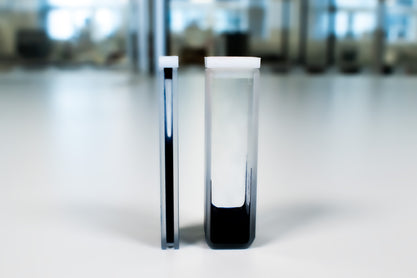
To prepare your samples for solution-state measurements in a spectrophotometer, you should consider the following:
- Clean cuvette thoroughly. If you can, put them through a standard glass washing procedure. At the very least, they should be rinsed with the last-used solvent and a rinsing agent, such as acetone, deionized water or IPA.
- Before loading your sample, rinse cuvettes with the solvent your sample is dissolved. This will remove residual solvents left over from cleaning.
- Use a cuvette filled with the diluting solvent as the reference measurement, i.e. for absorbance spectroscopy. This will ensure that your measurement will account for any optical effects introduced by the quartz cuvette or the solvent.
- Choose an appropriate sample concentration.
- Optimize the path length for your experiment. Use a cuvette with a smaller path length if you cannot reduce your sample concentration. Smaller path length also reduces the volume of sample needed, which can be useful if you have a small amount of sample or if your material is expensive.
- Always ensure that your samples are completely dissolved in your chosen solvent. Wherever possible, filter solutions before using to remove contaminants.
Thin Films
There are some situations where it is more suitable to measure your samples as thin films. For example, if measuring the properties of layers in a device or coatings on a surface. Studying thin films better represents the materials performance in their given applications.

To prepare a thin film for UV-Vis spectroscopy:
- Ensure your thin film is an appropriate thickness. Like concentration for solution samples, varying film thickness will affect your measurements. If spin coating, film thickness can be changed by varying spin speed or precursor concentration.
- When preparing your sample, try and make your films as smooth and uniform as possible. Any defects, pinholes or inconsistencies in your film can affect your spectroscopy measurements.
- You should prepare the film so that the sample covers most of the substrate surface evenly. This will make it much easier to conduct your measurement.
Measurement Tips
- In some spectrophotometers, it is necessary to measure a reference spectrum before absorbance and transmission measurements. You can use a blank quartz substrate or cuvette filled with solvent.
- If you change anything during an experiment, retake this reference measurement. This is because, for both transmission and absorbance spectroscopy, you are comparing the light traveling through your sample to this reference measurement.
- When measuring fluorescence from thin films, it is important to account for any light reflection - especially if you are using a specular substrate such as smooth glass. This should be considered when choosing your measurement angle.
Optimizing Measurement Variables
Wavelength Range
As spectrophotometers usually use a monochromator to select illumination wavelengths, second order effects can impact your measurement. Second order effects occur where a monochromator’s output wavelength is double the wavelength also produced by the light source. For example, if a monochromator can output at 400 nm and 800 nm, when the output is set to 800 nm, there will be second order effects from the 400 nm dispersed light. In these situations, both signals from the 800 nm first order light and the 400 nm second order light will combine in the output.
To avoid second order effects, you need to select a wavelength range that does not cover any wavelengths that are double any other wavelengths in the range. For example, to measure the absorbance between 380 nm and 1000 nm, you would need to do two measurements: the first between 380 nm and 750 nm and the second measurement between 750 nm and 1000 nm.
Wavelength Step
The wavelength step determines the resolution of the measurement. The smaller the wavelength step, the more detailed the measurement but the longer it will take.
Delays Between Measurements
A delay setting allows you to define a delay time between switching to a new wavelength and taking a measurement. This can help when performing measurements of samples that react slowly to changing illumination. Determining a delay time might also ensure that signals from previous measurements aren’t included in your subsequent measurements.
Signal Accumulation
Some spectrophotometers have accumulation functions, which take several independent measurements and sum the values to increase signal intensity.
In these systems, the spectrophotometer software takes several measurements and accumulates the intensity values at each wavelength. Any noise will be inconsistent between measurements, while the signal should keep consistent intensities. This means that only the spectral peaks are amplified and the signal-to-noise ratio increases. This can be especially useful if you have low signal intensity. However, this will significantly increase measurement time, especially if measuring an entire spectrum.
Averaging Measurements
Averaging is similar to accumulation, but instead of summing the measurements, the average of mulitple measurements is used. This creates a smoother graph and increases the signal-to-noise ratio.
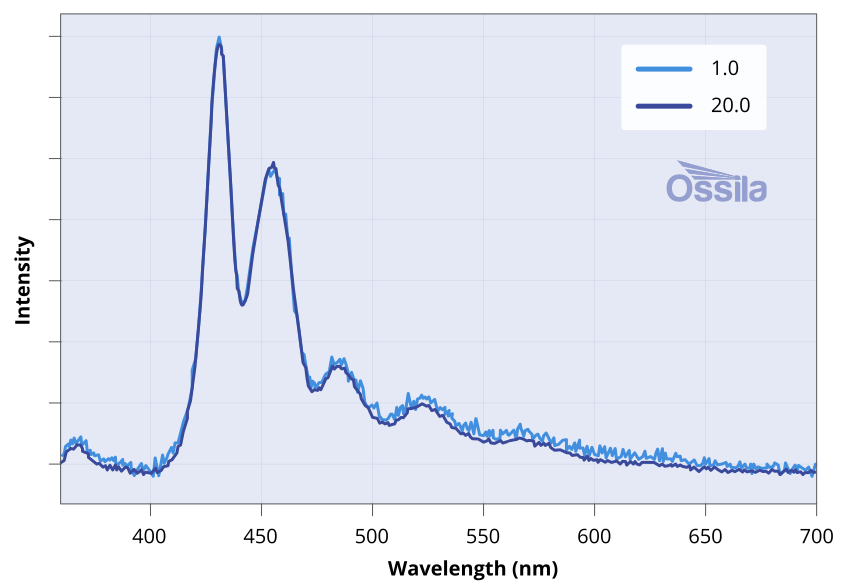
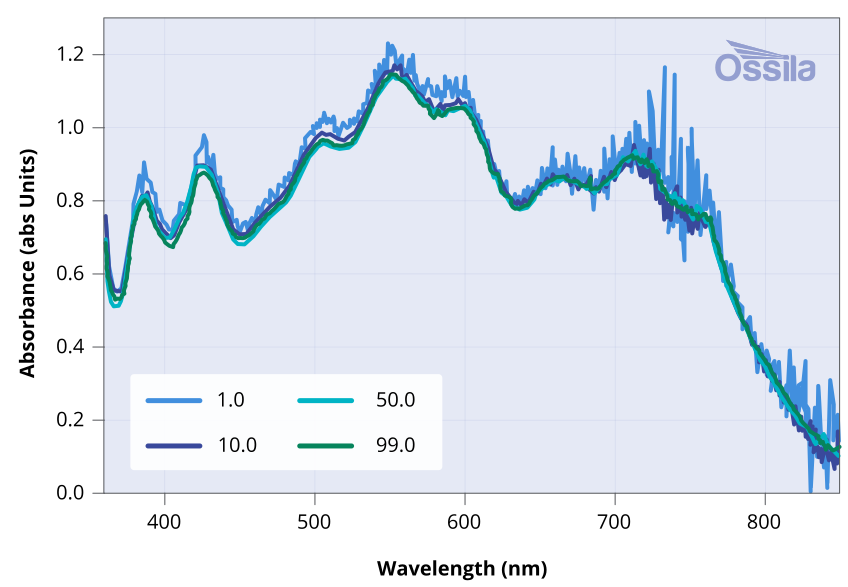
This can be especially important for measurements where there are low levels of light detection, such as absorbance measurements of P3HT:o-IDTBR films, averaging over many spectra can help to significantly increase the signal-to-noise ratio.
Accumulation and averaging can be used together to both increase the signal and reduce the impact of noise. In such cases the signal is accumulated for each measurement used in an averaged data point. Therefore, use of both will significantly increase the measurement time.
Light Power
The power of the illumination source will affect the intensity of the measured signal: the higher the illumination power, the higher the output signal. However, if set too high it can result in the detector saturating, removing details from the measurement. Generally, for absorption and transmission measurements, the more transparent the sample, the lower the power should be.
More Resources
 How to Measure Absorbance
In an absorbance measurement, a sample is exposed to a broadband light source and a spectrometer measures the light that is transmitted through it. Using these transmittance measurements, you can calculate relative absorbance at different wavelengths.
Read more... Absorbance Measurements with the Ossila Spectrofluorometer
Absorbance spectroscopy is capable of revealing critical information about a sample's molecular structure, concentration, and optoelectronic behaviour, and can even track dynamic changes such as shifts in phase or chemical composition. This guide demonstrates how to use the Ossila Spectrophotometer or Spectrofluorometer to take reliable absorbance measurements.
Read more...