MeO-4PADBC
CAS Number 3067167-86-3
Self-Assembled Monolayers (SAMs), Perovskite Interface Materials, Charge Transport Layer Materials, Perovskite Materials,
Small Self-Assembled Monolayer Molecule for High Efficiency Solar Cells
Hole transport or extraction layer for NFA-polymer solar cells and p-i-n perovskite solar cells
Overview | Product Information | MSDS | Literature | Related Products | Technical Support
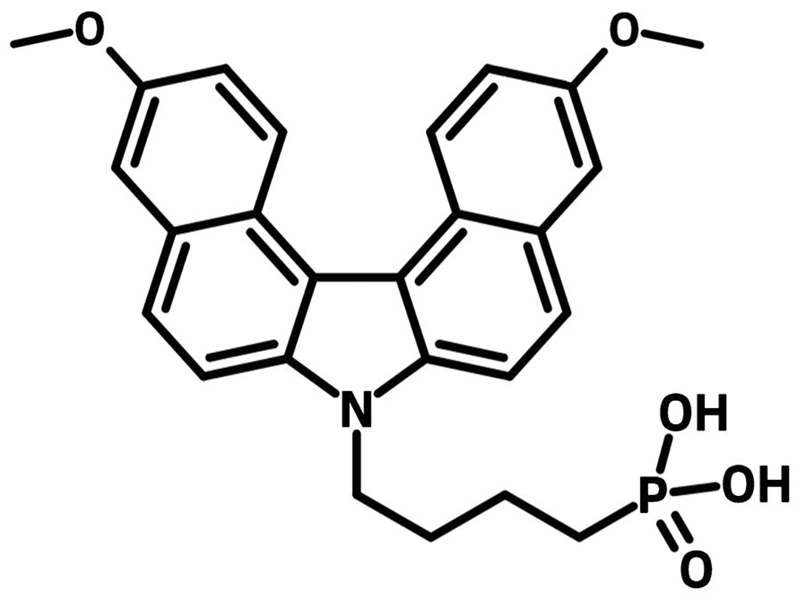
A self-assembled monolayer (SAM) with a fused 7H-dibenzo[c,g]carbazole terminal group, a butyl linker, and a phosphonic acid group servicing as the anchor. MeO-4PADBC is the methoxy substituted 4PADCB, which is a known hole transport layer (HTL) material for highly efficient inverted perovskite and all perovskite tandem solar cells.
MeO-4PADBC is normally used in combination of NiOx, serving as a thermally robust hole-selective layer (HSL) to improve and stabilize the NiOx/perovskite interface. The MeO-4PADBC molecules form tridentate bond with the NiOx film to effectively reduce the voltage loss and maintain a strong fixation effect under thermal stress. This hole-extraction layer demonstrates an optimal dipole moment and favourable contact with the perovskite film, giving low defect density, an ideal energetic alignment, and fast hole extraction.
Verified power conversion efficiency (PCE) of 25.6% is achieved for p-i-n perovskite solar cells based on NiOx/MeO-4PADBC hole-extraction layer and a more than 90% of their initial efficiency is retained after continuously operating at 65 degrees Celsius for 1200 hours under 1 sun illumination.
Serving as hole selective contact for organic solar cells and perovskite solar cells, MeO-4PADBC is an alternative to PEDOT:PSS with superior performance and the convenience of solution deposition at low concentration, i.e. 1 mM.
General Information
| CAS Number | 3067167-86-3 |
|---|---|
| Chemical Formula | C26H26NO5P |
| Molecular Weight | 463.46 g/mol |
| Absorption* | λmax (n.a.) |
| Fluorescence | λem (n.a.) |
| HOMO/LUMO | HOMO (ITO/MeO-4PADBC) = -5.34 eV, HOMO (ITO/NiOx/MeO-4PADBC) = -5.45 eV |
| Synonyms | MeO-4PADCB, MeO-CbzNaph, (4-(3,11-Dimethoxy-7H-dibenzo[c,g]carbazol-7-yl)butyl)phosphonic acid |
| Classification or Family | 7H-Dibenzo[c,g]carbazole derivatives, Self-assembly monolayers, Hole transport layer, Hole extraction layer, p-i-n Perovskite solar cells, Organic photovoltaics |
Product Details
| Purity | > 98% (HPLC) |
|---|---|
| Melting Point | n.a. |
| Appearance | White to off-white powder |
Solution Processing Procedure
Typical processing solvents: IPA, IPA/DMF, ethanol
Typical concentration: 1.0 mg/ml, 0.3 mg/ml, or 1 mM
Typical processing procedure:
MeO-4PADCB solution in ethanol (0.3 mg/ml) is deposited onto the centre of the substrate surface and spin-coated for 30 s at the speed of 4000 rpm. After being annealed for 10 min at 100 ℃ in nitrogen, the MeO-4PADCB coated substrate is cooled down to room temperature and washed with ethanol by spin-coating ethanol solvent for 30 s at the speed of at 4000 rpm. The now coated and cleaned substrate is then annealed for 5 min at 100 ℃ to afford the MeO-4PADCB self-assembled monolayer on the surface of the substrate.
For NiOx/MeO-4PADBC film, the NiOx ink (10 mg/ml in deionized water) is spin-coated onto the ITO substrate for 30s at the speed of 2000 rpm, followed by coating MeO-4PADCB solution in ethanol (0.3mg/ml) for 30 s at the speed of 4000 rpm. The substrate is annealed for 40 min at 100 ℃ in air. The resulted NiOx/MeO-4PADBC substrate is then washed with ethanol through spin-coating for 30 s at the speed of at 4000 rpm, annealed for 5 min at 100 ℃ (DOI: 10.1126/science.ade9637).
Chemical Structure
MSDS Documentation
 MeO-4PADBC MSDS Sheet
Literature and Reviews
- Z. Li et al. (2023), Stabilized hole-selective layer for high-performance inverted p-i-n perovskite solar cells, Science, 382 (6668), 284-289; DOI: 10.1126/science.ade963.
- Y. Duan et al. (2024); A Comprehensive Review of Organic Hole-Transporting Materials for Highly Efficient and Stable Inverted Perovskite Solar Cells, Adv. Funct. Mater., 2315604; DOI: 10.1002/adfm.202315604.
Related Products