CN-T2T
CAS Number 1872292-95-9
Host Materials, Dopant Materials, Charge Transport Layer Materials, TADF Materials,
Electron Transport Layer Material with Triazine Core
Electron deficient semiconducting material for developing highly efficient exciplex OLEDs
Product Information | Device Structures | MSDS | Literature | Related Products | Technical Support
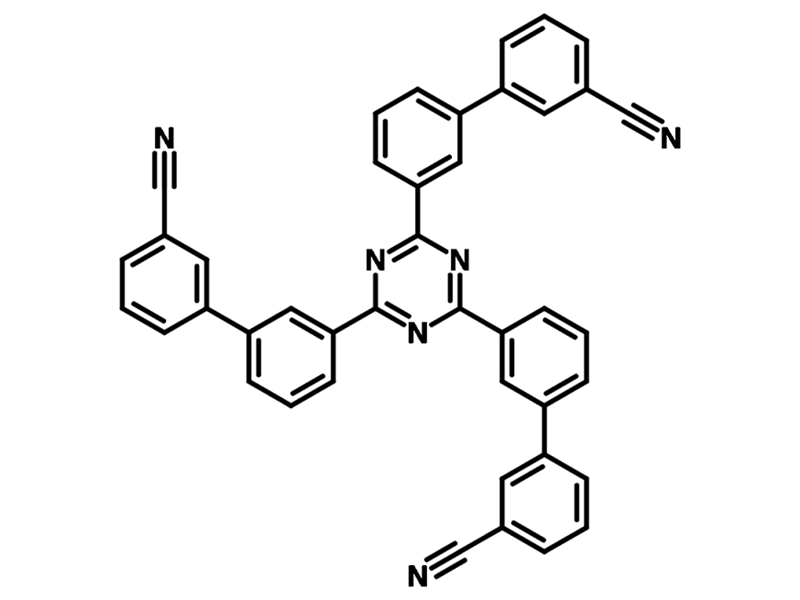
CN-T2T has a triazine core and three [1,1'-biphenyl]-3-carbonitrile side groups that attached to the core at 2,4-6-positions. Being electron deficient, CN-T2T is either used as electron transport layer material or as electron acceptor with electron donating materials such as BCzPh and Tris-PCz to form exciplexes for developing highly efficient exciplex OLEDs.
An efficient deep-red phosphorescent OLED using a TCTA:CN-T2T exciplex system as the host and a red-emitting Ir(piq)2acac and a deep-red Ir(fliq)2acac double emitting layers achieved high peak efficiency of 19.1% (10.2 cd/A and 13.8 lm/W) and a power density of 5 mW/cm2 with low operating voltage of 5.2 eV.
A yellow OLED device with exciplex cohost of MS-OC:CN-T2T and PO-01 as dopant achieved the highest efficiency among the tested yellow-emitting OLEDs, having a luminance efficiency of 80.0 cd/A, power efficiency of 113.0 lm/W, low turn-on voltage of 2.1 V, high maximum luminance of 142,464 cd/m2, and peak EQE of 27.1% [1]

High Quality Sublimed Material
With >99.0% purity

Simple Worldwide Shipping
Reliable delivery via tracked courier

Electron Transport Layer
Electron deficient material

Efficient Exciplex OLEDs
External quantum efficiency of 19.1%
General Information
| CAS Number | 1872292-95-9 |
|---|---|
| Chemical Formula | C42H24N6 |
| Molecular Weight | 612.68 g/mol |
| Absorption* | λmax 220, 270 nm |
| Fluorescence | λem 405 nm (film) |
| HOMO/LUMO | HOMO = 6.7 eV, LUMO = 2.7 eV |
| Synonyms | 3’,3”’,3””’-(1,3,5-triazine-2,4,6-triyl)tris[1,1′-biphenyl]-3-carbonitrile |
| Classification or Family | Triazine derivatives, Electron transport layer (ETL) materials, Exciplex, Exciplex cohost, Sublimed materials. |
Product Details
| Purity | Sublimed* >99.0% (HPLC) |
|---|---|
| Melting Point | TGA: Td = 418° C. (5% weight loss) |
| Appearance | white to off-white crystals/powder |
* Sublimation is a technique used to obtain ultra pure-grade chemicals, see sublimed materials for OLED devices.
Chemical Structure
Device Structure(s)
| Device Structure | ITO/HATCN (10 nm)/TAPC (35 nm)/BCzPh (10 nm)/BCzPh:CN-T2T (1:1)/ CN-T2T (40nm)/LiF (1 nm)/Al (100 nm) [2] |
|---|---|
| Colour |
 Green Green
|
| Max Current Efficiency | 57.32 cd/A |
| Max EQE | 21.05% |
| Max. Power Efficiency | 68.47 lm W-1 |
| Device Structure | ITO (150 nm)/HAT-CN (10 nm)/TAPC (40 nm)/TCTA (5 nm)/TCTA:CN-T2T:Ir(piq)2acac (46:46:8) (11 nm)/TCTA:CN-T2T:Ir(fliq)2acac (48.5:48.5:3) (25–14 nm)/CN-T2T (50 nm)/LiF (1.2 nm)/Al (120 nm) [3] |
|---|---|
| Colour |
 Red Red
|
| Max Current Efficiency | 12.5 cd/A |
| Max EQE | 21.5% |
| Max. Power Efficiency | 17.8 lm W-1 |
*For chemical structure information, please refer to the cited references.
Pricing
| Grade | Product Code | Quantity | Price |
|---|---|---|---|
| Sublimed (>99.0% purity) | M2414A1 | 100 mg | £210 |
| Sublimed (>99.0% purity) | M2414A1 | 250 mg | £420 |
| Sublimed (>99.0% purity) | M2414A1 | 500 mg | £670 |
| Sublimed (>99.0% purity) | M2414A1 | 1 g | £1070 |
MSDS Documentation
![CN-T2T - 1872292-95-9 - 3’,3”’,3””’-(1,3,5-triazine-2,4,6-triyl)tris[1,1′-biphenyl]-3-carbonitrile](https://www.ossila.com/cdn/shop/files/product-downloads-msds.svg) CN-T2T MSDS Sheet
CN-T2T MSDS SheetLiterature and Reviews
-
Highly efficient (EQE > 27%) Yellow OLEDs using spiro[fluorene-9,9′-phenanthren-10′-one]-carbazole-based donor–acceptor–donor host materials, Y. Lin et al., J. Mater. Chem. C, 11, 3101-3111 (2023); DOI: 10.1039/D2TC05296B.
-
Balance the Carrier Mobility To Achieve High Performance Exciplex OLED Using a Triazine-Based Acceptor, W. Hung et al., ACS Appl. Mater. Interfaces, 8 (7), 4811–4818 (2016); DOI: 10.1021/acsami.5b11895.
-
A Method to Realize Efficient Deep-Red Phosphorescent OLEDs with a Broad Spectral Profile and Low Operating Voltages, W. Chen et al., Materials, 14, 5723 (2021); DOI: 10.3390/ma14195723.
-
Optimization of a triazine-based acceptor (CN-T2T) as the electron transport layer for highly efficient near-infrared perovskite light-emitting diodes, A. Kurniawan et al., J. Mater. Chem. C, 11, 11564-11570 (2023); DOI: 10.1039/D3TC01251D.
- Revealing the Cooperative Relationship between Spin, Energy, and Polarization Parameters toward Developing High-Efficiency Exciplex Light-Emitting Diodes, M. Wang et al., 31 (46), 1904114 (2019); DOI: 10.1002/adma.201904114.
- Quantifying the Electrical Excitation Level of Quantum Dots for Mitigating Electroluminescent Efficiency Roll-Off, Q. Cai et al., Adv. Mater., e73638 (2026); DOI: 10.1002/adma.73638.