


Fluorescence Lifetime Measurement
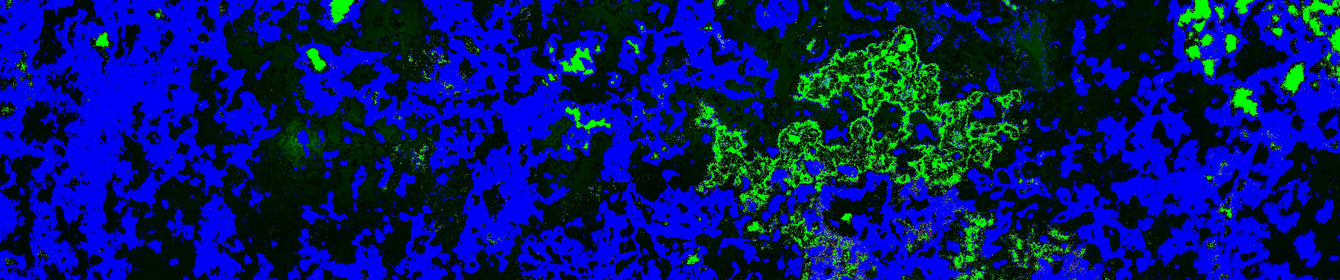
Fluorescence lifetime measurement systems measure the decay of fluorescence emission over time. This technique complements steady-state fluorescence, which measures wavelength dependent distribution of emission. Advanced systems can integrate both measurements into one instrument, enabling time-resolved fluorescence spectroscopy or even confocal microscopy, known as Fluorescence Lifetime Imaging Microscopy (FLIM).
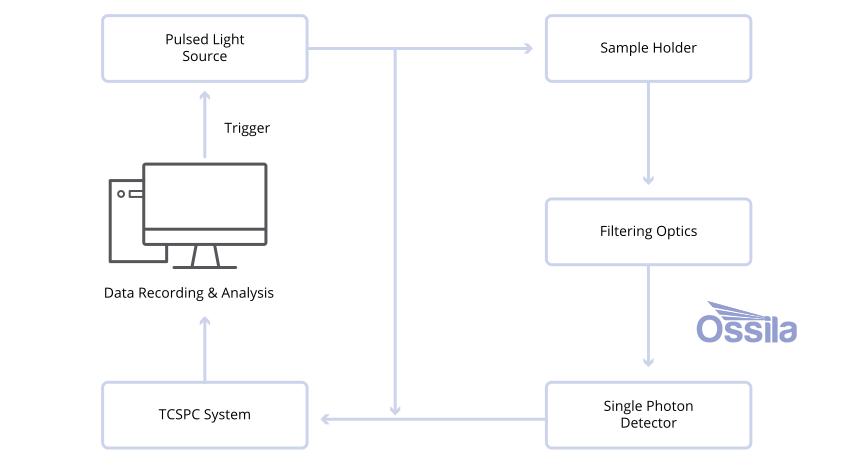
In a typical fluorescence lifetime setup, a pulsed light source, often operating in the picosecond range, excites a sample. The emitted fluorescence is detected by a sensitive single photon detector (such as an avalanche photodiode, hybrid photodetector, or multichannel plate detector) and processed by a time-correlated single-photon counting (TCSPC) system.
This system precisely measures the time interval between the excitation signal, and the detection of individual photons. By attenuating the fluorescence signal to less than one detected photon per excitation pulse, a high-resolution histogram of arrival times can be generated. From this, you can reveal the fluorescence decay curve.
These systems are invaluable for characterising biomolecules and fluorophores, their microenvironments, and molecular interactions. By providing insights into dynamic processes, they offer a powerful tool for biological, biomedical and photonics research. Fluorescence lifetime provides valuable insights into the fluorophore's environment, its interactions with other molecules, and its dynamic behaviour.
Fluorescence Lifetime Spectrometer
Fluorescence lifetimes are measured by spectrometers or spectroscopy systems with specialized temporal components. These fluorescence lifetime spectrometers require the following components:
-
Excitation Source
These systems require a high-resolution, pulsed light source. Historically, expensive lasers were used to generate picosecond pulses, but recent advancements in LED and laser diode driver circuits have enabled the generation of pulses with sub-nanosecond duration, making systems more affordable. -
A Sample Holder
The sample must be held in a suitable cuvette or a sample holder. To minimise interference from the excitation light, fluorescence emission is detected at a 90-degree angle. A monochromator or a series of long-pass filters can also be used to select desired fluorescence wavelengths. -
Single Photon Detector
The fluorescence signal is detected using a sensitive single-photon detector. This is a high resolution detector capable of detecting individual photons. Example single photon detectors include Avalanche Photodiodes (APD), Silicon Photomultipliers (SiPM), Hybrid Photodetectors (HPD), Multichannel Plate Detectors (MCP), or Photomultiplier Tubes (PMT). The detector must have a fast rise time (around 100 picoseconds) and high gain (at least 105) to accurately measure individual photons. The fast output signal from the detector is then sent to the TCSPC for processing. -
Timing Systems (Time Correlated Single Photon Counting)
The detection and timing of fluorescence photons is handled by a time-correlated single photon counting (TCSPC) system. This system has two input channels: one for the signal from the detector and another for a synchronisation signal from the excitation source. Both signals are processed by constant-fraction discriminators (CFDs) to ensure precise timing, and their zero-crossings are recorded by a Time-to-Digital Converter (TDC). -
Analysis
A computer controls the excitation light source, setting the appropriate parameters and triggering the pulses. It also collects data from the TDC and analyzes the photon arrival times to determine the fluorescence lifetime decay curve.
Only a small fraction of emitted photons (1/50 - 1/100) are measured per excitation pulse, so building a full picture of fluorescence lifetime will require many individual excitation and measurement cycles. Additionally, most fluorescence lifetimes are quite short (on the nanosecond-picosecond scale). Therefore, these systems require very fast pulsed light sources to consistently re-excite the fluorophore, and a quick response measurement system to process individual measurements extremely quickly.
Fluorescence Lifetime Data
After detection and processing, each lifetime measurement is plotted onto a histogram. By accumulating these measurements, the data builds to create a fluorescence decay curve.
A fluorescence decay curve follows an exponential probability distribution which reflects the exponential decay of fluorescence. This graph shows the probability of a photon arriving at the detector at time t after the excitation pulse. By analyzing the shape of this decay curve, you can find the fluorescence lifetime (τ). This is the point on the curve where the fluorescence intensity has reached 1/e of its initial fluorescence intensity.
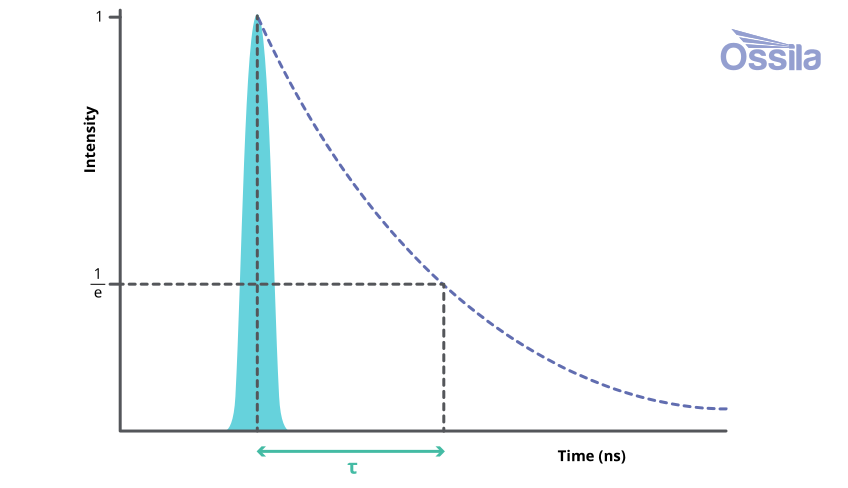
Quantifying τ can provide critical insights into the excited-state dynamics and the local microenvironment of a fluorophore. τ depends on any factors that affect radiative emission (Γ), non-radiative decay mechanisms (knr) or energy transfer pathways from the fluorophore to another molecule (kt). Fluorescence lifetime is theoretically described using the following equation:

Why Measure Fluorescence Lifetime?
- A fluorophore's lifetime is extremely sensitive to its interaction with other molecules and its general environment. Fluorescence lifetime is a useful method for monitoring the microenvironment of a sample (pH, temperature, concentration, etc).
- Compared to steady-state photoluminescence, τ is not affected by factors like excitation light intensity, background light or photobleaching.
- Fluorescence lifetime measurements are generally not concentration dependent.
- As fluorescence lifetime depends on both radiative and non-radiative factors, it can be used to probe internal non-radiative recombination pathways and quenching processes that are often missed by steady-state fluorescence measurements.
- Fluorescence quenching can help distinguish between two fluorophores with similar emission spectra. The equation below shows how the fluorescence lifetime of multiple fluorophores will contribute to the overall fluorescence decay curve.

Fluorescence lifetime is the principle foundation of fluorescence-lifetime imaging microscopy which creates images using fluorescence lifetime, rather than intensity. This technique is particularly useful for cellular or neuron imaging, where concentration effects and light scattering provide issues with intensity-based fluorescence imaging.
Some methods take advantage of the sensitivity of fluorescence lifetime to non-radiative decay mechanisms. Some fluorescent materials interact with other molecules releasing energy through non-radiative processes or transferring energy to another molecule directly. This is known as quenching. Resonant energy transfer techniques rely on this phenomenon. Fluorescence is quenched or the fluorescence emission changes depending on the proximity of a fluorophore to a quencher. One example of this, in time-resolved Förster resonance energy transfer (FRET) techniques, energy transfer between the donor and acceptor molecules will reduce τ. Lifetime-based FRET can be used to differentiate between fluorophore states and to probe a fluorophore's environment.
Monochromator
Further Resources
 Pulsed LED Light Source
A pulsed LED light source is a high-energy light source which deliver light to a sample in short pulses (often nanosecond or picosecond resolution). Choosing the right pulsed light source is a critical decision in fluorescence spectroscopy, as the instrument’s specifications directly dictate the resolution and speed of your data acquisition.
Read more...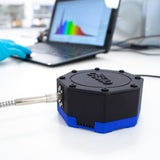 Single Photon Detector
A single photon detector or single photon counter is a detector capable of capturing and recording individual photons. This is especially useful for measurements like time-resolved spectroscopy, fluorescence lifetime measurements and microscopy, quantum photonics and even some particle physics detectors (e.g. in Cherenkov radiation).
Read more...