


Pulsed LED Light Source

A pulsed LED light source is a high-energy light source which deliver light to a sample in short pulses (often nanosecond or picosecond resolution). Choosing the right pulsed light source is a critical decision in fluorescence spectroscopy, as the instrument’s specifications directly dictate the resolution and speed of your data acquisition.
By delivering light in high-intensity excitation pulses, these sources allow for the precise measurement of fluorescence lifetimes offering deeper insights into molecular structures and complementing standard steady-state measurements.
While picosecond lasers have long been the industry standard for their power and precision, the rise of pulsed LED and diode sources has made these complex measurements more accessible, affordable, and maintenance-free for the modern laboratory. Using LEDs in pulsed light sources offer the advantage such as:
- Lower cost
- Longer lifetimes
- Minimal maintenance
- A wide range of available wavelengths
What Are Pulsed Light Sources?
A pulsed light source provides short, high intensity excitation pulses that stimulate the electrons in a sample into excited electronic states. The are vital tools for use in fluorescence lifetime measurements. Fluorescence emission requires fast excitation times. In other words, they need to pump as many electrons as possible into the excited state in as short a time frame as possible.
Laser systems have been traditionally used as the pulse excitation sources for fluorescence experiments as lasers can reliably and consistently achieve the high-intensity, short-width pulses need. However, over the past 30 years, pulsed laser diodes and pulses LED light sources have become popular, as they are lower price, compact and need minimal maintenance.
The suitability of a pulsed light source for an experiment depends on a few key factors:
-
Pulse width
Defines the duration of a single flash. For experiments such as time-correlated single photon counting, the excitation pulse width must be at least an order of magnitude below the fluorescence lifetime of the target fluorophore. -
Repetition rate
The number of pulses per second. This is measured in Hz (often MHz) and, as far as light sources go, this determines the data acquisition speed. -
Emission Wavelength
Emission wavelength determines the excitation energy. This should be close to an absorbance maximum peak in your sample. -
Optical Power
This is a measure of the energy supplied per unit time. In this case, this is usually given in terms of photons. Again, this will affect the available data acquisition time of the photon counting system.
Fluorescence Lifetime

Fluorescence lifetime measurements record the time taken for a fluorophore to emit fluorescence after excitation. This essentially measures how long the fluorophore remains in an excited state. These methods can be extremely helpful along side steady-state spectroscopy measurements, helping distinguish between fluorophores with similar spectra, or giving more information about the electronic and vibrational structure of a molecule.
Fluorescence consists of three steps:
- Incoming photon excites an electron into higher electronic + vibrational state (S0→S1,v1,2,3,etc)
- Vibrational relaxation (S1, v1,2,3,etc →S1)
- Relaxation back to the ground state, emitting a photon (S1→S0)
Fluorescence lifetime (τ) therefore depends on three components: the emissive rate (Γ), the rate of non-radiative decay processes (knr) and the rate of energy transfer (kt).

Fluorescence lifetime spectrometers detect photons emitted by a sample, and measure the time between the initial source and their detection. Every one of these time measurements is added to a histogram, which over significant time becomes a fluorescence decay curve.
Empirically, τ is the time taken until for the intensity value on this decay curve to reach approximately 36.79% (1/e) of the peak intensity. Following this, it is important to note that τ represents an average. Not all emissions will not happen at time τ, but this should be the average emission time.
Why Use LEDs in Pulsed Light Sources?
Pulse light sources have traditionally used lasers such as picosecond dye lasers or Ti:sapphire lasers. However, these systems are expensive and often difficult to operate or align. Also, the high-intensity achieved by these laser systems combined with the low wavelength mean there are serious safety considerations involved with using high-energy laser systems in your lab.
LEDs consume little power, are easy to operate and require hardly any maintenance. They are also much more cost effective than the previously mentioned laser sources. These qualities make fluorescence lifetime measurements attainable for more researchers. Pulsed LED light sources are suitable for most fluorophores with an excitation peak above 350 nm. A pulse width of hundreds of picoseconds is good enough to measuring nm-scale decay times.
However, some fluorescence measurements require pulses of tens of picoseconds, femtoseconds or even attoseconds. For these measurements, pulsed LED light sources will not be suitable. Alternative pulsed light sources include femtosecond titanium sapphire lasers, picosecond dye lasers, coaxial flashlamps or laser diodes. Most of these can achieve higher intensities, lower wavelengths or shorted pulse times.
Learn More
 Light Sources for Spectroscopy
Optical spectroscopy concerns light in the UV, visible and IR regions of the electromagnetic spectrum which is either emitted by, or interacts with, a sample. With our USB spectrometer, it can be performed using a range of different light sources. These can typically be categorized as being either monochromatic or broadband. The type of light source used in any spectroscopy set up will depend on the type of measurement being taken.
Read more...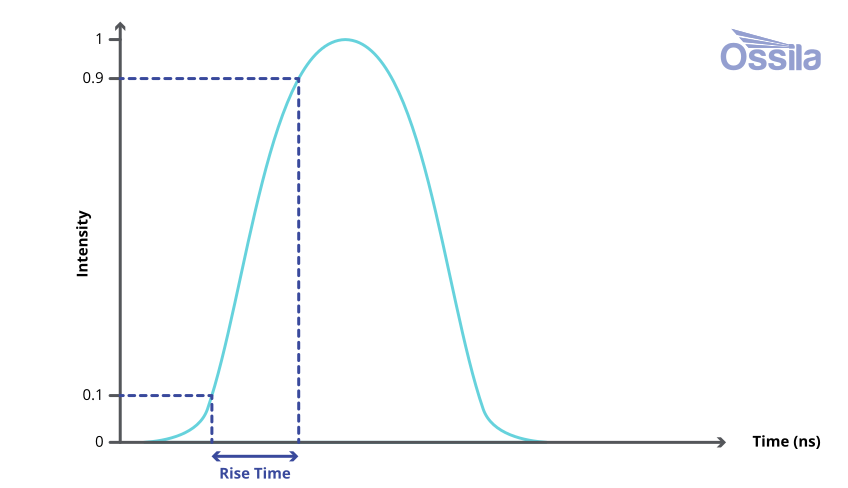 Single Photon Detector
A single photon detector or single photon counter is a detector capable of capturing and recording individual photons. This is especially useful for measurements like time-resolved spectroscopy, fluorescence lifetime measurements and microscopy, quantum photonics and even some particle physics detectors (e.g. in Cherenkov radiation).
Read more...