


tBu-4PACz
CAS Number 3023627-39-3
Self-Assembled Monolayers (SAMs), Latest Products, Perovskite Interface Materials, Charge Transport Layer Materials,
Hole Transport Layer Interface for Perovskite Solar Cells
Self-assembled monolayer for efficient hole-extraction and suppressed interfacial recombination losses
Product Information | MSDS | Literature | Related Products | Technical Support
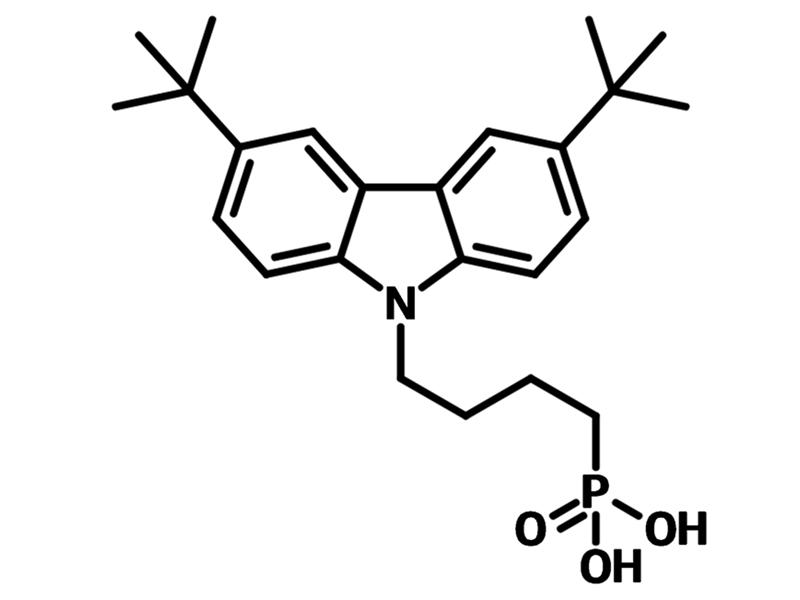
tBu-4PACz is a self-assembled monolayer material featuring a steric di-tert-butylcarbazole terminal, a butyl linker and a phosphonic acid anchor. Developed for high-efficiency perovskite solar cells as a hole transport layer interface between the substrate and the perovskite active layer. The bulky di-tert-butyl groups on the carbazole terminal prevent undesired aggregation of the self-assembled molecules on the interface, which in return facilitates more efficient hole-extraction and suppresses interfacial recombination losses.
The terminal carbazolyl moiety of tBu-4PACz containing di-tert-butyl groups is hydrophobic and this results in wetting issues upon the deposition of the perovskite layer. To overcome the wettability of tBu-4PACz, a second component is introduced to adopt a mixed SAM system as the hole-extraction layer in inverted devices. The second component could either be another self-assembled monolayer material, such as MeO-2PACz, or 1,6-hexylene-diphosphonic acid (6dPA). With MeO-2PACz as the mixed SAM, tBu-4PACz based inverted PSC shows high power conversion efficiency (PCE) of 26.25% (26.21%, certificated) with outstanding fill factors over 86%. Also, the mixed SAM based inverted PSC devices demonstrate great stability, retaining over 94.7% of their initial efficiency after 500 h continuous maximum power-point tracking under simulation 1-sun irradiation.
Serving as hole selective contact for organic solar cells and perovskite solar cells, tBu-4PACz is an alternative to PEDOT:PSS with superior performance and the convenience of solution deposition at low concentration, i.e. 1 mM.
General Information
| CAS Number | 3023627-39-3 |
|---|---|
| Chemical Formula | C24H34NO3P |
| Molecular Weight | 415.51 g/mol |
| Absorption* | λmax (n.a.) |
| Fluorescence | λem (n.a.) |
| HOMO/LUMO | HOMO = -5.16 eV, LUMO = -0.63 eV (DFT) |
| Synonyms | (4-(3,6-Di-tert-butyl-9H-carbazol-9-yl)butyl)phosphonic acid |
| Classification or Family | Carbazole derivatives, Self-assembly monolayers, Hole transport layer, Hole selection layer, p-i-n Perovskite solar cells |
Product Details
| Purity | > 98% (HPLC) |
|---|---|
| Melting Point | 184–186 °C (melting and decomposition) |
| Appearance | White powder/crystals |
Solution Processing Procedure
Typical processing solvents: Methanol, ethanol
Typical suggested concentration: 1.0 mg/ml or 1.0 mM
Typical processing procedure: tBu-4PACz and MeO-2PACz are separately dissolved in ethanol (0.5 mg/ml) and then mixed in a 3:2 (v/v) ratio. The cooperative self-assembled monolayer (co-SAM) solution is then spin-coated onto a clean and ultraviolet-treated ITO substrate surface, followed by annealing for 10 min at 100 ℃ (from solar cell fabrication, DOI: 10.1002/smll.202407387).
Chemical Structure
MSDS Documentation
 tBu-4PACz MSDS Sheet
Literature and Reviews
- Z. Su et al. (2024), Stereo-Hindrance Induced Conformal Self-Assembled Monolayer for High Efficiency Inverted Perovskite Solar Cells, Small, 20 (52), 2407387; DOI: 10.1002/smll.202407387.
- A. Al-Ashouri et al. (2023), Wettability Improvement of a Carbazole-Based Hole-Selective Monolayer for Reproducible Perovskite Solar Cells, ACS Energy Lett., 8 (2), 898-900; DOI: 10.1021/acsenergylett.2c02629.
.
Related Products




Licensed by Helmholtz-Zentrum Berlin für Materialien und Energie GmbH in Germany and Kaunas University of Technology in Lithuania.