


BrMeOPh-4PACz
CAS Number 3053380-37-0
Latest Products, Self-Assembled Monolayers (SAMs), Perovskite Interface Materials, Charge Transport Layer Materials,
Self-Assembled Monolayer for High Efficiency Perovskite Solar Cells
Uniform coverage of self-assembled molecules for efficient charge transport, BrAs, CAS No. 3053380-37-0
Product Information | MSDS | Literature | Related Products | Technical Support
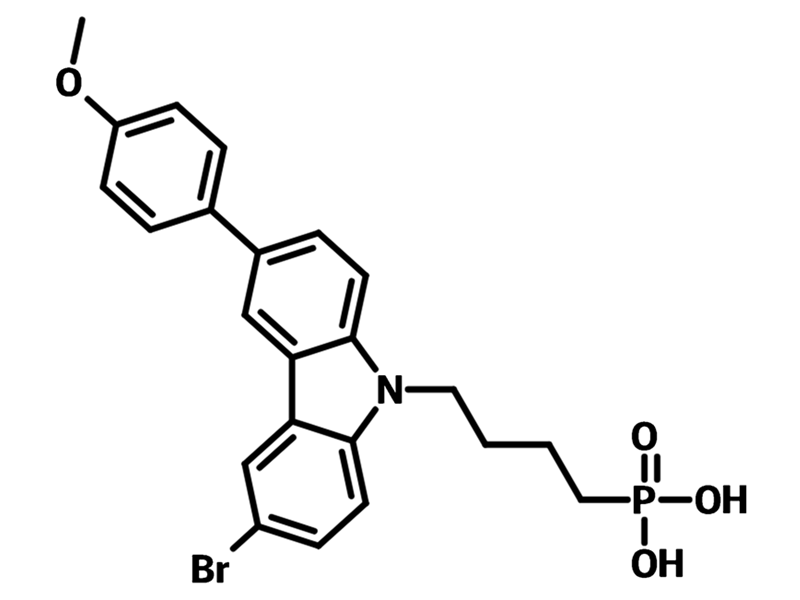
BrMeOPh-4PACz is a self-assembled monolayer material developed as a hole selection layer interface for highly efficient and stable perovskite solar cells. This molecule features an unsymmetric structure with a 3-bromo-6-(4-methoxyphenyl)-9H-carbazolyl terminal, a phosphonic acid anchor and butyl linker. The asymmetric large dipole (4.72 D) in BrMeOPh-4PACz, established by the electron-accepting bromine and electron-donating methoxyphenyl, reorientates the carbazole terminal and strengthens the short-range Coulomb interactions. This results in a more densely packed self-assembled monolayer film with a uniform coverage of self-assembled molecules for efficient charge transport. In addition, the introduction of the bromine on one side of the carbazole terminal reduces the valence band offset while maintains the wettability by keeping a methoxyphenyl group on the other side.
The donor–acceptor interface imposed by the bromine and methoxyphenyl substituents promotes ultrafast energy transfer to improve thermal carrier extraction and minimize energy loss, resulting in good photostability. With the lattice-matching N-hydroxyethyl phthalimide (PIE) molecules to release the compressive stress and stabilize the buried interface, BrMeOPh-4PACz-PIE based perovskite device demonstrates a power conversion efficiency of 27.28% (certified: 27.19%) and retains over 95% of the initial efficiency after 1,500 hours of illumination under 1-sun light-soaking.
Serving as a hole selective contact for organic solar cells and perovskite solar cells, BrMeOPh-4PACz is an alternative to PEDOT:PSS with superior performance and the convenience of solution deposition at low concentration, i.e. 1 mM.
General Information
| CAS Number | 3053380-37-0 |
|---|---|
| Chemical Formula | C23H23BrNO4P |
| Molecular Weight | 488.32 g/mol |
| Absorption* | λmax 288 nm (in film) |
| Fluorescence | λem (n.a.) |
| HOMO/LUMO | HOMO = -5.23 eV, LUMO = -0.99 eV (DFT) |
| Synonyms | BrAs, (4-(3-bromo-6-(4-methoxyphenyl)-9H-carbazol-9-yl)butyl)phosphonic acid |
| Classification or Family | Carbazole derivatives, Self-assembly monolayers, Hole transport layer, Hole selection layer, p-i-n Perovskite solar cells |
Product Details
| Purity | > 98% (HPLC) |
|---|---|
| Melting Point | N/A |
| Appearance | Off-white powder |
Solution Processing Procedure
Typical processing solvents: Methanol, ethanol
Typical suggested concentration: 1.0 mg/ml or 1.0 mM
Typical processing procedure: BrMeOPh-4PACz solution (1.0 mM) in methanol is spin-coated onto a clean and ultraviolet-treated FTO substrate surface for 30 s at the speed of 2000 rpm, followed by annealing for 10 min at 100 ℃. PIE solution in IPA is spin-coated for 30 s at 5000 rpm then annealed for10 min at 100 ℃ (from perovskite films and solar cell fabrication, DOI: 10.1038/s41566-025-01827-6).
Chemical Structure
MSDS Documentation
 BrMeOPh-4PACz MSDS Sheet
Literature and Reviews
- C. Tian et al. (2026), Photostable donor–acceptor interface for minimizing energy loss in inverted perovskite solar cells, Nat. Photon., 20, 287–295; DOI: 10.1038/s41566-025-01827-6.
Related Products




Licensed by Helmholtz-Zentrum Berlin für Materialien und Energie GmbH in Germany and Kaunas University of Technology in Lithuania.