


What is a Spectrophotometer?
Spectrophotometer vs Spectrometer | Spectrophotometer Components | Measuring Absorbance With Spectrophotometer | Choosing A Spectrophotometer
A spectrophotometer is an instrument used to measure absorbance or transmittance of light after it interacts with a sample. This is an important measurement for many research applications. Absorbance and transmission measurements can be used to:
- Identify materials by mapping molecular absorption profiles.
- Work out solute concentrations in solutions.
- Detect trace impurities in samples.
- Track the progression of a chemical reaction.
Spectrophotometers differ from simpler modular spectrometers as they take individual measurements at specific wavelengths, whereas USB spectrometers measure the intensity of transmitted light at many wavelengths simultaneously.
By measuring light one wavelength at a time, spectrophotometers are more sensitive than spectrometers, and they can achieve much higher resolution.
Spectrophotometer vs. Spectrometer
Although spectrophotometers and UV-vis spectrometers measure the same thing, they have different designs and therefore have different benefits and limitations.
Spectrometers are instruments built to separate and measure the intensity of different spectral components simultaneously. Therefore, UV-vis spectrometers disperse light using a diffraction grating, then direct this dispersed light towards an array detector.

The spatial separation of this dispersed light is measured by multiple detectors across this array (often a charge-coupled device). This way the CCD detector can measure wavelength and intensity at the same time. Often, the density of this array determines the spectrometers spectral resolution. Spectrometers require a separate sample holder and light source.
Spectrophotometers use a single pixel detector which allows higher resolution and sensitivity. They have separate compartments to disperse light (often using a monochromator) and transmit it through a sample holder with a fixed position. These individual components are built into a single unit.

A Quick Comparison
Despite both instruments being capable of absorption and transmission measurements, spectrophotometers and spectrometers differ in design and setup. While spectrophotometers contain multiple optics components, a spectrometer is an individual instrument for integration with separate components.
| Spectrophotometers | Spectrometers | |
|---|---|---|
| Diffraction Grating | Rotating (in monochromator) | Fixed |
| Sensor | Single-pixel photodetector | Multipixel array (CCD) |
| Entrance Slit | Adjustable | Fixed |
| Measurement Acquisition | Intensity of transmitted light at specific wavelengths | Entire spectrum at once |
| Light Source Included? |

Broadband |
 |
| Sample Holder Included? |
For thin films and liquids |
|
| Additional Components Needed | None | Light source, sample holder, optical fibers |
| Price | £6000 | £1250 |
Spectrophotometer Components
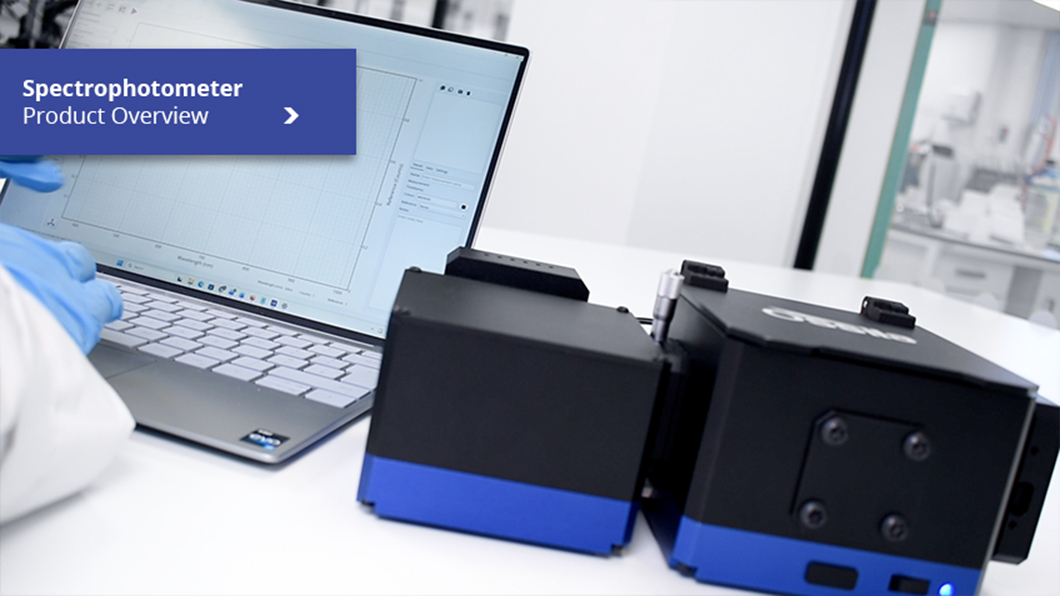
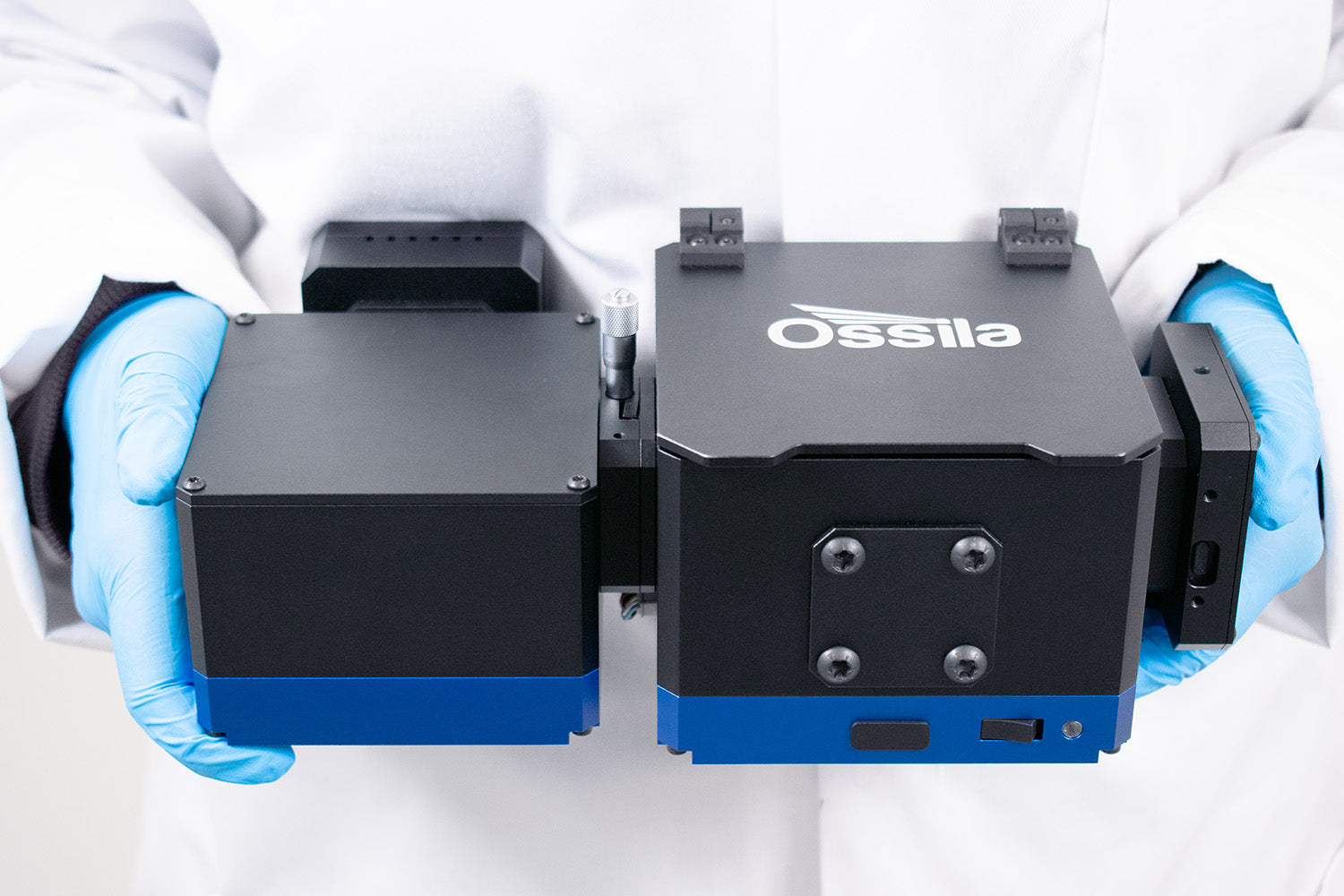
Spectrophotometers contain several components housed in one system. The Ossila spectrophotometer contains:
- A broadband white light source
- A monochromator
- A sample holder (also containing focussing optics)
- A silicon photomultiplier detector
How to Measure Absorbance with a Spectrophotometer?
Spectrophotometers use absorbance spectroscopy principles, a technique grounded in the Beer-Lambert Law. This law relates the amount of light absorbed by a sample to the absorbing properties of that sample and the path length of the light. Specifically, absorbance (A) is given by:

Where
- ε is the molar absorptivity (a constant for a given substance and wavelength)
- c is the concentration of the absorbing species
- l is the path length of the sample (usually the width of a cuvette, in cm)
Absorbance is measured on a logarithmic scale, representing the ratio of incident light intensity (I0) to transmitted light intensity (I) as it passes through a sample:

Absorbance is a unitless quantity and is a relative measurement. But one conclusion that can be drawn from these two equations, is that even small changes in concentration can result in significant changes in absorbance.
Absorbance measurements are wavelength dependent. Molecules absorb specific wavelengths of light based on their electronic structure, giving rise to characteristic absorption spectra for every material. These spectra serve as molecular fingerprints, allowing for both qualitative identification and quantitative analysis of compounds.
To ensure accurate absorbance measurements, spectrophotometers are typically zeroed or baseline-corrected using a blank (a cuvette containing only the solvent). This corrects for any absorbance by the solvent or cuvette material itself, ensuring only the sample’s contribution is measured. Then the sample is placed in the spectrophotometer, and the absorbance spectrum is measured.
Choosing a Spectrophotometer
When choosing a spectrophotometer, consider the following factors:
- Wavelength range
- Resolution
- Bandwidth
- Sample volume
- Price
- Available lab space
Ossila Spectrophotometer Specifications
| Wavelength | 380 - 1000 nm |
| Wavelength accuracy | <1 nm |
| Dimensions | 75 (W) x 50 (H) x 5 (D) mm |
| Sample Size | Standard cuvette: 10 x 10 mm; maximum height 52 mm |
Ossila Spectrophotometer vs. Spectrofluorometer
Spectrophotometers and spectrofluorometers share a common foundation, but differ in complexity and capability. Spectrophotometers use a single monochromator and detector to select the wavelength of incident light and measure absorption and transmission. Spectrofluorometers can be used in this way too, but are also equipped with a second monochromator and detector, which can be used to isolate the emission light coming out. In addition, the Ossila Spectrofluorometer includes a UV light source alongside the broadband white light source, as many fluorescent molecules require ultraviolet wavelengths to excite fluorescence. Together, these additional components enable spectrofluorometers to capture both emission and excitation fluorescence spectra as well as absorbance and transmission data.
At a Glance
| Ossila Spectrophotometer | Ossila Spectrofluorometer | |
|---|---|---|
| Number of Monochromators | 1 | 2 |
| Number of Detectors | 1 | 2 |
| Broadband Light Source | |
|
| UV Light Source | |
|
| Suitable for Absorbance Measurements? | |
|
| Suitable for Fluorescence Measurements? | |
Both emission and excitation spectra |
| Price | £6000 | £11000 |
Spectrophotometer

Read More
 Spectrophotometry
Spectrophotometry examines the interactions between visible light and matter through measurements like absorbance, transmission and reflectance spectroscopy.
Read more... Choosing Spectroscopy Instruments
UV-Vis spectroscopy (or optical spectroscopy) is a simple but effective technique used to probe the molecular structure of a material. Measuring absorbance and emission of light from a sample can give you vital data about:
Read more...