


Radioactive Decay Series
Jump to: Uranium-238 and Uranium-235 Decay Series | Thorium-232 Decay Series | Naturally Occurring Radioisotopes
Radionuclides spontaneously undergo radioactive decay to reach a more energetically favourable nuclear configuration. Some decay directly to a stable product in a single step, while others pass through a series of unstable intermediates before reaching a stable ground state. This sequence is known as a radioactive decay series, or decay chain. Each step in the chain involves a specific type of nuclear transformation.
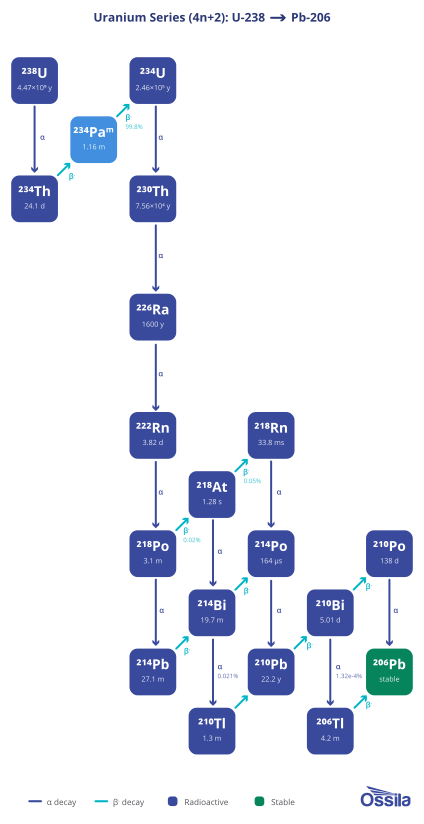
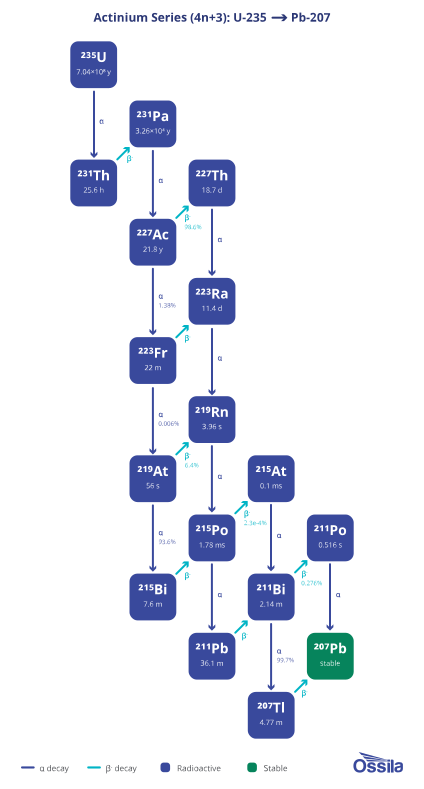
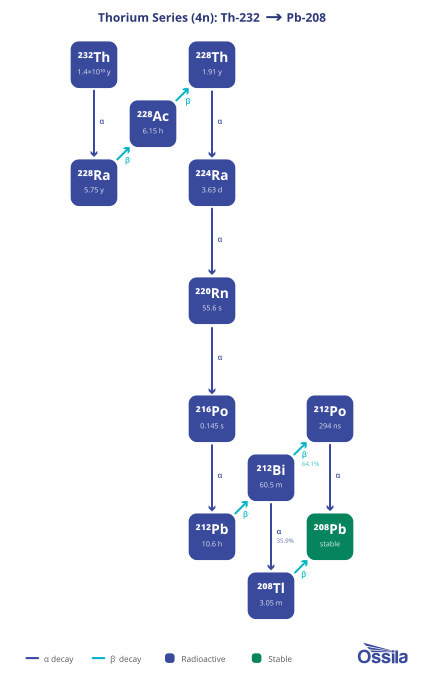
Decay series diagrams visualise these transformations. Each box represents a nuclide, typically labelled with its chemical symbol, mass number, and half-life. Arrows between boxes indicate the specific decay mode:
- α (alpha) decay emits a helium nucleus, removing two protons and two neutrons (ΔA = −4, ΔZ = −2)
- β− (beta-minus) decay converts a neutron into a proton, emitting an electron and an electron antineutrino (ΔZ = +1, A unchanged)
These transformations frequently leave the daughter nucleus in an excited state, which subsequently relaxes to the ground state via the emission of γ (gamma)-ray photons.
Where a nuclide can decay by more than one pathway, branching arrows show each route along with its specific branching fraction. Following the arrows from the long-lived parent nuclide at the top of the diagram down to the stable end-product traces the complete journey of the decay chain. While a significant portion of natural terrestrial radioactivity stems from isolated, single-step decays (most notably Potassium-40, 40K), the complex, multi-step radioactive sequences found in nature are driven by three primordial chains: the uranium series (238U), the thorium series (232Th), and the actinium series (235U).
Uranium-238 and Uranium-235 Decay Series
Source, Abundance, and Decay
Uranium is commonly found in many types of rocks including granite and shale. Natural uranium consists primarily of two primordial isotopes, Uranium-238 (238U) and Uranium-235 (235U). Uranium-238 is the most abundant of these at 99.27%, while Uranium-235 makes up approximately 0.72%.
Uranium-238 has a half-life of 4.46×10⁹ years and decays through a long chain of unstable intermediate isotopes before finally reaching a stable isotope of lead (206Pb). In a closed system, this decay chain reaches a state called secular equilibrium where the activity of each intermediate daughter isotope equals the activity of the parent 238U isotope.
Key Emissions and Practical Relevance
The 238U decay chain produces several universally recognized background peaks. Radium-226 (226Ra) is a highly regulated intermediate isotope in this chain because it decays directly into Radon-222 (222Rn). Radon is a radioactive noble gas that easily escapes from porous rocks and building materials. This mobility is challenging because it can lead to severe inhalation hazards. Further down the decay sequence, Bismuth-214 (214Bi) and Lead-214 (214Pb) produce prominent gamma emissions. The chain terminates at Lead-206 (206Pb) but long-lived isotopes like Lead-210 (210Pb) and Polonium-210 (210Po) dominate the lower portion of the chain in practice.
Thorium-232 Decay Series
Source, Abundance, and Decay
Thorium (232Th) is approximately three times more abundant in the Earth's crust than uranium. It is found in various minerals and trace amounts in manufactured metals. 232Th makes up nearly 100% of natural thorium. It has a half-life of 1.40×10¹⁰ years and operates similarly to the uranium series, decaying through a distinct sequence of intermediate isotopes such as Actinium-228 (228Ac) and ending at stable Lead-208 (208Pb).
Key Emissions and Practical Relevance
A critical isotope in this sequence for researchers is Thallium-208 (208Tl), which emits a very high-energy gamma ray at 2614.5 keV. This specific emission often scatters inside the detector crystal and creates a broad Compton continuum across the entire baseline of a spectrum.
Naturally Occurring Radioisotopes
Beyond the uranium and thorium decay series, several other naturally occurring radioisotopes undergo single-step decays to a stable daughter without forming decay chains.
Potassium-40
Source, Abundance, and Decay
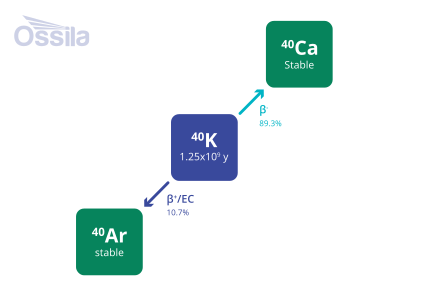
Potassium is a ubiquitous element found in building materials, soil, and biological tissue. The radioactive isotope 40K makes up approximately 0.0117% of all natural potassium. It has a half-life of 1.25×10⁹ years and undergoes two different decay pathways. Approximately 89% of the time, it undergoes β- decay to become stable Calcium-40 (40Ca). The remaining 11% of decays occur via electron capture.
Key Emissions and Practical Relevance
During electron capture, the nucleus transforms into an excited state of Argon-40 (40Ar*). This excited nucleus immediately releases energy by emitting a single gamma ray photon at 1460.8 keV. This specific high-energy peak is a standard and unavoidable feature in environmental gamma spectroscopy.
Beryllium-7
Source, Abundance, and Decay
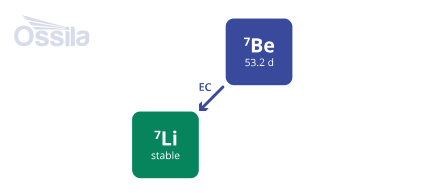
Beryllium-7 is the most prominent cosmogenic gamma emitter. Primary cosmic rays strike stable oxygen and nitrogen nuclei in the upper atmosphere. This violent interaction fragments the stable atoms and creates lighter unstable isotopes like 7Be which continually settle down to the Earth's surface via precipitation. It has a relatively short half-life of 53.22 days and decays exclusively via electron capture into stable Lithium-7.
Key Emissions and Practical Relevance
During this decay process, it emits a distinct 477.6 keV gamma ray. Researchers monitoring environmental air filters or analyzing rainwater samples frequently observe the 7Be peak as a direct result of ongoing cosmic ray interactions.
Lutetium-176
Source, Abundance, and Decay
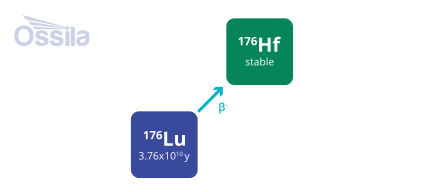
Lutetium is a rare earth element where the radioactive isotope Lutetium-176 has a natural abundance of 2.59%. It has a very long half-life of 3.78×10¹⁰ years and undergoes β- decay to reach highly excited states of Hafnium-176 (176Hf).
Key Emissions and Practical Relevance
The excited Hafnium nucleus immediately drops to its ground state by emitting a cascade of gamma rays. The most visible gamma emissions occur at 307 keV, 202 keV, and 88 keV. When used as an external check source, the low-energy beta particles are safely absorbed by the source encapsulation and the detector housing. This allows the distinct gamma photons to pass through and create clean and easily identifiable photopeaks.
Lanthanum-138
Source, Abundance, and Decay
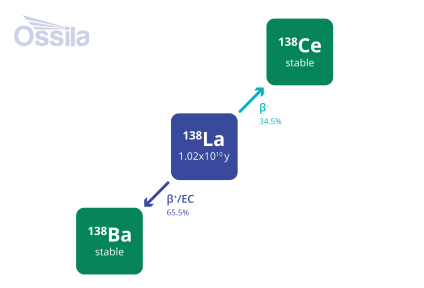
Lanthanum is another rare earth element where the radioactive isotope 138La has a natural abundance of only 0.09%. It has a half-life of 1.02×10¹¹ years and is unique because it undergoes both electron capture and β- decay.
Key Emissions and Practical Relevance
These dual decay paths yield simultaneous gamma emissions at 1436 keV and 789 keV. The presence of two widely spaced and predictable energy peaks makes 138La an excellent material for multi-point energy calibration despite its inherently low specific activity.
Contributors
Written by
Product Developer
Diagrams by
Graphic Designer