


Roll-to-Roll Coating Machine: Working Principles and Applications
In the laboratory, research is often focused on small-scale devices and films deposited via batch processing methods, such as spin coating. Spin coating is good for small-scale procedures that require well-defined film thicknesses. However, you cannot apply spin coating practices to large-scale manufacturing processes, and it wastes large amounts of material.
For these films to be produced on a large scale, the jump must be made from small-scale production to more scalable processing methods. Roll-to-roll (R2R) coating refers to a range of coating techniques used mainly in printing industries. These techniques continually solution process inks on to flexible substrates using a system of rollers.

What is Roll-To-Roll Coating?
Roll-to-roll coating refers to a range of techniques where a material is continuously coated on a substrate as the substrate is wound from one reel to another. These are techniques that can be scaled up massively and are already used in many industries, from newspapers to solar cells.
Unlike small-scale methods that coat on the scale of centimeters squared, R2R techniques can coat kilometers of flexible substrate. R2R processing is seen as the ideal method for large-scale processing as it can coat large areas very quickly and can combine several different printing or coating techniques.
Roll-to-Roll vs. Sheet-To-Sheet

Most lab-scale solution coating techniques are sheet to sheet processes. Sheet-to-sheet techniques include dip-coating, slot-die coating and most bar and blade coating machines. Different S2S techniques can coat areas of various sizes, but only one sheet at a time.
S2S techniques are great for experimentation. These techniques are closer to roll-to-roll methods than spin coating (which is often the research standard), so this processing knowledge can be more easily translated into large area deposition. Additionally, sheet-to-sheet methods are quicker to run and require less materials than roll-to-roll processing. Therefore, these methods are a great place to start when scaling your processing techniques. These techniques also offer higher control over film thickness and consistency which can be vital for process optimization.
However, there are specific issues that are introduced when coating is translated onto a conveyer belt. Moving and positioning flexible substrates, the orientation of various components and coordinating solution delivery, deposition and post processing all require precise alignment and optimization. Therefore, where possible, gaining real roll-to-roll experience is ideal. Also, once a process is established, R2R is a better way of maintaining uniformity.
How Does Roll-to-Roll Coaters Work?
Roll-to-roll coating methods require an ink or paste-based coating material and a flexible substrate.
In R2R coating, the system unwinds the substrate from the first roller, applies the coating with the coating head, dries it, and then rewinds the substrate onto a second roller. The substrate is stretched between the two rollers. By rotating the reels at the same rate, the substrate is continually moved underneath a coating head. By tuning the delivery of solution with the movement of the substrate, this can be an extremely efficient method of coating thin films. The drying stage usually needs some sort of post-deposition curing (air knife / laser / high temp /etc.) before being rewound.
Therefore, roll to roll coaters need a solution delivery system, tension/winder control components and a control system that allows users to regulate both simultaneously. These printing or coating techniques have minimal ink wastage and can produce many meters (even km) of coated layers with high efficiency.

Roll-To-Roll Coating Techniques
There are several coating methods that can be compatible with roll-to-roll coating. However, each of these techniques will require a different coating head and likely a different system configuration.
Coating techniques that are suitable for R2R scaling include:
- Slot die coating – Where a slot die head delivers solution straight to the substrate
- Gravure printing – A micropatterned surface or coating wheel picks up solution from a reservoir and imprints on the substrate
- Inkjet printing – This technique directs droplets of ink towards a surface to create a specific pattern.
- Screen printing – A rotating cylindrical mesh screen presses ink outward through its patterned openings via an internal squeegee, transferring the pattern onto the substrate as it moves continuously beneath the rotating screen.
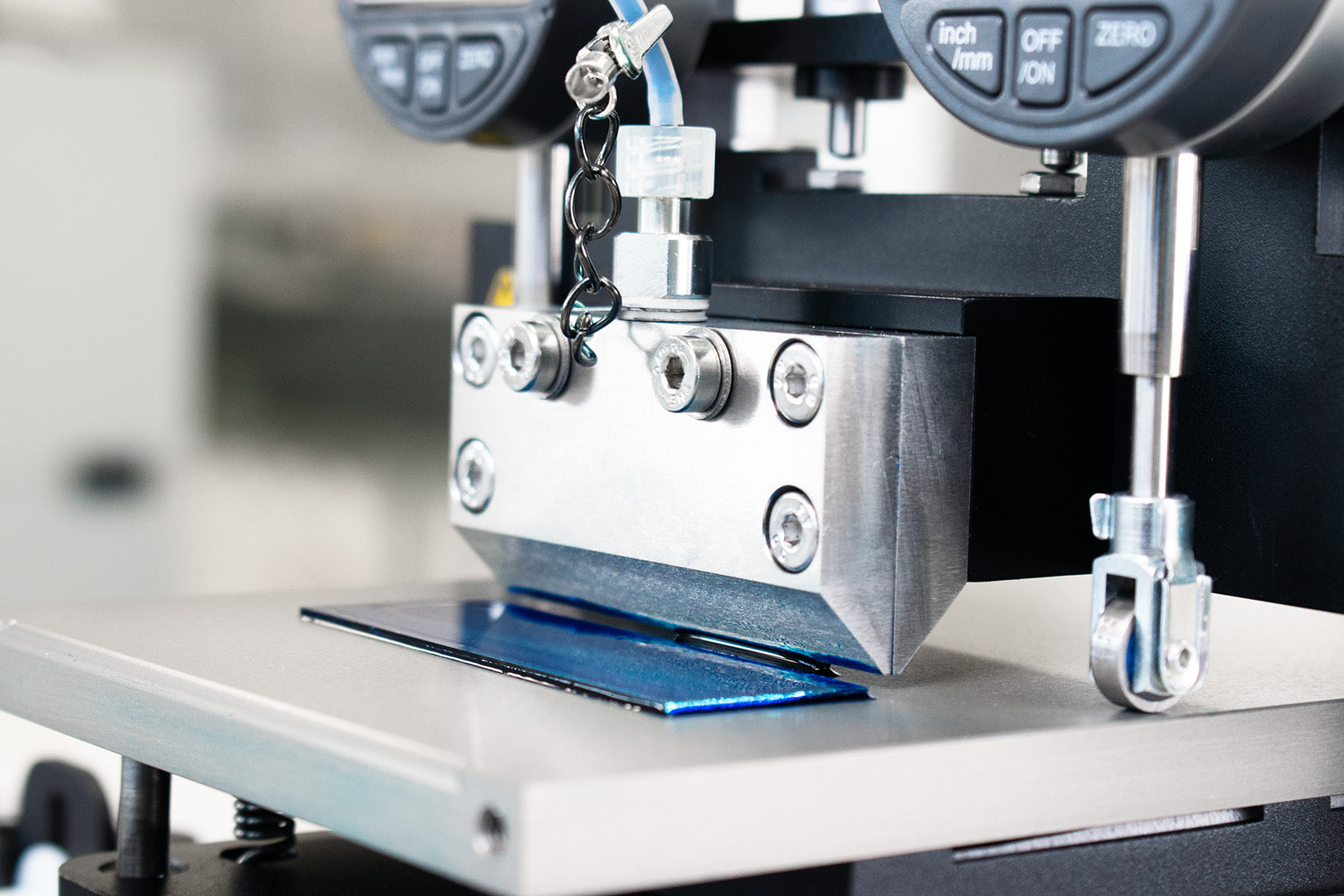
- Blade Coating – a small gap is left between the reservoir and substrate, with a doctor blade determining film thickness.
Challenges of Scaling Up
R2R processing requires as much process optimization as any small-scale coating technique. Challenges include finding the stable coating window, working out a solution delivery system and facilitating post-processing treatments.
Alongside this, the increased operation time and larger coating areas means the film properties may change during the coating time. Unwanted variation in the coating over time is known as 'drift', and it is hard to prevent or control.
Due to the size of the equipment, cost and access are serious considerations. Industry scale R2R coating systems are expensive, and these systems need a lot of solutions and substrate material for each run. This limits the use of R2R processes in many laboratory scale experiments.
Potential Applications for Roller Coaters
- Battery research and energy storage techniques
- Third generation flexible or tandem solar cells
- Printed electrodes for sensor technology
- Aerogel films
- Dielectric co-polymers
Further Reading
 Screen Printed Electrodes
Screen-printed electrodes (SPEs) are an important development within electrochemical analysis methods, offering a sensitive, cheap, and simple platform for sensing technologies across various fields. Screen printed electrodes can be particularly useful for environmental analysis sensors, detecting biomolecules and biomarkers, flexible electronics and more.
Read more... Spray Coating: Droplet Formation and Deposition
Spray deposition or spray coating is a scalable wet-coating technique used in many applications. A spray coater can be used in many industries to coat large substrates or objects with odd shapes. The flexibility of the applicator and robustness of the process means that spray coating can be adapted to coat almost anything.
Read more...