Keeping Photovoltaic Testing Accessible: The Ossila Solar Simulator
Included as Standard | Meeting International Standards | Accessible & Affordable Features | Free Software | The Ossila Solar Simulator
The Ossila Solar Simulator is an affordable Class AAA solar simulator designed for small-area solar cells; an accessible option for small labs. The carefully calibrated array of LEDs generate a high quality spectrum at impressively low costs, while providing a long lamp lifetime, individual LED power control, and a short warm up. Be confident in your research results with system classification that follows international standards and take advantage of experimental flexibility without the huge price tag.
Included as Standard
With useful, well-designed components included as standard, the Ossila Solar Simulator sets you up for reliable testing straight away, without demanding a huge investment that blows your research budget.
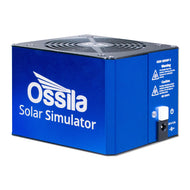
 High power LED lamp with a calibrated array capable of spectral tunability across 350 nm – 1000 nm.Optical breadboard for test board flexibility or easy fixing onto larger optical tables.Adjustable height stand to accommodate thicker or curved samples and your choice of test board.Free software with a simple interface for customizable control.Certification and quality control data for confidence in performance and your experimental results.
As a modular instrument with testing flexibility, the solar simulator is easily adapted to a wide range of experimental setups, whether you are focused on standard photovolatic testing, curved substrates, and even integration into larger existing systems, like probe stations. Plus, while we sell a range of compatible test boards, we don't tie you into the Ossila ecosystem. Instead, the breadboard and adjustable height stand mean that you can adjust the setup to suit your preferred and specific testing components.
Meeting International Standards
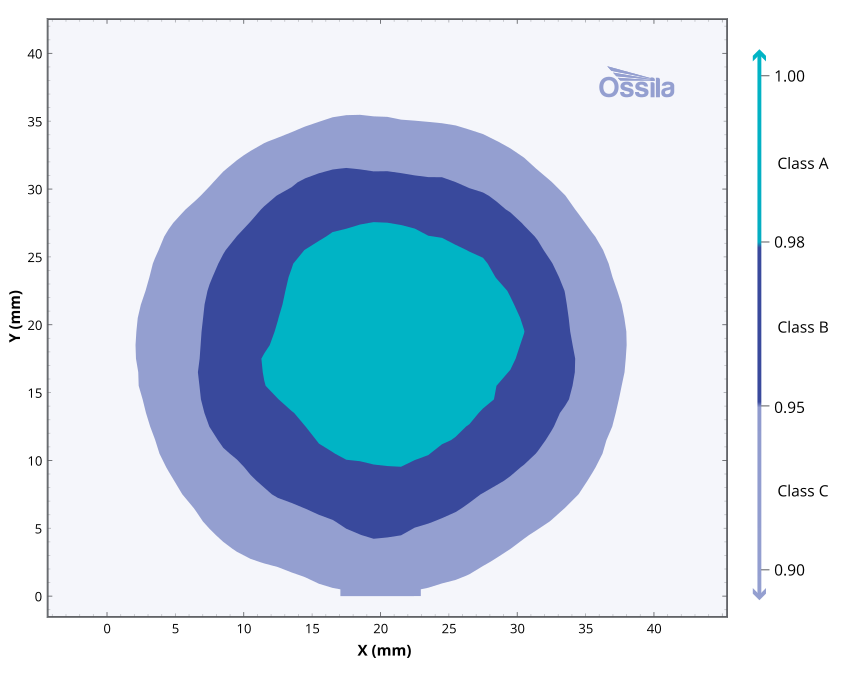
Our goal is to make to make research affordable, but we also want results to be reliable, equipment performance traceable, and methods easily replicated. Like all trusted models, we calibrate our solar simulator according to international standards. Following the IEC 60904-9:2020 standard, the Ossila Solar Simulator is guaranteed to be Class AAA rated over a 15 mm diameter area, which is ideal for photovoltaic devices fabricated on 20 mm x 15 mm substrates. As you begin to scale your devices, the B and C rated spatial uniformity over larger diameter areas makes the transition to initial testing of larger devices convenient with a single system. Most importantly, we individually calibrate each system with a NIST traceable spectroradiometer and include a performance report so you can reference specific calibration data in your research.
| Spectral Match | A |
|---|---|
| Spatial Uniformity (over 15 mm diameter area) | A |
| Spatial Uniformity (over 25 mm diameter area) | B |
| Spatial Uniformity (over 32 mm diameter area) | C |
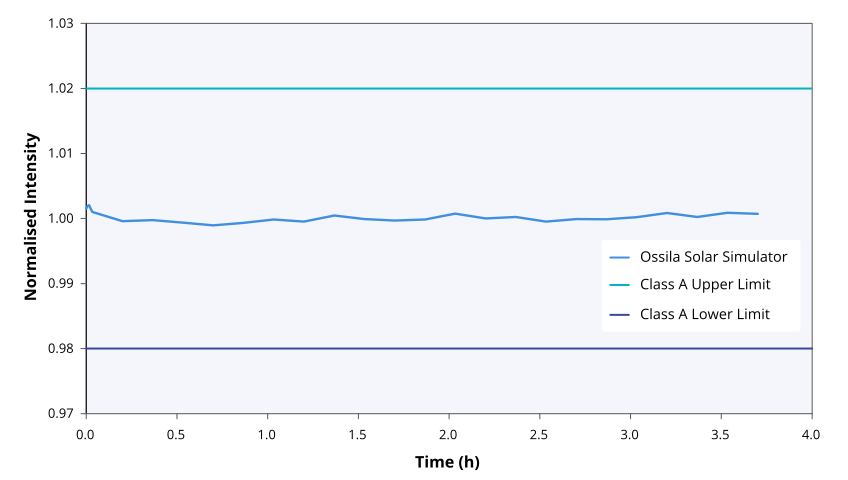
| Temporal Instability | A |
Alongside the required reporting of spectral coverage and deviation, we also clearly state the total irradiance for the irradiance graphs relating to our product. While it is common practice for other manufacturers to scale their spectral irradiance graphs (usually 0.1 – 0.5 Suns) to more conveniently compare the spectral shape to the AM1.5G spectrum, the spectra for the Ossila Solar Simulator is taken at 1 Sun irradiance. We show the full power of the solar simulator (and Sun) for the most accurate spectral representation, then if you would prefer to use only the power that is in the region 300-1000 nm, you can simply set the power level to 70 W/cm2.
Click on the graphs below to take a closer look at the classification data.
Spectral Irradiance
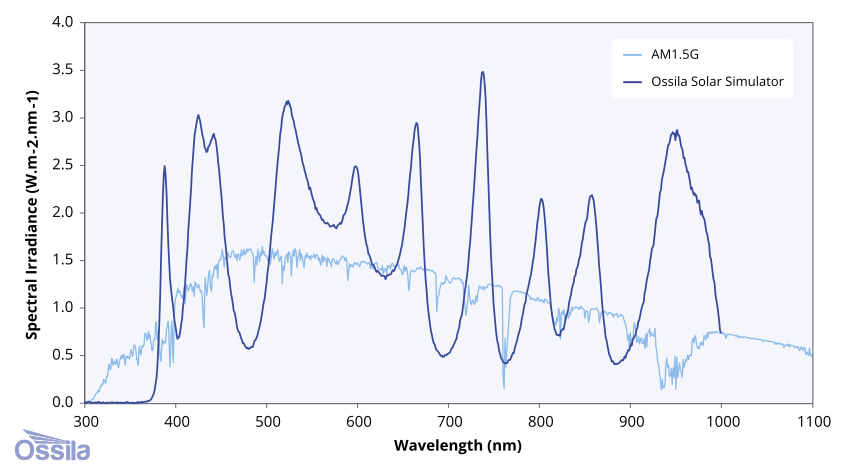
Spectral Match
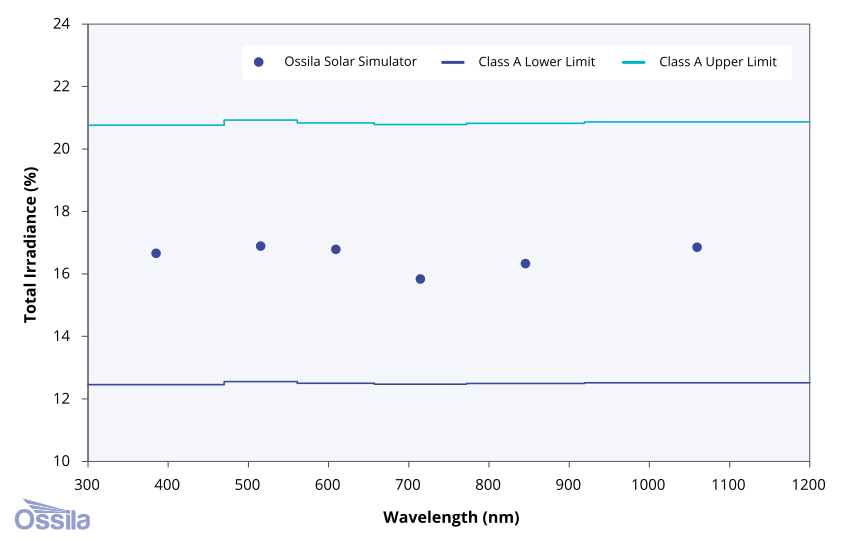
Spatial Uniformity
Temporal Instability
Accessible & Affordable Features
An intentional balance of affordability and high performance, the Ossila Solar Simulator provides reliable, calibrated light at a low cost. But we didn't stop there. Beyond the performance determined by the international standard, we prioritized useful features like the modular design, compact footprint, and software to control spectral output in the design, being sure to keep the final price down. The experimental flexibility enabled by these features is why our solar simulator is a popular choice for small labs, who would otherwise be priced out by other feature-rich options on the market. And as the solar industry turns its attention to low light and indoor photovoltaics, we've made sure your research can keep up. All of our solar simulator lamps can be paired with the indoor light filter and calibrated to test indoor photovoltaics, following newly defined standards.
By designing the solar simulator to be modular, we have a high performance lamp that we have built on to create a range of different systems. We offer five solar simulator products to fit different testing requirements and budget. From a standalone lamp ideal for integration into custom setups to an automated solar cell testing kit that simplifies your testing processes with an integrated solar simulator and characterization instrument.


Free Software
The Ossila Solar Simulator Console enables you to control and customize the output of your LED solar simulator. You can choose the overall power level or control each LED individually to tailor the output to your specific requirements. The user-friendly software can be installed on as many PCs as you want and you can access future updates for free. If bought as part of the testing kits, additional software is included for I-V measurements and characterization.
If you want additional customization, the lamp is also easily controlled through a serial command library. This is useful for specialist measurements, non-conventional spectral output, or automation in your measurements.
See the Ossila Solar Simulator Software in action below.
The Ossila Solar Simulator
We make photovoltaic research accessible no matter the resources behind you. The Ossila Solar Simulator is designed for testing small-area solar cells in labs with modest or limited research budgets. Scale up is always the goal but often budget constraints make it impossible to justify a larger area system just in case scale up becomes achievable. Importantly, this solar simulator still gives you flexibility in your experiments because we know how fundamental custom setups are to small, specialized research teams.
We are proud to be a budget-friendly option that doesn't compromise on performance or quality.
Solar Simulators