


Sodium Ion Batteries vs. Lithium Ion Batteries
Jump to: What Are Sodium-Ion Batteries | Sodium-Ion Battery Structure | Sodium-Ion Battery Materials | Pros & Cons | Applications
Sodium-ion batteries (SIBs) use sodium-ion intercalation to store and release energy in the same way that lithium-ion batteries use lithium ions. Sodium is over 1,000 times more abundant than lithium and can be sourced from inexpensive and common materials such as seawater and soda ash. Global lithium demand is projected to outstrip supply by 2028 unless significant progress is made in recycling technologies, mining efficiency, or alternative materials are found. Sodium-ion battery technology offers an exciting potential as a substitute to lithium. Another benefit is that SIBs are also more thermally stable due to the potential use of non-flammable electrolytes.

Current prototypes of SIBs have lower energy density (90–150 Wh/kg) compared to typical LIBs (130–285 Wh/kg). However, there has not been the same extent of optimization in battery cell design for SIBs as LIBs. The larger ionic radius and lower redox potential of sodium compared to lithium leads to challenges in energy density and structural stability. Nevertheless, using sodium-ions as a more sustainable alternative to lithium-ions for energy storage is an exciting research avenue for current battery scientists. Researchers are focusing on addressing the energy density limitations of SIBs while maintaining or extending their cycle life.
Sodium-Ion Battery Materials

What are Sodium Ion Batteries
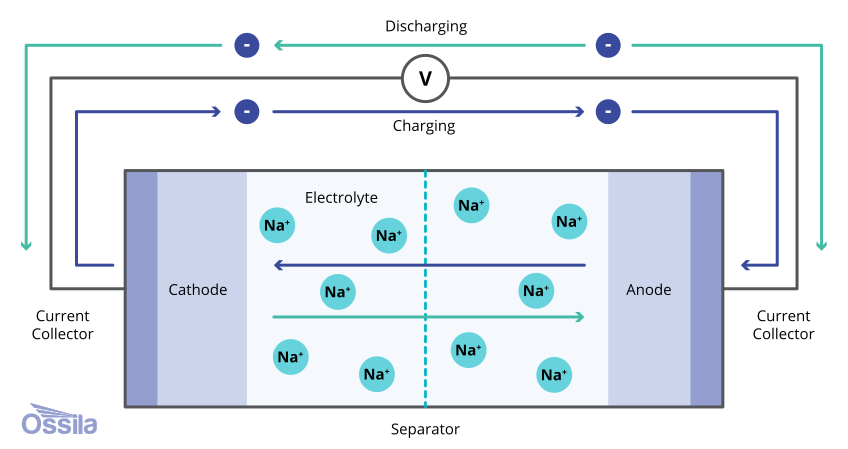
Sodium ion batteries operate using similar principles to lithium-ion batteries. Sodium-ions intercalate with the different electrodes depending on whether the battery is charging or discharging. At the point of intercalation, redox reactions take place in order for electrons to be released or gained.
Charging: Sodium ions leave the cathode, are transported through the electrolyte and are then inserted into the anode. Not thermodynamically favorable so requires an external power supply to drive the reaction.
Discharging: Sodium ions leave the anode, are transported through the electrolyte and are then inserted into the cathode. Thermodynamically favorable so occurs naturally without the need for external power source.
Sodium-Ion Battery Structure
A typical SIB has an anode, a cathode, current collectors and a separator infused with an electrolyte containing either aqueous or nonaqueous sodium ions. For reliable battery performance, the electrochemical potential of both electrodes must stay within the stable range of the electrolyte.

This stability window is defined by the energy gap between the electrolyte's Lowest Unoccupied Molecular Orbital (LUMO) and Highest Occupied Molecular Orbital (HOMO). If the anode potential rises above the LUMO level, the electrolyte may decompose which leads to safety issues including thermal runaway. To prevent this, a protective layer called the solid electrolyte interphase (SEI) forms on the electrode surface, restricting electron transfer and preventing reduction of the electrolyte. This thin protective layer forms on the anode surface to prevent excessive electrolyte decomposition. In the same way, if the cathode potential falls below the HOMO level, a passivation layer is also needed to block electron flow from the HOMO to the cathode and avoid unwanted reactions.

Sodium-Ion Battery Materials
Although the overall structure of SIBs is similar to that of LIBs, the chemical and electrochemical properties of sodium-ion battery materials differ significantly.
Anode Materials
Anodes for SIBs typically follow three different mechanisms for storing sodium ions - insertion, conversion, and alloying. The development of these materials is driven by the need to find alternatives to graphite, which is standard in lithium-ion chemistry. Graphite cannot effectively intercalate the larger sodium ion. While organic molecules offer a sustainable alternative via multielectron redox reactions, they are not yet widely used due to issues with solubility and low conductivity.
Insertion/Intercalation Anodes
Insertion or intercalation electrodes store sodium ions inside their structure without disturbing their three-dimensional framework. They usually undergo less volume expansion in comparison to alloying and conversion electrodes. The amount of intercalated sodium is determined by the thermodynamic equilibrium at the electrode/electrolyte interface. Carbon based materials are the most studied insertion anodes for SIBs because of their chemical and thermal stability:
Carbon-based Insertion Anodes
Carbon materials, including amorphous carbon, heteroatom-doped carbon, and biomass derived carbon have sodium storage capabilities. Their abundant, low cost, nontoxic and highly safe nature makes them promising electrode candidates for SIBs:
| Hard Carbon | Hard carbon (HC) anodes are the main candidate for commercial SIBs. They contain randomly oriented pseudographitic domains where sodium ions can be intercalated. They also contain some porosity, surface defects, and heteroatoms (N, S, P, etc.), which supply pathways for sodium mobility and more sodium storage active sites. The different precursor morphologies largely affect the electrochemical performance of HC anodes. They also face challenges due to their low initial Coulombic efficiency (typically <80 %), which hinders their practical use. |
| Soft Carbon | Modified soft carbon (SC) anodes with high capacity and low cost also have potential for commercialization. SIBs with modified carbon nanostructures have high-rate capability and long cycle life. This is due to the design of multidimensional nanostructures that can reduce volume change during Na+ insertion and extraction. However, nanostructured carbons have high initial irreversible capacity due to electrolyte decomposition and SEI layer generation. |
Conversion Anodes
Conversion reaction anodes react during sodiation (charging) to form new products according to the following reaction equation:
MaXb + (bc)·Na ⇋ aM + bNacX where M is a transition metal and X a non-metal.
Metal oxides, sulfides, selenides, nitrides, phosphides, and hydrides have been explored for anodes in SIBs and can deliver high specific capacities up to 1800 mAh g−1. However, issues of large volume expansion through battery cycling (430% for phosphides and 300% for oxides) lead to irreversible capacity losses and low initial coulombic efficiencies.
Alloy Anodes
Anode materials featuring alloying reaction mechanisms are one of the most attractive candidates, due to their great potential for high-energy SIBs. The mechanism is based on sodium alloying and dealloying reaction with some elements from groups 14 and 15 to form Na-M intermetallic binary compounds. These anode materials deliver high capacities from 300 to 2000 mAh g−1, since a single atom can be alloy with manifold Na ions. However, large volume changes degrade the electrode and give rise to low cyclability. Examples of alloying anodes include; Sn, Sb, P, Ge, Bi, Si, Pb, and As.
Cathode Materials
Cathode materials for SIBs can be categorized into polyanionic compounds, Prussian blue analogues and layered transition metal oxides. Sodium has a higher standard reduction potential than lithium (-2.71 V vs -3.04 V) so SIBs naturally have a lower cell voltage. To compensate, cathode materials must be designed to operate at the highest possible potential without decomposing the electrolyte.
Polyanionic Compounds
Polyanion-based cathodes have open-framework structures that are more resistant to volumetric changes during sodium insertion and extraction. NASICON-type (Na1+xZr2SixP3−xO12, 0 < x < 3) sodium super-ionic conductor structures with 3D open frameworks enable rapid Na⁺ diffusion and high structural stability. Many studies have focused on improving the capacity of NASICON-type phosphates (eg. Na3V2(PO4)3) by substituting vanadium with cheaper, more sustainable elements. Manganese- and iron-based NASICON phosphates are especially promising due to multi-electron redox couples (e.g., Mn²⁺/Mn⁴⁺), which enhance specific capacity. Similarly, fluorophosphate materials demonstrate higher energy density than other polyanionic compounds, owing to their elevated operating voltages.
Prussian Blue Analogues (PBAs)
Prussian blue analogues (PBAs), including prussian white powder, have emerged as particularly promising cathodes for SIBs due to their open frameworks and tunable electrochemical properties. They have the general formula of AxM'[M''(CN)6]1−y where A is an intercalated alkali metal (sodium for SIBs technology) and M'/M'' refer to transition metals (commonly Ni, Mn, Co, Cu and Fe). The transition metals provide two different redox activity centers, M'2+/3+ and M''2+/3+ which enables a two-electron transfer capacity via reversible sodium-ion insertion and extraction. However, the presence of [Fe(CN)₆]⁴⁻ vacancies and residual lattice water remains a critical challenge, as these defects can trigger structural collapse and parasitic side reactions with the electrolyte. Achieving high-performance PBAs requires specialized synthesis techniques to minimize these vacancies and ensure a high degree of crystallinity, often referred to as "low-defect" Prussian Blue.
Layered Transition Metal Oxides
Layered transition metal oxides (NaxMO2, where M is typically a transition metal like Mn, Fe, Co, or Ni) are the front-runners for commercial sodium-ion batteries. Their structure consists of alternating layers of edge-sharing octahedra and layers of sodium ions. The layered structure facilitates the intercalation and deintercalation of sodium ions upon discharging and charging. The main difference between these materials is how the sodium environment is shaped and how the layers are stacked. The key groups are:
O3-phase - Sodium ions in octahedral sites (O) and there are three (3) transition metal layers in a repeating unit.
P2-phase – Sodium ions in prismatic sites (P) and there are two (2) transition metal layers in a repeating unit.
Sodium nickel iron manganese oxide (NFM) contains three transition metals in a 1:1:1 ratio (Ni:Fe:Mn) and is typically O3-phase. Each transition metal plays a distinct role in enhancing the performance of this SIB cathode material:
- Nickel supplies high capacity due to its ability to change its oxidation state from Ni2+ to Ni4+ (it can hold more Na+) and it also elevates the average operating voltage.
- Iron also increases the voltage and improves the structural stability by reducing the fraction of Mn3+ (leads to unstable phase transitions and lattice oxygen loss). Iron redox couples are active in sodium oxides but not lithium oxides, meaning their abundance can be exploited in SIBs and not in LIBs.
- Manganese enhances structural stability, as Mn4+ minimizes structural distortion and is the backbone of most SIB cathodes.
In other layered transition metal oxides for SIBs, copper is often added to stabilize the structure and raise the operating voltage. This again is uniquely available to sodium chemistry compared to lithium chemistry.
One of the biggest headaches with layered oxides is their tendency to react with moisture and CO2 in the air. Doping the material with elements like Magnesium (Mg) or Titanium (Ti) can secure the layers together and make them much more resilient to the atmosphere.
Electrolytes
Electrolytes are an important component of SIBs are required to have a wide electrochemical stability window, high thermal resistance, and excellent ionic conductivity. The different types of electrolytes used include organic electrolytes, ionic liquids, aqueous electrolytes, solid-state electrolytes, and hybrid systems. Organic electrolytes are currently used in commercial applications, but aqueous and solid electrolytes offer distinct benefits for future use. Researchers are currently working on modifying electrolytes to improve their compatibility with electrode materials, to improve battery safety and longevity.
| Electrolyte | Examples | Pros | Cons | Safety | Sustainability |
|---|---|---|---|---|---|
| Organic | Carbonate solvent (EC: PC (1:1) + NaPF₆) Ether solvent (DEGDME + NaTFSI) | High ionic conductivity | Flammable, toxic solvent | Risk of thermal runaway | Commonly petroleum-based |
| Aqueous | Neutral (Na2SO4) Alkaline (NaOH + ZnCl2) Water-in-salt (NaTFSI 21 m) | Non-flammable, low cost | Narrow voltage window (1.23-2.5 V), Corrosion (in alkaline), Water reduction (water-in-salt types) | Excellent Safety | Water-based |
| Solid-state | Oxide (NASICON, Na₃Zr₂Si₂PO₁₂) Sulfide (Na₃PS₄) Polymer (PEO + NaTFSI) | Non-flammable, dendrite suppression, sulfide have high conductivity | Low conductivity, brittle, Sulfides are sensitive to air, polymers have lower conductivity and mechanical strength | No risk of leakage | Ceramic processing |
| Ionic Liquid | Pyrrolidinium ([PYR₁₄] [TFSI] + NaTFSI) Imidazolium ([EMIM][BF₄] + NaBF₄) | Wide voltage window | High cost, viscosity challenges | Thermally stable | Energy intensive |
Separators
Separators impart safety within sodium-ion battery function but must facilitate free ion flow between electrodes. The structure and chemical composition of SIB separators significantly influence the battery's ion transport rate, internal resistance, cycle performance, rate performance and overall safety. The key properties of separators are porosity (< 1 μm), mechanical strength, electrolyte wettability, permeability, and electrochemical stability. Due to the larger ionic radius and higher viscosity of sodium electrolytes in SIBs compared to LIBs, separators a required to have better wettability and higher porosity to maintain ion conductivity.
Sodium dendrites pose a higher risk than lithium dendrites. The separator plays an important role in preventing short circuiting through optimized pore size and mechanical strength. Research is focused on creating thin, low-cost, and thermally stable separators compatible with sodium electrolytes, capable of maintaining dimensional integrity under heat and mechanical stress, and facilitating fast, stable ion transport-all.
Sodium Ion vs. Lithium Ion Batteries
The comparison of the key differences in sodium-ion and lithium-ion battery technology is in the table below:
| Property | Sodium-Ion Batteries | Lithium-Ion Batteries |
|---|---|---|
| Gravimetric Energy Density / Wh/kg | 90-160 | 180-260 ✓ |
| Volumetric Energy Density / Wh/L | 200-400 | 400-700 ✓ |
| Cost | Lower ✓ | Higher |
| Safety | Lower risk of thermal runaway ✓ | Higher risk of thermal runaway |
| Cycle Life / cycles | 500-2000 | 1000-3000 ✓ |
| Performance at low temp (-20 °C) / % nominal capacity | 90% ✓ | 60-70% |
| Environmental Impact | Lower due to more abundant resources, reduced reliance on critical metals, potential for more green recycling ✓ | Higher due to reliance on scarce/critical metals (Co, Ni) and more recycling challenges. |
As discussed, energy density and cycle life are the key performance factors where LIBs win out over SIBs. However, battery performance is reliant so heavily on cell design and the amount of investment in SIB cell design pales in comparison to that of LIBs. Therefore, efforts can be made to resolve these issues with plenty of scope still available to researchers. The abundancy of lithium is not going to change any time soon, therefore our global reliance on it leaves us vulnerable. The increased safety and reduced cost of SIBs are huge drivers in SIBs emerging as a viable alternative to LIBs. Especially in instances where energy density is not the key priority for a given energy storage application. For low temperature performance, SIBs show significantly greater nominal capacity retention.
Contemporary Amperex Technology Co., Limited (CATL) launched its first-generation SIBs cell monomer in 2022 which highlighted SIBs advantages in low temperature environments. The SIB has an energy density of 160 Wh kg−1, very close to LiFePO4 (LFP) batteries (180 Wh Kg−1) and Li(NiCoMn)O2 (NMC) batteries (240 Wh Kg−1). It can reach 80% charge within 15 min at room temperature and maintains over 90% discharge retention in a −20°C environment. There are also examples of great success in increasing the cycle lifetime of SIBs such as Na₃V₂(PO₄)₂F₃ paired with hard carbon in the ALISTORE prototype which exceeded 4000 cycles.
Sodium-Ion Battery Materials
Battery Applications Comparison
The key difference between current SIB and LIB technology is the higher energy density of lithium-ion storage. However, batteries are used for lots of different applications that have different energy and power requirements. Understanding the key requirements of a battery for a given application means that sometimes SIBs are a viable option. The cost, operating temperature and safety benefits of SIBs are important factors for consideration in battery design.
Sodium-ion batteries are particularly attractive for stationary energy (grid) storage and low-to-medium power mobility systems where energy density is less critical and safety is a primary concern. While LIBs remain the gold standard for high-performance electric vehicles and compact consumer electronics due to their superior gravimetric energy density, SIBs excel in large-scale installations where cost-per-kilowatt-hour and cycle life under extreme temperatures are more vital than weight. This allows SIBs to mitigate supply chain risks associated with lithium and cobalt. They are a specialized solution for applications like home solar batteries and e-bikes, where affordability and safety are more vital than having the longest possible range.
Learn More
 An Introduction to Transition Metal Oxides (TMOs)
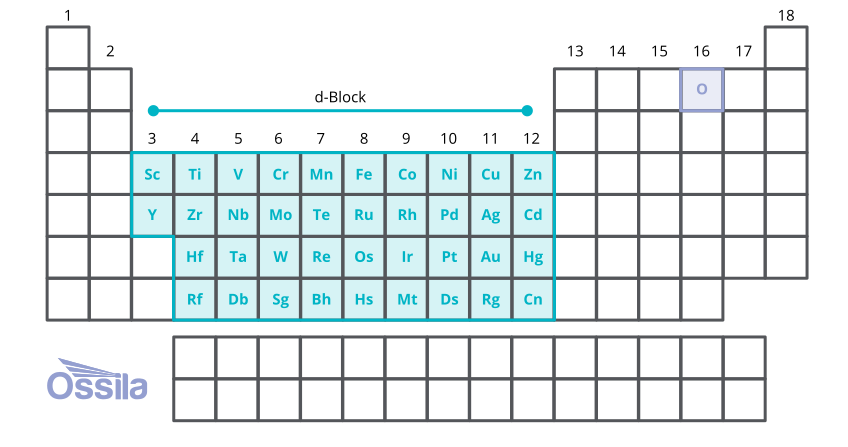
Transition metal oxides (TMOs) are compounds of transition metals bonded to oxygen. A transition metal is an element in the periodic table that has a partially filled d-shell or which forms cation with an incomplete d-shell. TMOs have been extensively researched due to their wide range of chemical and physical properties.
Learn more... An Introduction to the Solid Electrolyte Interphase (SEI)
A solid electrolyte interphase (SEI) forms on the negative electrode due to the decomposition of electrolyte. The decomposition by-products build up on the surface of the anode and form an independent phase of material, different to the electrode and electrolyte.
Read more...
References
- Sodium ion batteries: A sustainable alternative to lithium-ion..., Mashfy, M. M. et al., Next Energy (2026)
- Assembly and electrochemical testing of renewable carbon-based anodes..., Alvira, D. et al., Journal of Energy Chemistry (2022)
- Carbon Anode Materials for Advanced Sodium-Ion Batteries, Hou, H. et al., Advanced Energy Materials (2017)
- Advancements in cutting-edge materials for sodium-ion battery anodes:..., Sharmin, T. et al., Materials Today Chemistry (2024)
- Alloy-Based Anode Materials toward Advanced Sodium-Ion Batteries, Lao, M. et al., Advanced Materials (2017)
Contributors
Written by
Application Scientist
Diagrams by
Graphic Designer