


Scintillator Materials

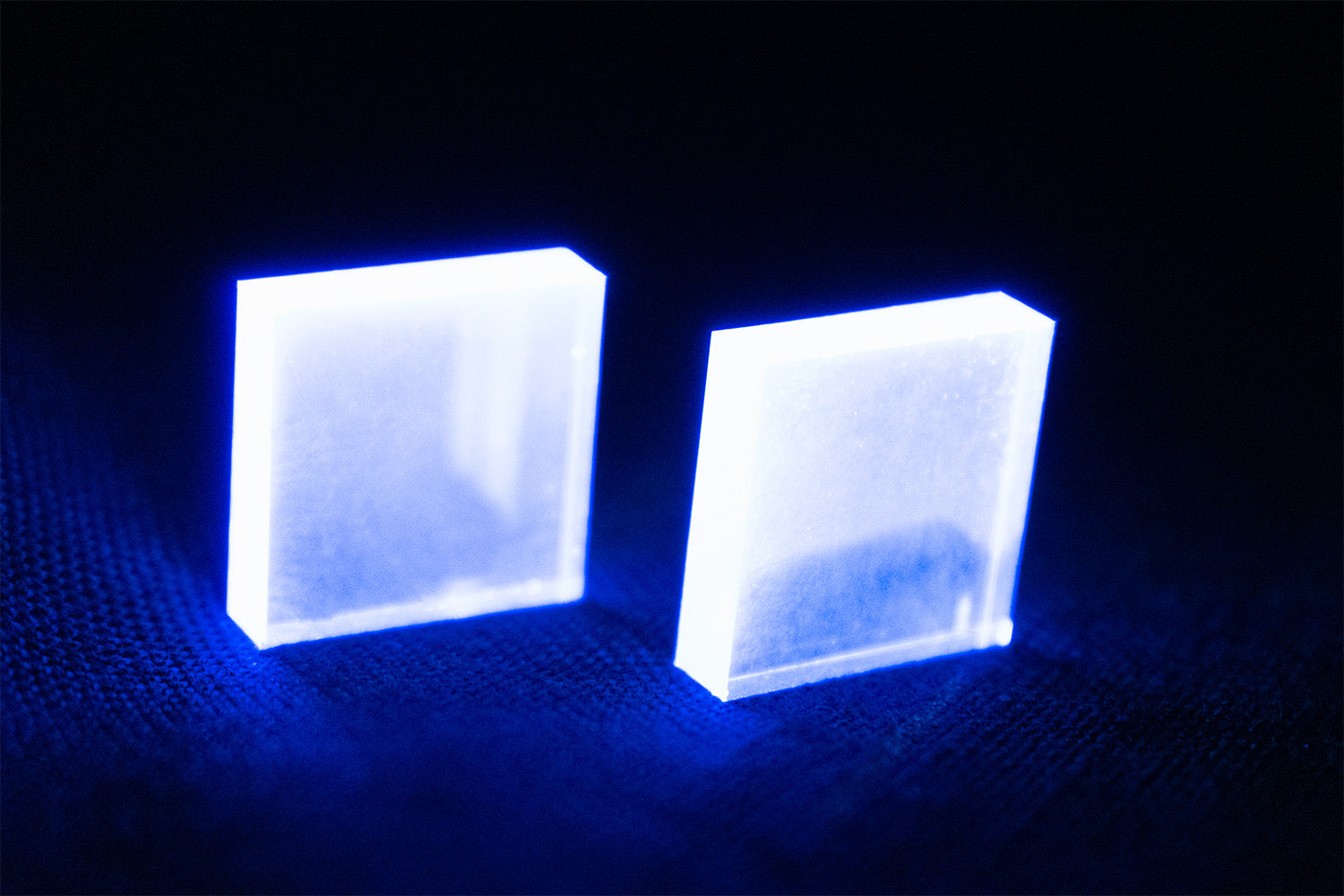
A scintillator is a material that will absorb energy from incoming radiation and convert it to a visible photon emission. These are used in scintillation detectors to measure and identify specific types of radiation.
Scintillation-based radiation detectors are highly effective and are used in a wide range of applications including medical imaging, security, environmental monitoring and particle physics research. There are two main kinds of scintillation detector: scintillation counters and scintillation spectrometers. Good energy resolution is very important in spectroscopy scintillators, whereas fast timing is the most important quality in counters.
Therefore, the choice of scintillator used in a detector is important. Different types of scintillators have different properties making them better suited to different applications. Organics and plastic scintillators have a fast response time, are easy to produce and can create large area detectors. However, their light yield is relatively low. On the other hand, inorganic scintillators have high light output and good linearity - but have a slow response time.
Contents
- What is a Scintillator?
- How Does A Scintillator Work?
- Scintillator Emission
- How Radiation Interacts with Matter
- Emission From Organic Scintillators
- Emission From Inorganic Scintillators
- Converting Photons to Electrical Signals
- Scintillator Properties
- Inorganic Scintillators
- Plastic, Liquid and Organic Scintillators
What is a Scintillator?
Radiation from ionizing materials is often invisible to the human eye and highly penetrating, making it difficult to detect. Radiation detectors are built to detect this, usually optimized around a specific type of radiation. These detectors are built on one of two principles:
- Using semiconductors to convert radiation to charge carriers.
- Using scintillation to convert radiation into photons, which are detected by a separate detector.
The scintillator material is the component in a scintillation detector that converts incoming radiation into emitted photons. These photons are then separately detected using a silicon photodiode (Si-PD) or photomultiplier tube (PMT).
Scintillation detectors combine scintillators with photomultiplier tubes or photodiodes to characterize a type of radiation.
- Scintillators absorb ionizing radiation and emit low energy photons.
- The PMTs/ Si-PDs convert these photons into electrical signals.
How Does a Scintillator Work?
Scintillator Emission
Most scintillation detectors require fast response times to work effectively. Therefore, fluorescence pathways dominate in most scintillator materials, rather than phosphorescent or TADF emission.
However, some scintillation detectors can use these slower emission events. This slower emission can be particularly useful for deciphering between different types of radiation with the same kinetic energy (known as pulse shape discrimination). However, most of the time, fluorescence is what we’re interested in.
How Radiation Interacts with Matter
Exactly how incoming radiation will interact with a scintillator depends on the type of radiation and the scintillator material, although it can be difficult to identify any single event.
There are three main ways that high energy radiation (such as gamma or X-rays) exert energy into a scintillator material: the photoelectric effect, Compton scattering and pair production.
| Mechanism | Process | Diagram |
|---|---|---|
| Photoelectric Effect |
High energy X-rays or gamma rays are absorbed by an electron, ejecting it from the atom, creating a free electron with some kinetic energy. |
 |
| Compton Scattering |
Interaction between a high energy photon and a free/ loosely bound electron. The photon transfers some energy to the electron, scattering both. |
 |
| Pair Production |
A high energy photon (over 1.022 MeV) creates an electron-positron pair, near the nucleus of an atom. |
 |
Excited electrons (and other charged particles) will have a significant impact on many atoms in the scintillator material as they move through it. Charged particles can interact with a scintillator material by:
- Emitting Bremsstrahlung radiation
- Transferring energy to another electron, producing electron-hole pairs
- Depositing heat into the scintillator
- Through collisional energy losses
Additionally, larger charged particles, such as alpha and beta particles, deposit energy through direct Coulomb interactions with orbital electrons as they travel through the medium. This causes ionization and excitation without requiring an initial photon interaction.
Due to the large number of events charge particles cause, you must consider the energy loss of charged particles as an average, rather than trying to consider individual events.
Any incoming radiation (high energy photon or charged particle) can lead to the creation of both photons and excited electrons which can further interact with the scintillator. These interactions (or events) will occur and combine in all sorts of different ways and can trigger further events. For example, the primary electrons created by the photoelectric effect can partially transfer their energy to other electrons, knocking them loose creating secondary electrons.
While there are key features to look out for, the combination of many different events makes it difficult to quantify or even identify individual events in scintillation spectroscopy systems.

Emission From Organic Scintillators
In organic scintillators, fluorescence is a property of the organic molecule itself. This means that the scintillator is not dependent on a lattice structure, unlike with organic scintillators.
This organic material requires an energy gap of 3-4 eV between its ground (s0) and first excited state (S1) to be an effective scintillator. Fluorescence at the organic scintillator molecule must occur through the following steps.
- At room temperature, most electrons will be in S00 state.
- Kinetic energy from incoming charged particles excites electrons into excited vibrational states
- Due to internal relaxation, the excited electrons dissipate energy, populating electrons in S10 state.
- Fluorescence occurs moving electrons S10S0x, where x is a vibrational ground state. This emits a photon of lower energy.
Fluorescence intensity at time t is

where \tau is fluorescence decay time, and I0 is the intensity of emitted light when t=0.
If the incoming radiation wavelength lies outside the energy levels of the scintillator, wave-shifters can be added to absorb and re-radiate light at a wavelength that can be absorbed by the organic scintillator.
Emission From Inorganic Scintillators
Unlike organics, the energy states and band gap of inorganic scintillators depend on the material’s crystal lattice. Usually, inorganic scintillators have bandgaps outside the visible region. However, doping these materials with small amounts of impurities creates sites where the band structure is modified, creating an extra energy level between the conduction and valence band. Relaxation from these extra energy levels will produce visible photons. These doped sites are known as luminescence centers or recombination centers.

Incoming radiation can create electron hole pairs anywhere in the crystal. From there, holes drift to activator sites, while the electron moves freely through the crystal. When a free electron finds a hole on an activator site, recombination occurs emitting a photon to the PMT or Si-PD.
For this reason, both the bulk crystal and dopant properties play a significant role in scintillation characteristics.
It should also be considered that as a charged particle moves through inorganic crystal, it dissipates energy creating many new electron-hole pairs.
Converting Photons to Electrical Signals
After photon emission, a detector is needed to turn this into a processable signal. Photomultiplier tubes (PMTs) are a popular choice which operate by directing scintillation photons onto a photocathode, while also releasing electrons to amplify signal, producing a measurable current from a single photon. PMTs generally have peak sensitivity in the 300–600 nm range, so a scintillator emission wavelength can be chosen with this window in mind.
Silicon photodiodes (Si-PDs) are another detector that can be used in scintillation detectors.
Important Scintillator Properties
An ideal scintillator has good energy resolution and linearity, high light yield and fast response time. It should also have the following properties:
- Minimal self-absorbance.
- A refraction index close to glass, to ease transition to other components.
- Emission wavelength within the detection range of the PMT/Si-PD. (Si-PDs and PMTs are most sensitive to 300 – 600 nm).
- Be durable, resistant to damage, reasonably priced and able to grow large area detectors.
This perfect scintillator material does not exist yet. Therefore, detectors must compromise depending on the desired application, required environmental conditions and the type of radiation.
The importance of each of these factors depends on the application. High yield and good energy resolution are very important for spectroscopy applications, whereas fast time response is most important for scintillation counters.
Some key properties of a scintillator detector are listed in the table below.
| Property | Description | Use in Detector |
|---|---|---|
| Energy Resolution | The FWHM of a calibration peak divided by the peak centroid position, expressed as a percentage. | Determines precision of the scintillator. Better energy resolution defines ability to distinguish between two closely measured peaks. |
| Light yield | The number of photons that is emitted per energy input (measured in photons/MeV) | High yield means the detector can measure low energy radiation with high signal to noise ratio. |
| Non-proportionality / Linearity | How linear is the relationship between the energy of the incoming radiation and the number of photons produced. Different at different energies. | Higher linearity leads to more accurate measurements across a wider dynamic range. Important for spectroscopy measurements. |
| Time response | How quickly does incoming radiation result in a measurable signal | Fast response times important for timing and counter detectors. |
Most of these properties describe the whole radiation detector, not just the scintillator material. However, the scintillator’s material properties will affect the detector significantly, especially the energy resolution.
Energy resolution measures how reliably the scintillator can convert incident energy into a consistent light response. By repeatedly measuring a series of identical emissions (such as the 662 keV gamma ray produced by 137Cs), you can measure peak broadening to quantify an instrument’s energy resolution.
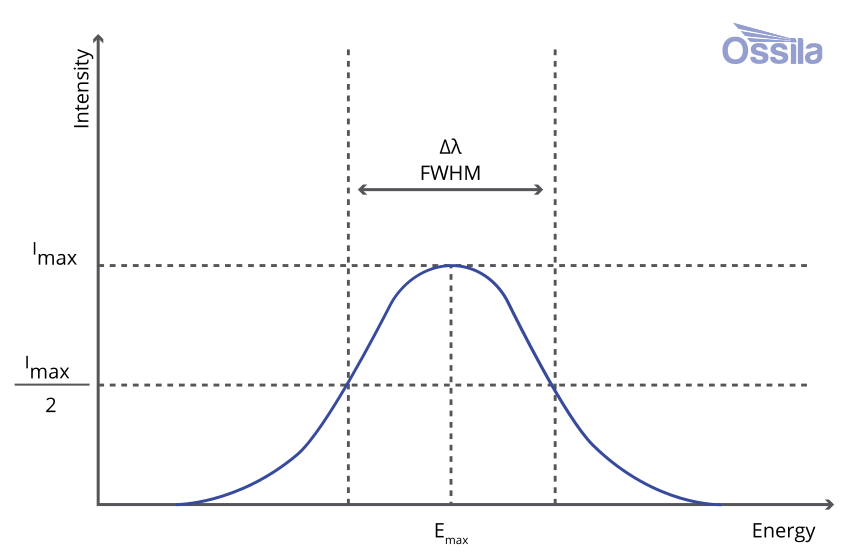
Energy resolution can be affected by many scintillator properties including scintillator dimensions, material inhomogeneities, non-proportional light yield, any location dependent absorbance factors within the scintillator crystal.
Finally, an important factor to consider is price. There are many orders of magnitude difference in price between the cheapest and the most expensive scintillators, for marginal improvements in properties. As well as the initial cost of the scintillator’s material, you must also consider the expense in maintaining and running experiment. For example, if a scintillator or detector requires low temperatures, this may require cryogenic conditions which increase the cost of running experiments.
Inorganic Scintillators
Many inorganic scintillators exhibit good radiation detection properties. Some materials traditionally used as scintillators are sodium iodide (NaI) and cesium iodide (CsI). It has been found that doping these crystals with elements like thallium and europium drastically improves their light yield. In this article, we will use the formation CsI(Tl) to mean thallium-doped cesium iodide, etc.

Inorganic scintillators use a well-defined crystal structure to channel free electrons to any available recombination sites. This results in a high light output as incoming radiation can be easily absorbed and re-emitted with low chances of self-absorption. However, the average decay times of inorganic scintillators can be longer than organic scintillators.
The most cutting-edge inorganic scintillators have a decay lifetime of 30-500 ns, although legacy inorganic materials tend to have much longer decay times.
Over the years, extensive research has led to the creation of some trusted scintillator materials including:
- NaI(Tl)
- CsI(Tl)
- CaF2(Eu)
- BGO (Bi4Ge3O12), a material with a high atomic number, most often used in PET imaging.
- Ce-doped wide band gap materials such as LuSiO5(Ce) and LYSO(Ce).
| Examples | Pros | Cons |
|---|---|---|
| NaI (Tl) |
|
|
| CsI(Na) |
|
|
| CsI(Tl) |
|
|
Newer inorganic scintillator materials have improved sensitivity, with much better energy resolution, which means that these detectors can better distinguish between radiation sources or gamma rays with different energies.
| Material | Photons/MeV | Energy Resolution (at 662 keV) |
|---|---|---|
| NaI(Tl) | 38,000 | 6-7% |
| Lu3Al5O12(Pr) | 20,000 | 3-4% |
| LaBr3(Ce) | 60,000 | 2.8% |
| SrI2(Eu) | 80,000 | 3-4% |
Garnet-based scintillators, such as cerium doped gadolinium aluminum gallium garnet (GAGG(Ce)) and praseodymium-doped lutetium aluminium garnet (LuAG(Pr)), are promising scintillator materials. GAGG(Ce) have high densities and atomic numbers, along with high light output 40,000-55,000 ph/MeV. They also have suitable emission wavelength for pairing with PMTs (~500 nm) and decent energy resolution. Practically, they are non-hazardous and non-hygroscopic. These crystals have a relatively good decay lifetime of 100-500 ns, which is perfectly suitable for spectroscopy applications. However, this is quite long for timing applications. LuAG(Pr) has a more modest light yield of 20,000 ph/MeV, but has a relatively fast decay time for these materials.
Lanthanum bromide and cerium bromide scintillators also offer a very impressive detector performance, with impressive light yield and energy resolution at high energies. Intrinsic factors seem to dominate spectral broadening effects for NaI(Tl) / CsI(Tl) while the relative impact of intrinsic factors is much reduced for LaCl3(Ce) and LaBr3(Ce).
However, they are expensive, relatively difficult to grow and have worse energy resolution at low energies, especially when compared to standard inorganic scintillators like NaI(Tl).
Eu-doped strontium iodide (SrI2(Eu)) is a particularly promising emerging scintillator material, notable for its exceptionally high light yield.
If any scintillator materials can achieve an energy resolution of 1% at 662 keV, a whole new world of applications opens up. This would bring scintillators close to the performance of high-purity germanium (HPGe) detectors. HPGe are the current gold standard for gamma ray spectroscopy, but require cryogenic cooling to operate and are extraordinarily expensive to produce. Therefore, they are expensive and difficult to maintain, especially for a large detector. Achieving 1% energy resolution in a room-temperature scintillator would make high-resolution gamma spectroscopy cheaper, easier, more accessible and useful in a lot of new applications and uses.
Plastic, Liquid and Organic Scintillators
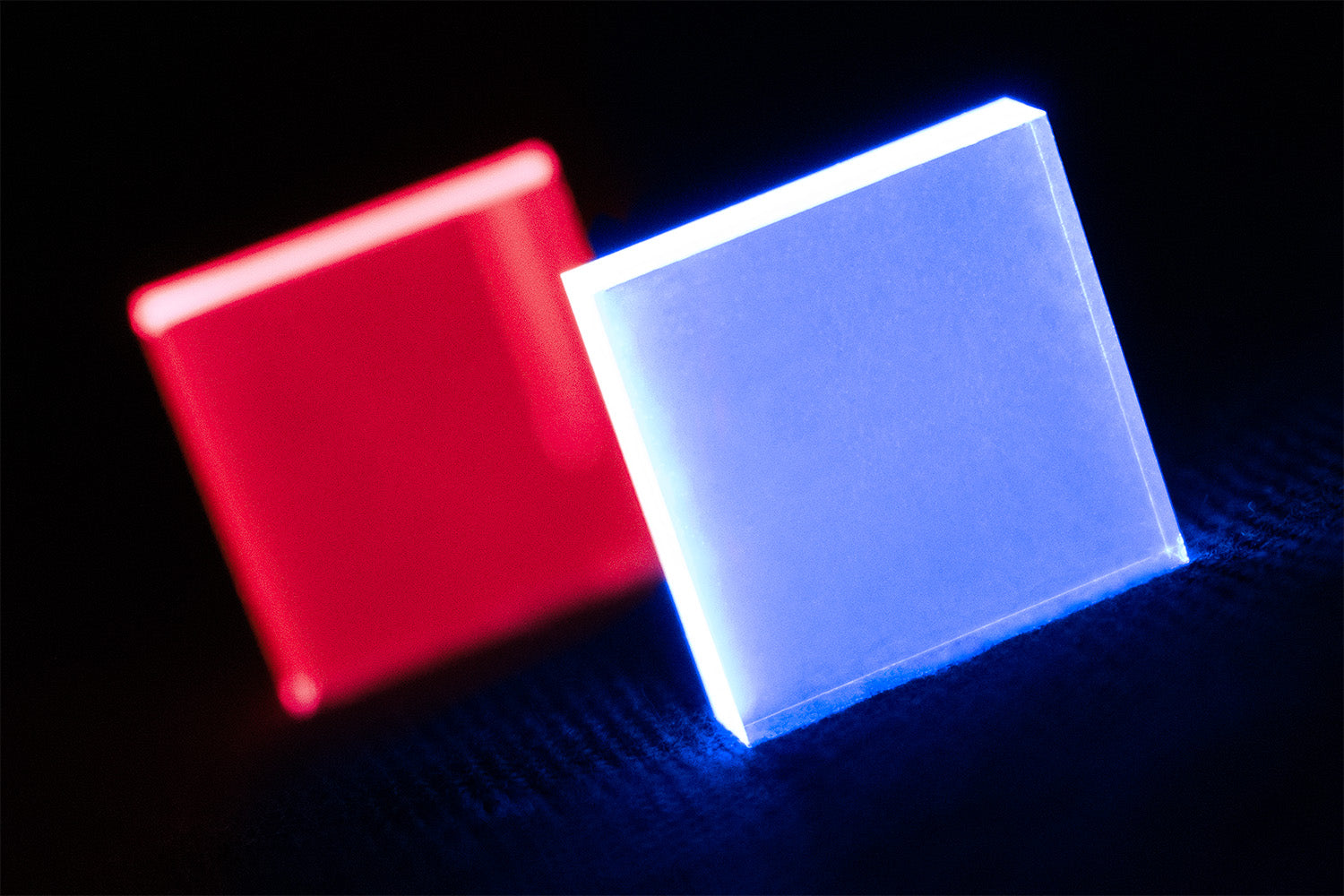
The decay time for organic scintillators is often a few nanoseconds. This short lifetime makes them attractive choices for timing systems, or radiation counters. They are also easy to produce, can easily build large area devices and are generally cheaper than inorganic scintillators.
As mentioned previously, organic scintillator materials rely on molecular fluorescence, rather than depending on a crystal structure. Therefore, one of the benefits of organic scintillator materials is that they can be used in a range of different forms: organic crystals, plastic or liquid scintillators.
In liquid scintillators, a small amount of organic scintillator material is diluted into a large volume of solution. This is a practical way of making very large volume detectors. The solvent absorbs incoming radiation, which is eventually transferred to scintillator materials.
While most organic scintillators exhibit linearity above 125 keV, the low atomic number (Z) and low yield of organic scintillators make them generally insufficient for high energy radiation applications and gamma-ray detection.
The light yield efficiency for a scintillator depends on both the energy, size and type of particle. Organic scintillators can also be affected by many non-radiative decay routes such as quenching. Organic scintillators struggle to detect heavier particles at low energies, due to quenching effects. Furthermore, organic scintillators can be more vulnerable to radiation damage and can be less durable.
| Types | Examples | Pros | Cons |
|---|---|---|---|
| Pure Organic crystals |
Anthracene Stilbene |
One of the original high-yield organic scintillators. Better at pulse shape discrimination. |
Fragile and hard to grow large area devices (10 cm maximum diameter and thickness) Lower yield compared to other methods. Efficiency depends on orientation of ionizing particle in crystal. |
| Liquid organic scintillator |
Organic scintillators dissolved in solvents. Often sold in sealed glass containers. |
Easy to create large volume detectors (for reasonable price). Less easily damaged by radiation. |
Any dissolved oxygen increases quenching, reducing efficiency. |
| Plastic Scintillators |
Solution containing scintillation materials and polymer such as styrene, PMMA or polyvinyl toluene. Polymer polymerized creating matrix containing scintillator. |
Inexpensive, solid, easy to create large volumes detector. Available in range of architectures, including fibers. |
Self-absorption of emitted light is an issue. High degradation due to radiation damage. |
It is possible to dope organic scintillators with an inorganic material (such as Pb, Sn) with high atomic number. This improves the suitability of organic scintillators for use in gamma ray detection.
More Resources
 Multichannel Analyzers: How They Work and What They Do?
A multichannel analyzer is a specialized electronic instrument designed to process and analyze many voltage pulses, typically generated by radiation detectors. MCAs will take an influx of radiation signals and produce a spectrum of signal intensity vs. energy, like the one in this C60-gamma ray spectrum.
Read more...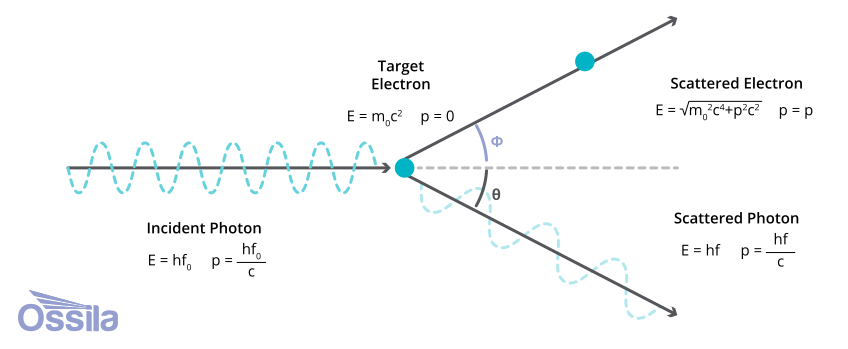 Compton Scattering
In the field of particle physics, Compton scattering is a key principle for understanding the interaction between light and matter, alongside the photoelectric effect at lower energies, pair production at higher energies, and photodisintegration and photofission at very high energies.
Read more...
References
- Radiopaedia (Accessed 2026)
- Radiation Detection and Measurement (Fourth Edition), G. F. Knoll, John Wiley and Sons Inc. (2010)
- Characterization of GAGG:Ce scintillators with various Al-to-Ga ratio, P. Sibczynski et al., Nuclear Instruments and Methods in Physics Research Section A (2015)
- Demonstrating Light Yield and Energy Resolution trends for..., A.R.L. Illoul and C.D. Armstrong
- Determination of energy resolution for a NaI(Tl) detector..., N. Demir and Z. N. Kuluöztürk, Nuclear Engineering and Technology (2021)