


Photoelectrochemistry

Photoelectrochemistry combines electrochemistry, photochemistry, and semiconductor physics to study electrochemical reactions influenced or driven by light. Unlike conventional electrochemistry, where reactions are powered entirely by an external voltage, photoelectrochemical systems use light to generate the electrical potential that a reaction requires.
Photoelectrochemistry is a fast-growing research area due to the many potential applications of accessing endothermic electrochemical reactions using solar energy.
Light-induced water splitting (or solar water splitting) is a popular research topic, where an illuminated semiconductor electrode generates charge carriers to drive hydrogen (HER) and oxygen (OER) evolution reactions. This can sustainably produce “green” hydrogen, which could play a critical role in decarbonising the transport industry.
Another application is in photoelectrochemical CO2 reduction (CO2RR), where the photoelectrochemical system converts CO2 into fuels or chemical feedstock.
Photoelectrochemistry techniques can also be used to drive or promote other electrochemical reaction of interest. In any application, it is essential to match the energy gap of the semiconductor material to the reactions redox window.
Photoelectrochemical performance is typically evaluated through current–potential measurements under illumination, commonly using techniques such as linear sweep voltammetry or chronoamperometry.
Photoelectrochemical Cells
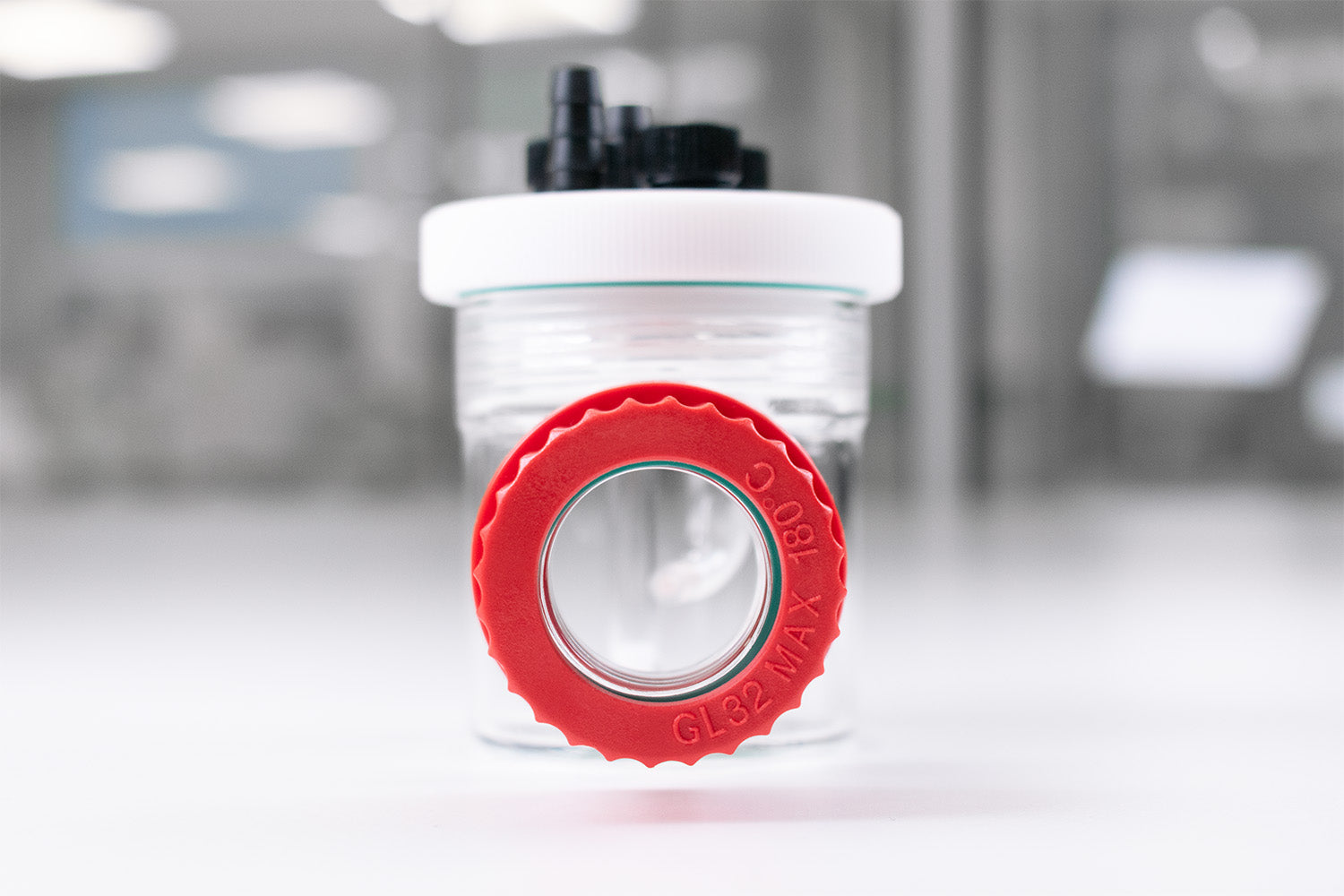
A photoelectrochemical cell (PEC) is a device that uses light to drive electrochemical processes. In these systems, a semiconductor or photosensitizer component is activated by light, creating charge carriers. These carriers are used to either:
- Create electrical energy
- Drive chemical reactions that store energy in chemical bonds, such as hydrogen production via water splitting
PEC systems are widely used to study these in situ under controlled conditions.
The key distinction between a PEC and a conventional electrochemical cell is an optically transparent window that allows controlled illumination of the electrode. This optical window ensures that light can be directed onto a working electrode within a sealed electrochemical environment without disrupting the system.
A typical PEC cell consists of a cell body with an optical window, a working electrode, a counter electrode, an electrolyte, and optionally a reference electrode. Many also include gas inlet and outlet ports for environmental control. The optical window is commonly made from quartz or UV-transparent glass. The working electrode is a semiconductor photoelectrode, which can function as either a photoanode or photocathode depending on the reaction under study. It is typically an n- or p-type semiconductor. This can be a thin film deposited on conductive substrates such as ITO or fluorine-doped tin oxide (FTO), connected to a working electrode holder. A platinum counter electrode is commonly used to ensure efficient charge transfer and complete the circuit.
Photoelectrochemistry Process
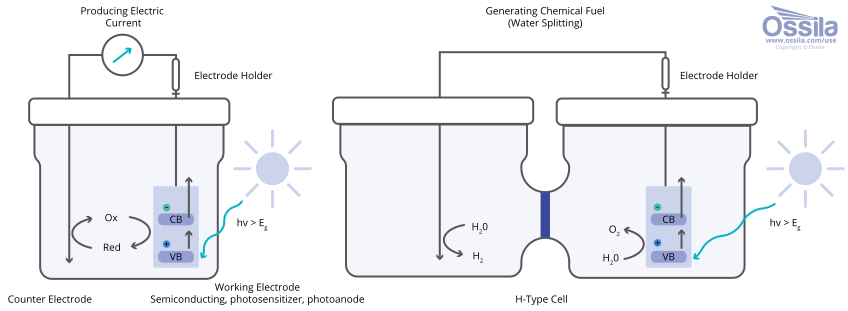
In a typical photoelectrochemical cell (PEC), the semiconductor electrode absorbs light and generates carriers. These carriers then participate in the electrochemical reactions at the electrode-electrolyte interface.
The photoactive semiconductor is the central functional component of the system. When illuminated with photons of energy equal to or greater than its band gap, electrons are excited from the valence band to the conduction band, generating electron-hole pairs. An internal electric field at the semiconductor-electrolyte interface helps separate these charge carriers and directs them toward the surface or the external circuit.
Under operation, photogenerated electrons are transported through the semiconductor to the external circuit, while holes migrate to the surface where they participate in oxidation reactions. The resulting regenerative cycle enables continuous electrical current generation under illumination.
In parallel, both electrons and holes can directly drive chemical transformations at the respective electrode surfaces. For example, in water splitting, electrons reduce protons to hydrogen at the counter electrode, while holes oxidise water to oxygen at the photoanode. In many experimental systems, an external potential is applied using a potentiostat to assist charge separation and control reaction kinetics.
Light Interaction, Photocurrent and Band Structure
In a semiconductor-based PEC system, light absorption is the first step in charge generation. Once an electron-hole pair is made, these charge carriers must be rapidly separated and transported to the interface or external circuit before recombination occurs.
When the semiconductor contacts the electrolyte, electrochemical equilibrium is established through charge redistribution. First, consider a scenario of an n-type photoanode and an electrolyte with a redox couple, and which are not in with each other. The n-type electrode has a fermi level that is larger than the electrochemical potential/redox potential of the redox couple. The n-type electrode also has a high electron density.

The positive photoanode surface attracts negative charge in the electrolyte, creating a Helmholtz layer to counter the mismatch of energy levels. This electron transfer will continue to occur until the fermi level of the semiconductor matches the redox level of the electrolyte. This process generates an internal electric field at the interface, resulting in band bending.
The band bending plays a key role in charge separation by driving electrons and holes in opposite directions. The magnitude of this effect, and therefore the efficiency of charge separation, can be further controlled by applying an external bias using a potentiostat.
Once charge carriers reach the electrode surface, they participate in redox reactions. Electron at the counter electrode drive reduction processes and holes at the photoanode drive oxidation processes.
The resulting photocurrent measured under illumination reflects the efficiency of light-to-charge conversion. This performance is governed by light absorption, charge carrier lifetime, charge transport within the semiconductor, and interfacial reaction kinetics.
Semiconductor Electrode Selection
The selection of appropriate semiconductor materials is critical because it determines whether a given redox reaction is thermodynamically feasible. Conduction band electrons must have sufficient energy to drive reduction reactions, while valence band holes must be sufficiently oxidising to drive oxidation reactions. In electrochemical terms, the semiconductor band edges must align with the redox potentials of the target reaction in solution.
This requirement significantly narrows the range of suitable photoelectrode materials. Commonly used semiconductors include TiO2, Fe2O3, and BiVO4 as well as silicon-based materials and thin films deposited on conductive substrates such as fluorine-doped tin oxide (FTO).
Do Photoelectrochemical Reactions Require An External Bias?
Photoelectrochemical reactions do not necessarily require an external bias. However, many photoelectrochemical systems require an external bias to operate efficiently. Applying an external potential can improve charge separation, reduce recombination, provide additional driving force for the reaction, and enable reactions that are not fully supported by the semiconductor alone.
When the semiconductor band edges are well aligned with the redox potentials, the reaction can proceed with little or no external bias and is referred to as a photo-driven electrochemical reaction. However, in many systems partial misalignment exists between band positions and the electrochemical window, requiring the application of an external bias. These systems are referred to as photo-assisted electrochemical reactions, where light and applied potential work together to drive the process.
In addition to applying an external bias, several material engineering strategies are commonly used to improve band alignment and enhance catalytic activity. These include the use of co-catalysts such as Pt, IrO2, NiFeOx, as well as band engineering, heterojunction formation, and surface modification techniques.
Photoelectrochemical Cells

More Resources
 What is a Redox Reaction?
A redox reaction, also referred to as an oxidation-reduction reaction, involves the loss or gain of electrons. The loss of electrons is called oxidation and the gain of the electrons reduction.
Read more... What is a Photoelectrochemical Cell?
An electrochemical cell is defined as a device that generates electrical energy from chemical reactions or uses electrical energy to drive chemical reactions. The simplest possible electrochemical cell consists of two connected electrodes in an electrolyte solution. The two electrodes are:
Read more...Contributing Authors
Written by
Product Development Electrochemist
Diagrams by
Graphic Designer