


Doctor Blade Coater: Set Up, Use and Maintenance
Doctor blade coating is an easy way of making uniform thin films over large areas. It is great for coating flexible substrates, foils and polymer films.
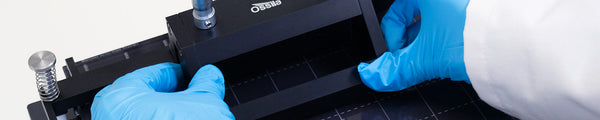
The Ossila Doctor Blade Coater combines the Automated Film Applicator with the stainless-steel digitally controlled adjustable film applicator. This system can reliably control coating gap and deposition speed of your coating process, giving you everything you need to create smooth thin films.
Setting Up The Ossila Bar Coater
Ensure that your film is sufficiently fixed to the surface. Vacuum stages provide an inbuilt mechanism to help fix flexible substrates down. If you are using the glass stage, you can use the clamp at the head of the automatic film applicator, combine with tape to fix your surface down.
When the substrate is fixed, position your Adjustable Film Applicator in front of the moving bar. If possible, we would recommend users run a “dry” applicator over an example substrate at your desired coating speed to ensure your method of fixing the substrate is adequate.
Use the micrometer gauges to lower the coating blade until the coating gap is zero.
The first time you turn on the micrometer gauges you need to hold “origin” button. Turn on using the “on” button and use “mm/in” button to toggle between units. Hold the “Origin” button to zero gauges.
Use the micrometer gauges to set your coating gap. The digital applicators will be accurate to 1 µm. It is important to ensure that these heights are level in order to achieve a uniform coating thickness.
Pour your coating solution into the coating reservoir and ensure the coating gap is sufficiently covered. Then simply enter your coating distance and speed, then start coating.
It will likely take some optimization to find the correct coating speed, thickness, and solution viscosity for consistent, uniform films. Therefore, you may see defects when first coating.
With adequate optimization, you can create consistent and uniform thin films with the Ossila Doctor Blade Coater system.
Cleaning and Maintenance For The Adjustable Film Applicator
Clean your adjustable film applicator as soon after use as possible in order to avoid seizing the height control mechanism. Below is a suggested process for cleaning the stainless steel applicator.
- Wipe the bottom of your AFA with water or other appropriate solvents to remove any residue coating material.
- Place your AFA in a dish or base before cleaning, and grab some tissues and clean room swabs.
- Liberally apply a mix of Hellmanex and water, or other appropriate cleaning solvents, to all internal surfaces of the AFA, then wipe coating material off.
- Pay particular attention to the joins between the coating blade and the AFA body.
- Move the micromanipulator gauges up and down and repeat this process until the applicator is sufficiently free from coating fluid.
- Rinse the Adjustable Film Applicator with water or other solvents.
- Make sure to thoroughly dry the applicator, using dry tissues and an air blower. Using the air blower helps to clear any leftover solvents from small crevices (e.g. within the springs, at the contact point between the micrometer and blade, etc).
Optimizing Doctor Blade Coating Methods
To optimize your coating process with the doctor blade coater, you can vary the following factors:
- Coating speed
- Blade coater height
- Solution viscosity
By adjusting with these variables, you can optimize your coating process to create a uniform thin film. For example, if you see these gaps in your coating film, you can try the following things:
- Reduce coating speeds
- Lower solution viscosity
Doctor Blade Coater
More Resources
 Diaphragm Vacuum Pump Working Principle
Diaphragm vacuum pumps are a type of positive displacement pump that uses a flexible diaphragm as the pumping mechanism.
Read more... How to Optimize Your Mayer Bar Coating Process
There are plenty of ways that you can optimize your bar coating process. Some of the main ways include: changing Mayer rod, changing solution concentration and viscosity, optimizing bar speed, etc.
Read more...