


Spectrometer Sample Holder
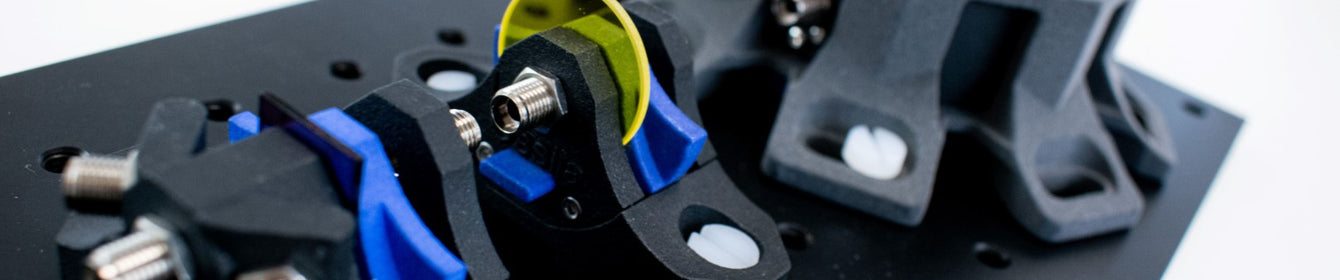
Selecting or designing an appropriate sample holder is key to ensuring reliable and consistent spectroscopy measurements.
When measuring the optical properties of a sample, the optical material will either be:
- Deposited into a thin film
- Suspended in solution
Each approach come with advantages and limitations, and both measurements are affected by different things. Whether the material is studied as a thin film or in solution will affect which properties you can investigate. Which is the right approach depends on the measurement, the samples properties and its desired application.
Do You Need a Sample Holder for Spectroscopy?
A designated sample holder is one of the most important pieces of equipment you need in spectroscopy. Sample holders enable you to properly position the sample for analysis, ensuring alignment is maintained and measurements are consistent. Dedicated holders allow for accurate measurement of the entire sample while preventing any blockage of the beam. Fixed sample holders will also protect the sample from vibration or temperature changes during analysis, thus eliminating possible sources of measurement errors. Put simply, if you can fix your sample in place, this makes everything so much easier.
Larger, enclosed spectroscopy systems, like spectrofluorometers, have dedicated sample chambers. These allow for consistent sample placement, ensuring reliable, comparable results.
Ossila sell sample two sample holders compatible modular USB spectrometers:
- One which is compatible with standard size cuvettes.
- One can hold thin film substrates of any width.
Both of these allow for different positioning of inlet and outlet light, so they can be used for a range of optical measurements.
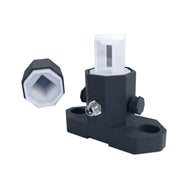
Cuvette Holder
The Ossila Cuvette Holder is compatible with standard 10 mm path length cuvettes.
Suitable for measurements on solutions including:
- Photoluminescence measurements
- Absorbance measurements
- Optical density measurements
- Transmission measurements
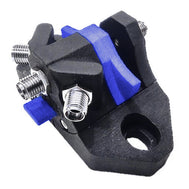
Spectroscopy Transmission Holder
The Ossila Spectroscopy Transmission Holder uses a compression mechanism to secure substrates in place. The 4-port version allows optical measurements at multiple different angles. This facilitates different measurements (i.e. both 90° for fluorescence compared to normal incidence for transmission).
- Absorbance / PL / Transmission measurements on thin films
- Investigate quenching in multilayer devices
- Assess transparency of a thin film
The Ossila Optical Spectroscopy Kit includes both of these substrate holders to allow you to be adaptable in both the measurements you take and the samples that you measure.
Why Use Quartz Glass Cuvettes and Substrates?
Whether your samples are liquids or thin films, you will need to use substrates or cuvettes which transmit light in the UV-Vis region. Quartz glass has very high transmission rates in the visible region and this extends down into the UV.

Optical Spectroscopy Kit
Learn More...
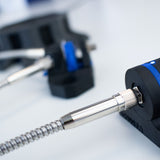 Choosing A Light Source For Your Spectrometer
Depending on your spectrometer application, you will probably need at least one illumination or excitation source. For electroluminescence measurements will require of some sort of testing board connected to an external voltage source. However, most characterization of optical materials require some sort of incident light.
Read more...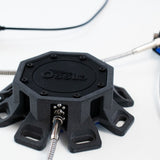 Measuring Thin Film Fluorescence
Measuring fluorescence (or photoluminescence) with the Ossila Optical Spectrometer will allow you to detect light emission from your sample between 360 nm - 1000 nm. You can use optical spectroscopy as a quick and easy way to characterize fluorescence from your sample. However, you will need an integrating sphere or a more complex system if you want to measure quantitative measurements such as PLQY.
Read more...