


Popular Biodegradable Polymer for Tissue Engineering
FDA and EMA-approved biocompatible copolymer of lactic acid and glycolic acid
Specifications | Pricing and Options | MSDS | Literature and Reviews
PLGA is a biodegradable, biocompatible copolymer of lactic acid and glycolic acid. Approved by the FDA and EMA, it finds applications in the medical field, such as surgical sutures, drug delivery, and tissue engineering. PLGA degrades through hydrolysis into lactic acid and glycolic acid, which are endogenous and easily metabolized by the body, leading to minimal systemic toxicity. Controlled by the adjustment of the molecular weight, the ratio of lactic acid to glycolic acid and the drug concentration, the degradation rate of PLGA as a drug delivery carrier allows for customizable release dosage and interval of encapsulated substances.
PLGA is also one of the most popular biodegradable polymers for tissue engineering. It is used to create scaffolds, fibers, and nanoparticles, and microspheres to target specific cells or tissues for treatment, and to support bone regeneration and tissue repair processes. Conventional chemotherapy suffers from severe side effects, uneven drug distribution, and rapid drug elimination, while PLGA-based nanoparticle drug carriers provide a controlled and sustained release mechanism, reducing toxicity to normal tissues while increasing drug concentration at the tumour site to enhance treatment efficacy. Also, by modifying the PLGA-based nanoparticles surface with different antibodies or peptides, specific targeting of tumour cells can be achieved.
General Information
| CAS Number | 26780-50-7 |
|---|---|
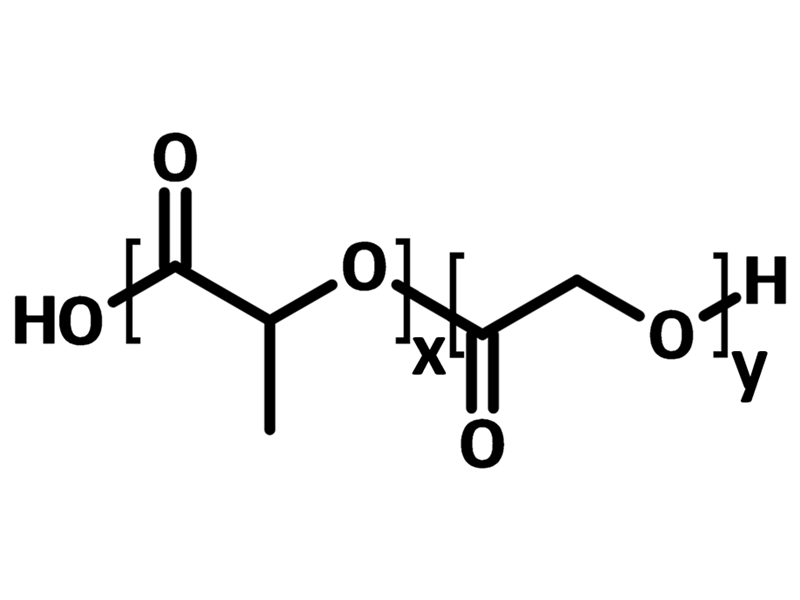
| Chemical Formula | (C3H4O2)x(C2H2O2)y |
| Synonyms | Poly(lactic-co-glycolic acid), Poly(D,L-lactide-co-glycolide) |
| PLGA (LA:GA) | 85:15 |
| Molecular Weight | Mn = 380,090, Mw = 617,353, PDI = 1.62 |
| Intrinsic Viscosity [η] | 2.43 dL/g (25 ℃ in Chloroform) |
| Solubility | Chloroform, dichloromethane, DMF |
| Form | White powder |
| Storage | 2 – 8 °C |
| Classification or Family | Polylactide, Polyglycolide, Biodegradable polymers, Biocompatible polymers |
Chemical Structure
Pricing
| Batch | Quantity | Price |
|---|---|---|
| M2575A1 | 1 g | £75 |
| M2575A1 | 5 g | £250 |
| M2575A1 | 10 g | £390 |
MSDS Documentation
 PLGA MSDS sheet
Literature and Reviews
- J. Yang et al. (2024); Recent Applications of PLGA in Drug Delivery Systems, Polymers (Basel), 16 (18), 2606; DOI: 10.3390/polym16182606.
- Y. Yang et al. (2025); Versatile PLGA-Based Drug Delivery Systems for Tumor Immunotherapy, Small Methods, 9 (5), 2401623; DOI: 10.1002/smtd.202401623.
- S. Rezvantalab et al. (2024); Machine learning assisted exploration of the influential parameters on the PLGA nanoparticles, Sci. Rep., 14, 1114; DOI: 10.1038/s41598-023-50876-w.