


Maximum Power Point Tracking Algorithms

Jump to: What Is The Maximum Power Point? | Perturb and Observe Method | Incremental Conductance and Others
Issues with MPPT | MPPT in Solar Cell Research
Maximum power point tracking (MPPT) refers to the algorithms used to control the output of solar panels. MPPT is often used in PV systems to maximize the output of large solar arrays. Variations in sun position, irradiance levels, temperature and shading can drastically affect the performance of solar cells. In real world conditions these factors vary constantly: over a 24-hour cycle, with day-to-day weather fluctuations and through changing seasons.
In maximum power point tracking, the ideal operational voltage is continually assessed and adjusted in order to maximize output power. This allows the PV system to adapt to changing conditions over a given time period.
One common example of MPPT is known as the "perturb and observe" method. Here, the system chooses an initial operational voltage and power extracted is measured. The power output is then measured (or "perturbed") at a voltage slightly above and below the VMPP. If either of these perturbations leads to an increased power output, the voltage moves incrementally in this direction until the new VMPP is found.
Maximum power point tracking is also an important tool when developing solar cells. I-V curves are used to characterize device performance, but they don't show how a device will perform in the field. MPPT replicates how a solar cell will be used under operational conditions, which is very important to address in solar cell research. For this reason, it is becoming much more common to include MPPT data alongside I-V sweeps in solar research papers.
An example of maximum power point tracking is shown in video below. This data is taken using the Ossila Solar Cell I-V Test System and its compatible software.
What Is The Maximum Power Point?
Simply put, the maximum power point refers to the point on an I-V curve where the device produces the most electrical power. Power is a product of voltage and current, and a fundamental principle of solar cells is that you cannot keep increasing voltage without reducing current and vice versa. As a result, there is always a trade-off when attempting to maximize voltage and current simultaneously. This will give you the maximum power point voltage (VMPP) and the maximum power point current (IMPP). The product of these values is the maximum power that can be pulled from the solar device.


The location of the maximum power point depends on the shape of the I-V (or J-V) sweep, but it will always be somewhere in the "knee" of the curve. In this MPP region, there is a roughly exponential relationship between current and voltage. The maximum power point can be found where dI/dV of the IV curve is equal and opposite to the absolute I/V ratio. This is the basis of the incremental conductance method of MPPT described later. The maximum power point can be more easily seen on a power density graph, as the peak of the graph.
Perturb and Observe Method
Perturb and observe is one of the most commonly used iterations of maximum power point tracking as it is the easiest method to reliably implement. This is especially useful in research applications where these measurements are used largely as proof of concept for scalability potential. It is a low-cost way to investigate maximum power point tracking and is achievable within most lab settings.
- The system chooses an initial operating voltage. Some systems use the maximum power point voltage (VMPP) found through initial characterization methods (e.g. I-V sweeps)
- The solar cell is held at this operating voltage (VMPP), and extracted power measured.
- The power output is measured slightly above and slightly below this operational voltage (perturbation).
- If with a particular perturbation the power drawn increases, then the system continues moving the operational voltage in this direction until the new maximum power point is found (any further steps produce a decrease in power).
- The voltage at the new maximum power point becomes the new operational voltage.
- The process repeats again from step 2.
One negative of the perturb and observe method is that it constantly oscillates around the MPP so some of the potential energy is wasted. In real life operations, this is a serious consideration. However, this is not so much of an issue with developing solar cells as you are just trying to demonstrate the stability within reasonable limits.
Incremental Conductance and Other Tracking Methods
Another approach used in MPPT is incremental conductance. This method relies on the principle that the MPP occurs at the point on the I-V curve where dI/dV is equal and opposite to I/V. In other words:

where VPV and IPV are the voltage and current at the maximum power point.
Following from this, if the operating voltage is below the MPP, then:

If the operating voltage is above the MPP then

By measuring incremental current and voltage changes, this method will tell you when the MPP voltage is reached without having to oscillate around it.
However, in practical systems the measured ratio rarely equals zero due to electrical noise, so a threshold must be used which ultimately limits resolution. Otherwise, this method will also result in oscillation around the maximum power point. Additionally, incremental conductance requires more computational time, increased measurement time between steps and more computational power.
Another way of tracking solar cell power output is via constant voltage methods. The term constant voltage can refer to either:
- The operational voltage is held at a set value and the current and power output tracked.
- The operational voltage is held at a set percentage of the (continually tracked) open circuit voltage. This is also known as the open voltage method.
Neither of these methods are technically maximum power point tracking methods, but they occupy a similar role in situations where MPPT is not appropriate.
Possible Issues with MPPT
We have already mentioned that MPPT methods, like perturb and observe and incremental conductance, have issues as the voltage will oscillate around the maximum power point. This leads to issue in solar arrays as some energy is wasted. However, it can also cause issues with developing solar cells, especially those with temperamental stability. For example, perovskite solar cells exhibit hysteresis and therefore oscillating the voltage around the MPP has been shown to lead to strong oscillations in power output.
Most MPPT methods, including Perturb & Observe and Incremental Current, rely on step changes relatively close to the VMPP. These methods can therefore be challenged by changes in atmospheric conditions. The ability to track MPP accurately in changing conditions depends on the time scale of the change.
- If the change occurs rapidly, it can take a long while for the algorithm to find the MPP again.
- If the change occurs slowly, these methods can track MPP more accurately, however it will be much less precise. They will tend to be playing catch up trying to track the MPP if it is changing consistently.
Maximum Power Point Tracking In Solar Cell Research
It is becoming more important to include techniques like MPP tracking in solar cell research. J-V sweeps do not provide a realistic representation of how solar cells would work in situ. Therefore, it is important to do some "real world" measurements" early on in the research process.
MPPT methods not only help confirm solar cell performance but demonstrate future viability of PV in near real world conditions. There are however specific things to consider when conducting maximum power point tracking on a laboratory scale.
You must carefully consider any quirks or mechanics of your device. For example, perovskites suffer hysteresis so any oscillating voltage measurements can be misleading.
In order for these impacts to be limited, or at least explored, you should choose appropriate threshold voltages, holding time and voltage steps in order to accurately track your solar cell performance. It may be a good idea to experiment with these parameters before conducting longer term stability investigations to make sure you are accounting for as many effects as possible.
More Resources
 Solar Cell Characterization & Testing
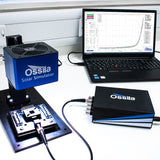
A solar simulator is used in combination with a solar cell I-V Test system or source measure unit, to measure the efficiency of solar cells and modules. To characterize how solar cells will perform in the real world, it is vital that you use a light source that effectively mimics the spectrum of the sun.
Read more... Solar Cell J-V Curve: How To Measure IV Curve of A Solar Cell
When it comes to testing the performance of solar cells, accurate measurements and reliable equipment are essential. The fundamental way to test your solar cell performance is by taking a current-voltage (I-V or J-V) measurement. The I-V curve provides valuable insights into a solar cell's efficiency, power output, and more generally electrical characteristics within the device. If you are conducting research into PV materials, understanding how to measure and interpret J-V curves is crucial in assessing device performance – but also for troubleshooting potential issues within your devices. In this article, we will guide you through the steps required to measure I-V (J-V) curves using various Ossila testing equipment.
Read more...
References
- Optimization of Perturb and Observe Maximum Power Point..., N. Femia et al., IEEE Transactions On Power Electronics (2005)
- Hill climbing hysteresis of perovskite-based solar cell: a..., N. Pellet et al., Progress In Photovoltaics (2017)